Yesterday I returned to Miami, and moving back into my room here has been a little like living in a stranger's home. Not that I've changed so much, it's just that I've gotten used to living with the same few possessions, which as the summer advanced has gotten to be more than a few. I gathered all kinds of things - a bunch of cd's, concert programs, a computer, a suitcase of stuff I'd left years before at my sister's house... So now I have to sort through all the new stuff, and combine it with the old stuff, and then there is the even older stuff, hiding in the recesses of my closets - somehow it all needs to fit into a tiny studio apartment in an orderly way. It's all very overwhelming and mind-numbing work, like being an archaeologist, archivist, museum curator, interior designer, and janitor all at once.
I can't help but seeing the process of sorting through this stuff as a metaphor for identity, which is perhaps why it's so difficult for me to throw any of it away! As unlikely as I am to wear my old Catalina Marathon t-shirt, or re-read that Phillip Roth novel, giving them away seems somehow like a betrayal of the person who was so immersed in that goal, or that story. If anything, books are more difficult for me to give away than clothes - most of my old socks pretty clearly aren't getting any better with age, but I worry that I might need some of those short stories again in the future. Those characters might come back and haunt me, and will I be able to find them? Will my memory be enough to contain them all?
I guess a lot of this struggle over stuff comes from insecurity about memory - why else keep all those old articles, pictures, books, if not for fear that my recollections of them will fade, and I'll lose all the wisdom and beauty and joy they represent to me? For that matter, why write in this blog, other than to somehow hold off the inevitable decay into obscurity of all my thoughts and impressions? And yet, the more data I manage to store electronically or in my closets, the more feeble and vulnerable my own memory seems.
Whenever I'm surrounded by boxes and suitcases, I think of that scene in Dante's Inferno, with the wasters and the hoarders screaming at each other, "Why do you waste?! Why do you hoard?!" I'm not really sure why I do either, or even which one I am doing at any given time - for all my regrets, I never can seem to help myself though.
I just discovered a brilliant essay by Nicole Krauss on this subject, titled "On Forgetting." To read it online, click here.
Wednesday, August 17, 2005


Friday, August 12, 2005
audition habits, part III
This is the third part in a series of posts summarizing the audition advice of Thomas Freer (TF), assistant principal timpanist and section percussionist in the Cleveland Orchestra. The previous post covered some strategies to streamline the preparation process before you even enter the practice room - categorizing the list, compiling recordings, studying tempi, marking your parts. The majority of TF's audition advice, though, was very much concerned with the kind of day-to-day work necessary to prepare for an audition - specifically, how to recreate the experience of taking an audition in obsessive detail; or as he put it, how to "practice auditioning".
1. Consistency: the hobgoblin of successful audition candidates
At its most basic level, to “practice auditioning” is simple common sense: of course we should make every effort to simulate the audition situation, so we can make that situation as comfortable and familiar as possible. You may not have an hour to warm up - so practice being ready to perform in 15 minutes, or with no warm-up at all. You won’t audition in a tiny practice room, so play in different acoustics, and get used to projecting in a larger space. If your audition is scheduled for 10 am, reserve your most intense practice sessions for the morning, so you’ll know how everything feels at that time. Wear clothing similar to what you’ll be wearing on the audition day - you don’t want to be thinking about how funny your shirt feels or how your shoes make you an inch taller than usual. The more ways you can find to approximate actual audition situations in your practice, the better prepared and more confident you will be.
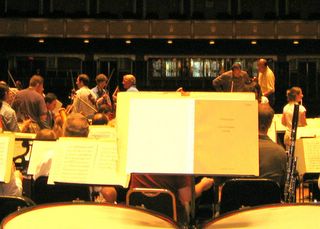
clear the stage, I'm trying to practice auditioning!
2. You need lots of warm bodies; comments can be nice, too
In order to truly simulate an audition, of course, you need an audition panel to listen. Most people would agree that “playing for people” is a vital step in developing audition chops - however, the usefulness is not so much in the feedback as the presence of people, and their ability to throw you unexpected demands. Give your audition panelists the clipboards and excerpts, as they will always want to write comments. But don’t let it become a masterclass situation, and don’t reduce your pool of panelists to people who play Don Juan better than you can - their job isn’t to solve your problems, but to sit behind a screen and force you to solve them yourself.
If you play as many mock auditions as TF recommends - as much as 90% of your practicing as the date approaches - you’ll amass an overwhelming array of comments, more than you could hope to absorb. You’ll also inevitably find a few which are helpful, and which you'll want to assimilate into your playing - if every comment sheet has the same criticism, they all might have a point! In general, though, you want to trust yourself, your teacher, maybe another musician or two whose input you value highly - and take everything else with massive doses of salt.
3. Trusting yourself means watching yourself
No matter how many brilliant musicians you are able to corral behind a screen to listen, the most helpful corrections will made by listening to yourself. Therefore recording and reviewing practice sessions, and especially practice auditions, is invaluable. TF highly recommends using a video camera whenever possible, as there are some problems that are just easier to fix if we can see them. Audio recordings can also reveal plenty of intonation, articulation, or rhythm problems, but video makes the process of diagnosing and fixing these problems much faster and more exact.
In either case, a recording is only useful if we are able listen to it and analyze it carefully. As TF said, as musicians we tend to not record ourselves enough, and when we do record we tend to listen back in a haphazard way. He recommended reviewing each take at least four times, emphasizing a different element on each playback:
Since attending TF's classes, I've listened to a few of my practice recordings in this way, and it's given me an incredible amount of useful information. My previous habit was to listen exclusively to sound quality, or just form a general impression - "I cacked a note on the Mozart, but the Beethoven rocked." Using TF's more systematic approach, I've been able to glean much more constructive criticism - "The Mendelssohn drags in the quarter notes, and the Brahms needs a clearer sense of direction." I'm sure that using video I could give myself even more useful comments, addressing bow placement, left hand technique, and general tension - I may even want to play back the tape a couple extra times to check for grooming errors and dumb facial expressions!
The next installment of "audition habits of a highly effective percussionist" includes advice for the day of the audition, plus some stuff that I didn't manage to fit into the first three installments. Thanks again to Tom Freer for all his help, and feel free to comment with your audition advice and suggestions!
1. Consistency: the hobgoblin of successful audition candidates
At its most basic level, to “practice auditioning” is simple common sense: of course we should make every effort to simulate the audition situation, so we can make that situation as comfortable and familiar as possible. You may not have an hour to warm up - so practice being ready to perform in 15 minutes, or with no warm-up at all. You won’t audition in a tiny practice room, so play in different acoustics, and get used to projecting in a larger space. If your audition is scheduled for 10 am, reserve your most intense practice sessions for the morning, so you’ll know how everything feels at that time. Wear clothing similar to what you’ll be wearing on the audition day - you don’t want to be thinking about how funny your shirt feels or how your shoes make you an inch taller than usual. The more ways you can find to approximate actual audition situations in your practice, the better prepared and more confident you will be.

clear the stage, I'm trying to practice auditioning!
2. You need lots of warm bodies; comments can be nice, too
In order to truly simulate an audition, of course, you need an audition panel to listen. Most people would agree that “playing for people” is a vital step in developing audition chops - however, the usefulness is not so much in the feedback as the presence of people, and their ability to throw you unexpected demands. Give your audition panelists the clipboards and excerpts, as they will always want to write comments. But don’t let it become a masterclass situation, and don’t reduce your pool of panelists to people who play Don Juan better than you can - their job isn’t to solve your problems, but to sit behind a screen and force you to solve them yourself.
If you play as many mock auditions as TF recommends - as much as 90% of your practicing as the date approaches - you’ll amass an overwhelming array of comments, more than you could hope to absorb. You’ll also inevitably find a few which are helpful, and which you'll want to assimilate into your playing - if every comment sheet has the same criticism, they all might have a point! In general, though, you want to trust yourself, your teacher, maybe another musician or two whose input you value highly - and take everything else with massive doses of salt.
3. Trusting yourself means watching yourself
No matter how many brilliant musicians you are able to corral behind a screen to listen, the most helpful corrections will made by listening to yourself. Therefore recording and reviewing practice sessions, and especially practice auditions, is invaluable. TF highly recommends using a video camera whenever possible, as there are some problems that are just easier to fix if we can see them. Audio recordings can also reveal plenty of intonation, articulation, or rhythm problems, but video makes the process of diagnosing and fixing these problems much faster and more exact.
In either case, a recording is only useful if we are able listen to it and analyze it carefully. As TF said, as musicians we tend to not record ourselves enough, and when we do record we tend to listen back in a haphazard way. He recommended reviewing each take at least four times, emphasizing a different element on each playback:
- Time - compare your tempo to what you intended. If the excerpt is in a strict tempo, check to see if your recording will sync with a metronome.
- Rhythm - listen to rhythmic relationships, paying particular attention to the solidity and character of the rhythmic gestures
- Intonation - concentrate on your pitch
- General musicality - now that you've isolated several elements, take a big picture view - are the sound and phrasing, appropriate, and can you hear the orchestra?
Since attending TF's classes, I've listened to a few of my practice recordings in this way, and it's given me an incredible amount of useful information. My previous habit was to listen exclusively to sound quality, or just form a general impression - "I cacked a note on the Mozart, but the Beethoven rocked." Using TF's more systematic approach, I've been able to glean much more constructive criticism - "The Mendelssohn drags in the quarter notes, and the Brahms needs a clearer sense of direction." I'm sure that using video I could give myself even more useful comments, addressing bow placement, left hand technique, and general tension - I may even want to play back the tape a couple extra times to check for grooming errors and dumb facial expressions!
The next installment of "audition habits of a highly effective percussionist" includes advice for the day of the audition, plus some stuff that I didn't manage to fit into the first three installments. Thanks again to Tom Freer for all his help, and feel free to comment with your audition advice and suggestions!
"what a difference a bass makes!"
That was the first thing that Herbert Greenberg, the retired concertmaster of the Baltimore Symphony, said after my group played Arthur Foote's A Night Piece in a coaching yesterday morning. Like the Martinu Sextet, which I wrote about a few weeks ago, this is a strictly optional bass part; the score says "a string quartet is sufficient". It's very flattering, though, when a distinguished musician like Mr. Greenberg thinks I've contributed something!
I joked in that earlier post about being a non-essential chamber music employee, but really I've felt very essential here at Kent/Blossom - being the only bass player means a lot of responsibility, and it means being noticed when I screw up! I think it's all too easy to sit in the back of the orchestra and become invisible - to blend in to the point of blandness. Playing a lot of chamber music and orchestra music as the lone bass player has made me more aware of my contribution, giving me opportunities to add my voice to the musical conversation, rather than just mumbling in the background.
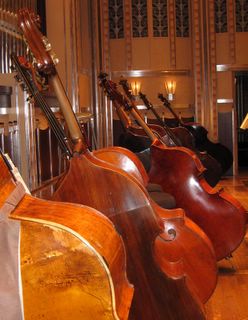
a bass section at rest
Mr. Greenberg was talking about bass players in European orchestras, whom he sees as much more actively and intellectually involved - he described bassists there as being "professorial", and much more central to the orchestra's identity. Some of the most brilliant people I know are American bass players, like Don Palma, Jeff Turner, Paul Ellison, Ed Barker, etc... Still, I'll never forget playing a 5-hour sectional with Janne Saksala, the former principal bass of the Berlin Philharmonic, working in minute detail on every note of Mahler's 5th Symphony. So I can see Mr. Greenberg's point - there is a certain kind of obsessively engaged musicality that seems to be a unique characteristic of great European bass players.
Ironically, the stereotype I often hear of European bass playing is that they are completely preoccupied with solo playing - all they practice is Dittersdorf and Rabbath, to the exclusion of basic, solid orchestral technique. Whereas the stereotype of American bass players is that we practice nothing but the Scherzo and Trio from Beethoven's 5th. Both stereotypes have their examples, I'm sure, but those examples are mostly to be found among students, trying to figure out how to get somewhere in auditions, and not in major orchestras, where bassists on both continents tend to be well-rounded musicians.
It was nice to hear Mr. Greenberg compare me to all those "professorial" bassists in Europe, and he asked me if I'd every thought of trying to work there. I have sent tapes to orchestras in Norway, but I've never had the confidence to actually fly overseas for an audition. Mr. Greenberg gave me his e-mail address and promised to let me know if he hears of any opportunities. I'm not holding my breath or anything, but maybe I'll brush up on my Norwegian, just in case!
I joked in that earlier post about being a non-essential chamber music employee, but really I've felt very essential here at Kent/Blossom - being the only bass player means a lot of responsibility, and it means being noticed when I screw up! I think it's all too easy to sit in the back of the orchestra and become invisible - to blend in to the point of blandness. Playing a lot of chamber music and orchestra music as the lone bass player has made me more aware of my contribution, giving me opportunities to add my voice to the musical conversation, rather than just mumbling in the background.

a bass section at rest
Mr. Greenberg was talking about bass players in European orchestras, whom he sees as much more actively and intellectually involved - he described bassists there as being "professorial", and much more central to the orchestra's identity. Some of the most brilliant people I know are American bass players, like Don Palma, Jeff Turner, Paul Ellison, Ed Barker, etc... Still, I'll never forget playing a 5-hour sectional with Janne Saksala, the former principal bass of the Berlin Philharmonic, working in minute detail on every note of Mahler's 5th Symphony. So I can see Mr. Greenberg's point - there is a certain kind of obsessively engaged musicality that seems to be a unique characteristic of great European bass players.
Ironically, the stereotype I often hear of European bass playing is that they are completely preoccupied with solo playing - all they practice is Dittersdorf and Rabbath, to the exclusion of basic, solid orchestral technique. Whereas the stereotype of American bass players is that we practice nothing but the Scherzo and Trio from Beethoven's 5th. Both stereotypes have their examples, I'm sure, but those examples are mostly to be found among students, trying to figure out how to get somewhere in auditions, and not in major orchestras, where bassists on both continents tend to be well-rounded musicians.
It was nice to hear Mr. Greenberg compare me to all those "professorial" bassists in Europe, and he asked me if I'd every thought of trying to work there. I have sent tapes to orchestras in Norway, but I've never had the confidence to actually fly overseas for an audition. Mr. Greenberg gave me his e-mail address and promised to let me know if he hears of any opportunities. I'm not holding my breath or anything, but maybe I'll brush up on my Norwegian, just in case!
Thursday, August 11, 2005

Tuesday, August 09, 2005
a humble proposal
Yesterday I read an interesting post by Davis of blogic, entitled "My evening with the Cleveland Orchestra". I wrote a post on the same topic this weekend, which he kindly linked as well. What especially interested me, though, was the comment that someone in Davis' family sent, correcting his misuse of the word "they're". I've made many similarly silly mistakes, and I'm always glad (if a little embarrassed) to have them pointed out to me.
It reminded me of an idea I had recently - there should be a league of freelance editors and fact-checkers, trolling the blogosphere and editing people's blogs for a modest fee. I'm sure there are hundreds of retired schoolteachers who would love to do battle against cyberspace illiteracy, and maybe earn a few dollars and some recognition as well. I sort of envision it as becoming a competitive, slightly subversive thing, like hackers but with better spelling. The best, fastest blog editors might even attain celebrity status - I can imagine posts like this one popping up:
It reminded me of an idea I had recently - there should be a league of freelance editors and fact-checkers, trolling the blogosphere and editing people's blogs for a modest fee. I'm sure there are hundreds of retired schoolteachers who would love to do battle against cyberspace illiteracy, and maybe earn a few dollars and some recognition as well. I sort of envision it as becoming a competitive, slightly subversive thing, like hackers but with better spelling. The best, fastest blog editors might even attain celebrity status - I can imagine posts like this one popping up:
Can I just tell you how cool it is that the star blog editor redpencil37 visited World Wide Fred today?! In just, like, 14 minutes, she fixed all my wack-ass grammar, and she even noticed that I had spelled the name of my dog Phishy four different ways, all for just $5 a post! Now all I have to do is go back and find all the places she wrote in "[sic]" - that must stand for "so incredibly cool!"Anyway, I hope my idea some day becomes a reality - in the meantime, I guess all the bloggers out they're will just have to edit there own work. So their.

Monday, August 08, 2005
an artful tailor of bass lines passes on
Check out NPR's Morning Edition today for a great remembrance of Keter Betts, a jazz bassist who had a brilliant career, accompanied Dinah Washington and Ella Fitzgerald, and died this past Saturday at age 77. I love his analogy of the bassist as a musical tailor, designing a suit in just the right style and fit to clothe the singer, who would otherwise be "buck naked". You can listen to the story online.
Subscribe to:
Posts (Atom)