Showing posts with label new music. Show all posts

Saturday, April 21, 2007

Gandolfi, Higdon, and inescapable grooves

As I mentioned previously, this evening's New World Symphony concert includes Jennifer Higdon's Concerto for Orchestra and a world premiere of an expanded version of Michael Gandolfi's Impressions from the Garden of Cosmic Speculation. As an added treat, both composers are here in Miami Beach and will be attending the concert, as they have the rehearsals for the past few days.

I don't know if audience members realize what a very cool thing it is to have a living composer involved in preparing his or her own work. We've all applauded for that solitary figure, bounding up to the stage at the end of the concert, and maybe wondered at the incongruousness of it all - how could this little, specific person have created something so big and so universal? The more composers I meet, the more I am impressed and respectful of the challenges they face, this alchemy of transforming personal experiences into artistic creation. It's a miracle, what they are able to do, and in some ways it is the essential purpose for what we all do.

At the beginning of this week everyone in the orchestra was wondering about this Gandolfi piece. Parts of it had been performed and recorded, other parts only existed as scores and synthesized MIDI audio files, and still others apparently had only been sketched. The movement numbers suggest that the piece will be in 11 movements, but last Monday we had only seen five or six of them. Conductor Robert Spano tried to relieve some of our anxieties at the first rehearsal, telling us how fantastic those unseen movements were, and mentioning some awesome grooves and a kick-ass trumpet solo in one of them. This only made some players more nervous, of course.

In the end, we settled on a version of the piece with nine movements - one of which is a 6-movement baroque suite entitled "The Senses". So it qualifies as an expanded version, but perhaps not the complete or final version. In a way that's appropriate to the feel of this piece, which is about a philosopher's garden - since the work both philosophy and gardening are never really finished, but always in a state of growth and revision. Talking to Gandolfi during a rehearsal break, he described how he set out to write a really great groove - a somewhat elusive thing in orchestral music - and in his movement "The Willow Twist" he seems to have succeeded. That's the movement with the big trumpet solo, along with a prominent trombone solo, and both players stand up like in a big band concert. Once you've created a great groove though, he said, the challenge is to get out of it - it sort of has a self-perpetuating momentum. The solution he chose was what he calls a "bow and arrow technique" - just at its most exuberant point, it dissolves into a new, spare texture in the upper strings.

Jennifer Higdon is also around, and has had some helpful suggestions for the prominent string solos which occur in 4 of the 5 movements. The most prominent and exposed bass solo is in the 3rd movement, and Higdon seems to have been inspired by the kind of spontaneous facility you hear in Edgar Meyer's bass playing. Our principal bassist this week, James Goode, does a great job of emulating that, and all week his solos have grown more confident and incisive. The 4th movement is an extended percussion groove, sort of a cadenza for that section of the orchestra. In this case, the groove proceeds directly into the 5th movement, which begins without pause. It's another exuberantly syncopated dance for the whole orchestra, with more prominent solos and lots of Bartok pizzicatos, perhaps a tribute to the original "Concerto for Orchestra."

Both composers are well represented online. Visit Michael Gandolfi's home page and Jennifer Higdon's for lots of news, information, and sounds. Tickets are still available for tonight's concert - visit the New World Symphony website for more information.

Friday, April 06, 2007

Deja Vu and the Colgrass triangle

Before tonight's performance of Deja Vu, his piece for four percussionists and orchestra, Michael Colgrass had some nice words of introduction. He was speaking via Internet2 from Toronto. He told a story about learning that he had just received a Pulitzer Prize for the work, back in 1977 - a young AP reporter called and, after he replied that no, he hadn't heard anything about it - asked for his spontaneous reaction! He said that he had always thought that prizes were like buckshot in a crowd; anyone can get hit. And that he thought his father would be pleased, since at that point he still didn't really understand what Michael Colgrass did for a living.

My favorite part of Colgrass' comments though, which I'm paraphrasing from my memory, was this:
I have never thought music was about prizes and recognition though. To me, it's about relationships, between a composer and performer, and the performer and audience. Within that triangle is where all the interesting and fulfilling aspects of music take place. And you, the audience, in many ways are the most important part of that triangle. So I thank you and I hope you enjoy this performance of Deja Vu.
As he finished speaking, I looked out on the audience and I could see many of them smiling and reacting positively - I really think it set a wonderful tone for the performance, which was completely engaging for me. I think I'll definitely steal Michael Colgrass' triangle idea, next time I introduce a piece to an audience!

Michael Colgrass has an excellent website with many writings - I especially enjoyed his "Letter to a Young Composer."

Sunday, February 04, 2007

new music amid the football frenzy

Last night we performed new music by Marc-Andre Dalbavie, Henri Dutilleux, and Wolfgang Rihm - probably not as big household names as Peyton Manning or Rex Grossman, but all still worth a listen. It's been interesting this week, practicing some rather severe, demanding music, while throngs of people all around South Beach party and celebrate football. As might be expected, our concert wasn't especially crowded. Not to judge our Super Bowl guests too harshly, but they probably aren't big contemporary music fans, while those who might have come had to face massive traffic and parking nightmares. So the barriers were pretty high, and the audience, as small as it was, seemed especially devoted.

They heard a spectacular performance from Barbara Hannigan, singing a beautiful setting of letters by Dutilleux, Correspondances. Dutilleux recently turned 91, and part of his longevity might be constantly setting challenges for himself - when we connected to him via Internet 2 in Paris, he insisted on speaking in fractured English, even as our conductor Reinbert de Leeuw tried to switch him over to French. His grammar, like the sonorities in his music, twists and turns between novel, puzzling, and delightful - always there is the sense of a searching imagination at play.

The other two pieces, Dalbavie's Color and Rihm's Two Other Movements, were not lacking in imagination either. Besides the obvious meaning, 'color' also signifies a practice common in medeival music, in which parts were layered and into overlapping melodic and rhythmic structures, called 'color' and 'talea'. It's one of those curious cul-de-sacs in music history, which long ago went out of style, only preserved in trivia and musicology courses, then modern composers like Messiaen and Dalbavie found new uses and brought it back to life in their music. There was a sense in Dalbavie's piece of music unfolding across different strata of time, freed from rigid bar lines even as the individual parts follow a careful logic.

So much new music can seem aimless - unlike football, we're not sure what the rules are, in what way they're being observed or stretched, or when the whole thing is likely to end. That was the case for me in the Rihm piece, which I found alternately fascinating and insufferable. (I try to be an advocate for the music while I'm playing it, but afterwards you can be ambivalent, right?) I honestly wasn't sure how it held together, and I was worried the audience's attention and patience might wander through the 40 minutes or so that it lasted. Still, the performance kept up a certain steady intensity, and I found I liked the whole thing better than I'd thought.

It's funny, even as music becomes easier to package, access, and consume, I think it sometimes becomes harder to really listen to it. I've listened to more music lately than ever before, on my iPod or stereo, but I surely forget, tune out, or miss more than I catch. Walking down Washington Avenue, trying to listen to a Corigliano Symphony, is like trying to catch water in your hands, with a bus bearing down from behind! In a certain way, I think we've returned (if we ever left it) to a time in which the concert hall is the only place this music can really live and breathe, and recordings can give only a vague suggestion. What once was practically impossible, hearing a symphony at any time, is now easy enough in theory. But for me anyway, the distractions always win out, and I'm left with the same old necessities: a concert hall, a live orchestra, an audience of fellow listeners - just like the composers intended.

Sunday, January 21, 2007

Kirchner and Borromeo

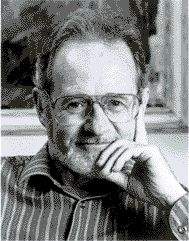
Before conducting his Concerto for Violin, Cello, Ten Winds and Percussion, Leon Kirchner swivelled around grudgingly on his stool and addressed the audience. "I've been told to say a few words about the next piece," he said, as though talking about himself was some great burden. Kirchner (shown right, photo courtesy the website of publisher G. Schirmer, Inc.) is 87, and sometimes appears his age, behaving as though every extraneous word or gesture were depleting a fast-diminishing supply.

Then again, once he began to speak, he couldn't have been more charming, insightful, and engaging - if a little mysterious. Because he didn't really talk about the piece to be performed, but just recited a few short poems, by Blake, Yeats, and this one by Goethe:
He who has Art and Science, has also religion;
He who has neither Art nor Science, needs religion.
All his comments were a bit enigmatic, alluding to his philosophical ideas about mathematics, music, and life, without getting into any long philosophical discussions. He did a very good job of introducing himself to the audience - if not the piece he was about to lead. Maybe that's the best way to introduce a complex, unfamiliar 20th-century piece, though. I think most of the audience sat up a little higher in our seats, as I did, intrigued by this slightly curmudgeonly but very eloquent old man, and we listened with great interest to a piece of 'difficult' chamber music which turned out to be fascinating, elegant, and wise - just like its creator.

Also on the program was a Schumann piano trio, and the Brahms Sextet with the Borromeo Quartet (shown in a photo from their website). I used to hear the Borromeo regularly when I went to NEC, and they were the quartet in residence there (as they still are, I believe). The group has changed a bit - a new violist, Mai Motobuchi, and a violinist who I played with in the Verbier Orchestra several years ago, Kristopher Tong. Together with founding members Yeesun Kim, cellist, and Nicholas Kitchen, first violinist, they've kept the same brilliant and thoughtful style of chamber music making though, and hearing them brought back pleasant memories of First Monday concerts in Jordan Hall.

It's funny how a group can replace half its members, and yet still maintain its unique qualities and traditions - the New World Symphony is probably the rare orchestra that turns over a third or more of its members each year, but every ensemble deals with personnel changes to some extent. The Borromeo played Brahms with two New World members, violist Chris Fischer and cellist Soo Jee Yang, and it really did seem like one fantastically augmented string quartet - the same impression I often get when hearing the Cleveland Orchestra's string section play. I suppose it's a sign that music is not only one of the noblest of arts, as Leon Kirchner said, but also a especially communicable one!

Saturday, December 02, 2006

rethinking Frankenstein!!

I'm a little ashamed to have written so dismissively of the Gruber piece earlier in the week - after rehearsing it for a few more days, and performing the piece this evening, I think it's much more than just squeaky toys and nonsense poetry. I would probably need a lot more study and listening to understand the piece completely, but I think its intent is something quite profound. It's trying to create this whole world of child-like impressions, naivety, and wonder, and at the same time express a lot of dark and unsettling emotions. There are moments when it's really uncomfortable to listen to these bizarre sounds, grumbling and shrieking and all kinds of human noises which we're not accustomed to hearing in the concert hall. And so the audience has to laugh or react, to relieve some of this tension. As simple and fun as the piece first appears, it has this incredible way of calculating the audience's emotions, and pushing them just so far that they have to squirm, and then laugh.

After the performance I got to speak with Kevin Hall, who writes Hidden City, and a friend who writes sex and the beach (I think she may be semi-anonymous). It was very cool to see some familiar faces in the audience, and feel a part of this little cultural scene in Miami - I think part of my decision to suspend blogging for a while was the feeling of sliding into irrelevance. It now seems to me kind of a self-fulfilling notion: once you think you have nothing significant to say, it becomes the truth. But really, concerts like this make me feel music is very meaningful, and as a performer I'm right in the thick of all that meaningfulness. So the challenge is to find the sense of the music for myself, and then to make sure that the audience can find it as well.

If that's my goal, probably the first thing I should do is to admit that I'm confused and lost a lot of the time too. (Not in the sense of losing my place on the page, which I can usually find, but losing the larger message). When I first open a new score, there's all this unfamiliar notation, strange instructions, a weird title - the superficial stuff which the audience also struggles with. I try and cling to the things I can easily read, the pitches and rhythms, and at least have these organized for the first rehearsal. A piece like Gruber's Frankenstein!!, there is simply so much going on, I can barely keep up with the part on my stand, and a few important signals and cues which will help me keep my place.

But as the rehearsal period goes on, I gain some familiarity, as I start to remember and look forward to certain moments - a strange chord, a rhythm that makes me feel like dancing. I'm still not sure I understand what the piece is about, at least not enough that I could stand up and give a lecture about it. Somehow though, in the process of learning its gestures, blending myself into its sonorities and harmonic language, I think I do reach some unconscious grasp of its meaning. I feel like my body contains something essential about the piece, even if my brain can't distill it into words. At least I tell myself this, so that I can feel ready to perform it!

Often, like tonight, the composer has something fascinating to say about the piece right before the performance. Gruber said that this piece, as silly as it may sound, has some very serious purposes, and made it clear that he wasn't merely showing off toy sounds. Speeches like this are for the benefit of the audience, but of course he knows the orchestra is listening too - I wonder sometimes if the conductor has planned it this way, saving those words until the moment right before we play so that they will be foremost in the minds of the musicians as well as the audience.

And so I try and play with as much understanding as possible - tonight I thought some lovely things happened, as well as some strange and not completely expected things. Even in new music, we can quickly form a set idea of how things must go, and it can be unnerving when the performance strays a bit, as it always will. Gruber was fun to perform with, because he seemed genuinely open to whatever strange new features might appear in his piece - he kept referring to our run-throughs as "versions". So no single version can be complete and authoritative, I suppose, which makes both the hearing and the performing an adventure. I can't say I completely "got" the piece Frankenstein!!, but after performing tonight's version for a very appreciative audience, I at least got an experience of it.

Tuesday, November 28, 2006

symphonic slapstick with H.K. Gruber

Most of the time a classical new music concert is a pretty serious affair - we all dress in black and our most solemn facial expressions. That might be a challenge at our New World Symphony new music concert this Saturday though, in which composer/conductor H.K. Gruber will conduct his own piece Frankenstein!!, and he'll also sing, dance, and play various kazoos.

At today's first rehearsal, H.K. Gruber had to tell us several times to keep a poker face - "be like Buster Keaton!" he said. (Who's that?) We might not have understood half of what he said, but the orchestra couldn't stop laughing. His piece seems to treat the orchestra as a big collection of toys, and then add some real toys into the mix just for more fun. There are slide whistles in the low brass, toy pianos in the bassoon and percussion, a car horn for the harp player.... All the winds stand up at one point and twirl noisemakers. In the bass section, we mostly just play the bass, but at one point we join the rest of the orchestra to harmonize on some nonsense poetry.

I guess we do sometimes treat ourselves too seriously as classical musicians. I'm pretty sure we're not humorless people though - we just don't want to compromise the composer's intentions. Most of the composers I've met, though, seem to have fantastic senses of humor, and I'm sure that Mozart, Haydn, Shostakovich, and Stravinsky did as well. Probably Beethoven never played a kazoo, but he definitely liked to surprise and shock his audience - and he was known to burst out laughing maniacallly during his own improvisations, from what I've heard.

So please come to the Lincoln Theater this weekend, but don't come expecting a lot of dour, sour new music posturing. At least for Saturday, you're more likely to find a whoopee cushion on your seat.

Saturday, March 26, 2005

Russian new music concert

Tonight our orchestra is playing a program of new music by Russian composers - we've just finished our dress rehearsal, so I thought I would write my thoughts about the concert, and then I can link to the newspaper if it gets reviewed so you can get the critic's take.

The first piece on the program is for solo violin and a chamber orchestra without violins - it is called Aftersight, by a composer named Kissine, and I don't play on it. I listened to a bit of the rehearsal though, and it sounded good. The soloist, Alexander Barantschik who is concertmaster of the San Francisco Symphony, plays it very convincingly and there are a lot of interesting orchestration effects to listen to.

In our system of string seating rotation, I got to be principal bass for the next piece, called Stufen by Sofia Gubaidulina. I was initially a little concerned, because much of the bass part is divided into 8 parts, and we only have 7 bass players. I quickly realized, though, that the intent was less like a Bach 8-part invention and more like a bunch of insects chirping on a summer evening. The effect is to sound just random and independent enough that there could be an infinite amount of people playing. While the notes and rhythms are a bit tricky, the effect is actually quite easy to pull off, I was pleasantly surprised to discover. I think the piece should come off very effectively, as long as the tape of Russian poetry starts when it is supposed to. The end of the piece features seven deep male voices reciting the same poem with different speeds and intonations, so that you can barely pick out more than short phrases, even if you understand Russian. It is kind of a spooky, mysterious way to end a piece, as long as the orchestra doesn't crack up listening to it.

The other piece for full orchestra is by Alfred Schnittke, and it is called In memoriam. In memoriam to whom, I'm not sure, though playing it I can't help thinking about Shostakovich all the time. It has a simple little theme that recurs in each of the five movements, including a beautiful waltz movement with solo clarinet. Another movement has a little aleatoric section - MTT, the conductor, said today in rehearsal that the reason for this is that "everyone goes ape a little differently", which I thought was a strangely profound thought. The bass section doesn't really do much, other than some solo harmonics and low B's. Our lowest note is normally a low C, so in cases like this we have to tune our lowest string down an extra half step, and try to remember so we don't play the wrong pitches in the rest of the piece. This isn't too difficult in this case, though - in one of the movements, we only play a single note. I was joking with my stand partner that I really disagreed with our interpretation of this movement, we need to sit with a slight more forward tilt to express the intensity of our 47 bars of rest. The last movement is a beautiful passacaglia with a 14-bar organ theme repeated 14 times.