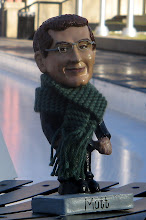
The CPO and Calgary Opera are opening a new production of Gounod's Faust this Saturday; this past Tuesday, we were in the orchestra pit at Jubilee Auditorium, about half-way through the 3rd act when news came that Barack Obama had won the presidential election. It actually came from Rob the violinist's cell phone, which was picking up a news website, and Jeff the bassist passed the message on to me.
It's difficult to really celebrate in the midst of playing a long French opera, but it was still an amazing moment. As much as I'd wished and hoped this would happen, it was such a validation to hear it become reality. Last night I watched both McCain's concession speech and Obama's victory speech, and I was impressed by both of them. However serious the problems we face in the US -- and I know they're incredibly serious -- for at least one wonderful day, nothing seemed insurmountable any more.
I haven't written much this week, since I started November with a short-lived attempt to write a novel for NaNoWriMo -- National Novel Writing Month -- and then quickly became too busy to even contemplate such a massive undertaking. It felt a bit like trying to run a marathon without any training, long, tiring, and increasingly painful. I have new respect for writers of fiction or any long form, which seems to involve a miraculous combination of imagination and discipline. Perhaps I'll try again next year, if I've written some pieces longer than a blog post by then. Everything seems impossible, I suppose, until you actually see it happen.
Showing posts with label politics. Show all posts
Showing posts with label politics. Show all posts
Thursday, November 06, 2008


Thursday, October 30, 2008
Joe the Cellist
I've been planning to write a "Joe the Orchestral Musician" post for a while, but last night Yo-Yo Ma beat me to it -- announcing on The Colbert Report that he was "Joe the Cellist":
for Canadians, watch the clip here
And please visit Drew McManus' blog Adaptistration to watch more Stephen Colbert interviews and vote for your favorite classical music interviewee -- Yo-Yo, Alex Ross, or Lorin Maazel.
for Canadians, watch the clip here
Colbert: How does it feel to be the #1 at something in the world?That sounds like a side-step to me. I thought maybe I would pick up the subject and ask, what are some of Joe the Cellist's concerns?
Ma: Well, for people who watch Arthur, you know Mikey the 8-year old cellist? I'm a superstar, because I'm in his show. And so he probably thinks of me as -- "Joe the Cellist."
Colbert: Are enough candidates addressing the concerns of Joe the Cellist?
Ma: Well, you know, I think it could take a while.
- arts funding (so he'll keep getting paid to play)
- music education (so kids will keep wanting to take lessons)
- safe and lively urban centers (so people will keep coming downtown to see his concerts)
- affordable health care (in case he gets tendinitis)
- public transportation and infrastructure (so he can make it to his gigs on time)
- floors made of penetrable materials (so his endpin doesn't slip)
And please visit Drew McManus' blog Adaptistration to watch more Stephen Colbert interviews and vote for your favorite classical music interviewee -- Yo-Yo, Alex Ross, or Lorin Maazel.
Tuesday, October 21, 2008
Jeff Weisner on brand loyalty

We each have a "brand" to our playing - a basic set of sound and style characteristics that hold true through everything we play. That brand is created from our core technique elements, the influence of our most important teachers and mentors, and our most basic musical preferences. I make the type of sound that I do on the bass because at some level I like it - it feels right to me, for reasons that I honestly can't even define exactly. It developed through my early years of study and my student days. Even as I have developed a more diverse palette of tone colors and styles in my playing, I still keep one foot (or at least a toe) in this core sound concept that I bring to my musical work.
-- excerpt from "Know Your Brand" by Jeff Weisner, Peabody Double Bass Blog
Drawing analogies to bass playing is a favorite pastime of mine, so I have to take up this recent post by Jeff Weisner. Jeff shares some very intriguing ideas about schools of playing, which he likens to political branding. He concludes that even the strongest players might benefit from an honest assessment of their own "brand", and might focus on projecting those qualities in auditions.
Jeff draws a careful distinction between monotonous, one-style-fits-all playing -- perhaps you could call the Steve Forbes school, taking one issue and hammering it mercilessly -- and playing with no real sense of integrity or authenticity, which he likens to John "Flip-Flop" Kerry. That's still a bit of a sore spot for me personally, having really believed in John Kerry in 2004. What we Kerry supporters called "nuance", many others labelled spinelessness -- though I guess we now have the satisfaction of saying, "I told you so."
The kind of playing that Jeff advocates is neither Forbes nor Kerry -- it can have sophistication, style, and nuance, but it never strays from an essential core sound. It's about playing to the audience, but not about saying, "I'll do anything to get your vote." It all comes back to integrity -- of sound, belief, and intention -- and integrity that comes from one's own highest standards, not the standards of some committee we know only from rumors and hearsay.
Jeff doesn't offer any political endorsements of his own -- maybe he's keeping his blog non-partisan, since it's the official mouthpiece of the Peabody Double Bass Department. I wonder how he judges the brand-salesmanship of these two presidential tickets, though. We have one candidate, Obama, who has worked to broaden the appeal of his party's brand, refining their historically polarizing positions on taxes, foreign policy, and social issues. The other styles himself as a "maverick" -- originally a term for un-branded cattle, it's become political-speak for someone willing to buck his party -- and yet he's run a rambling, divisive campaign that's alienated many independent voters as well.
In a year when the Democratic party brand has so many advantages -- largely because the Bush administration has tarnished the Republican brand, as well as the brand of the nation as a whole -- perhaps McCain's best strategy is to run with the brand of the maverick. As Jeff makes clear, though, there are certain advantages to a clear, recognizable brand -- you know what you're selling, and people know what they're getting. When it's a question of security, a clear and confident brand is sometimes enough to carry an audition or an election.
Thoughts?
Monday, October 20, 2008
pointing out the obvious
 Rehearsing the "Flying Music" from E.T. last Friday, conductor Richard Kaufman stopped the orchestra at one point and turned to the bass section. "This is a bass soli," he told us, which was rather surprising since we weren't playing much more than pizzicato downbeats. He went on, "For John Williams, the bass section is the engine of the orchestra!"
This is always nice to hear, though from the bass section's perspective we're pretty much always the engine of the orchestra. If a conductor makes a point of it, we'll play louder and more assertively, and maybe further to the front side of the beat. As in most things a conductor asks for, there's no major transformation -- just a shift in emphasis, a heightened sense of importance. Maybe that will project to the audience, maybe not; in any case, the other sections of the orchestra will probably be more attentive to what we're doing, and so we'll be better able to contribute.
An analogy in last week's New Yorker caught my attention on a similar subject:
In his acceptance speech at the Convention and in the first debate -- his two big-audience occasions on foreign policy -- Obama mentioned cooperation but emphasized aggressive action much more strongly. In that way, the Obama campaign is like a symphony orchestra, with the need for international cooperation as the string section and the necessity for aggressive action as the horns. Both sections are always playing, but usually one or the other is playing louder. During the fall campaign, the horns have dominated the strings.As an orchestra musician, a lot of things about this analogy bother me -- the strings and horns are always playing? why is it just "louder", what about differences of articulation, tone quality, expression, etc.? and how about the different voices within the strings, not to mention the brass and percussion and woodwinds, what do they represent?
- "Worlds Apart," by Nicholas Lemann, October 13, 2008 issue of The New Yorker
All that is just nit-picking, though, since I think it's a very effective analogy for what the point Lemann is making. We do balance our messages, and we'll change our focus, wording, and content for different settings and audiences. It's one of the most basic elements of human communication, so essential that we might not give it much thought. And it's also a good explanation for what a conductor does in balancing the orchestra -- he or she draws our attention to certain things, or minimizes certain others. Within any musical score, be it John Williams or Beethoven, there are countless details and possibilities for what might happen -- the conductor gets to imagine those possibilities and, with the cooperation of the orchestra, bring out the details that make the imagined real.
Saturday, October 18, 2008
the well-tempered political candidate
We’ve been watching Barack Obama for two years now, and in all that time there hasn’t been a moment in which he has publicly lost his self-control. This has been a period of tumult, combat, exhaustion and crisis. And yet there hasn’t been a moment when he has displayed rage, resentment, fear, anxiety, bitterness, tears, ecstasy, self-pity or impulsiveness.
-- David Brooks, "Thinking about Obama", NY Times Oct. 16, 2008
For some who oppose him, his equanimity even under the ugliest attack seems like hauteur; for some who support him, his reluctance to counterattack in the same vein seems like self-defeating detachment. Yet it is Obama’s temperament—and not McCain’s—that seems appropriate for the office both men seek and for the volatile and dangerous era in which we live. Those who dismiss his centeredness as self-centeredness or his composure as indifference are as wrong as those who mistook Eisenhower’s stolidity for denseness or Lincoln’s humor for lack of seriousness.I've been reading a lot of political commentary lately, and the question of temperament seems to be on a lot of people's minds. Even in the testiest exchanges, Barack Obama projects an air of coolness and centeredness, an even temperament that contrasts with John McCain's manic shifts and gestures. Even before the substance of their arguments is assessed, many people find Obama's bearing and composure more "presidential".
-- The New Yorker, Oct. 13, 2008, Comment by the editors
It's not just about posture, tone of voice, and gestures -- I also had the impression that Obama focused more on the larger issues, worked towards compromise and understanding rather than petty bickering, and returned the conversation to issues of real importance. When you think back over those debate performances, though, the contrast in temperament serves as a useful shorthand for all the other differences between the candidates.
Variations in temperament can also determine an orchestral audition, I think, and not just in the sense of playing in tune. Audition committees want to hear someone who is collected, confident, and centered, who plays with a sense of inner calm -- without being boring. It's a tricky balance to maintain, especially under conditions of pressure and nervousness.
Among musicians I know who have used enderol (a beta-blocker), most have said that it helps restore this state of equanimity. They're able to sail through excerpts without any wild surprises or reactions -- things affect them less, and so they feel more like themselves. Personally I prefer not to use enderol, and have worked to accustom myself to that nervous hyper-sensitivity. Also, I find tools like focused breathing and meditation can help to restore a natural sense of calm.
Don Greene, the psychologist who has pioneered a technique to maintain performance under pressure, uses the analogy of a race-car driver. At the speeds they're moving, even the slightest twitch can throw their steering out of control; a normal correction back to neutral might instead throw them far in the opposite direction. Like a political or audition candidate, they need to tune their mental responses -- their internal temperament -- to the conditions under which they operate. They need to moderate their reactions and impulses, even while driving with extreme boldness and confidence.
There has never been a moment when, at least in public, he seems gripped by inner turmoil. It’s not willpower or self-discipline he shows as much as an organized unconscious. Through some deep, bottom-up process, he has developed strategies for equanimity, and now he’s become a homeostasis machine.
-- David Brooks, from the same article quoted above
As spectators, we might not be able to appreciate the internal forces they're having to manage -- we merely see a musician, politician, or race car driver performing well. It's a peaceful sport played with tremendous internal violence, as Don Greene likes to describe golf. Only when we watch a less successful performer -- or try to perform as well ourselves -- can we really appreciate the power on display.
Tuesday, September 16, 2008
putting El Salón in context
Speaking of politics in music, this week the CPO will be performing El Salón México by Aaron Copland -- a piece written in the early 1930's, during a phase Copland's career when he was actively promoting leftist and socialist ideals through his music.
Nowadays, the piece is most often programmed as a splashy, dancing burst of Latin color. That's how it fits into our program, which is titled "Tango Nights" and features several pieces by Piazzola, the Symphonic Dances from West Side Story, and El Salón México. Until I read Alex Ross' new history of 20th-century music, The Rest is Noise, I wouldn't have noticed any deeper meaning to the work either. Ross puts El Salón into the context of the period, and explains the political intentions of its creator, in a way that sheds a fantastic light on this quirky, tuneful little piece.
I'd recommend The Rest is Noise to anyone who thinks they just don't get 20th century music -- who finds it confusing, intimidating, or exasperating -- or who just wants a deeper understanding of music like El Salón, and how it relates to the political and social upheavals of our time. I guess that means I'd recommend it to just about everyone.
Nowadays, the piece is most often programmed as a splashy, dancing burst of Latin color. That's how it fits into our program, which is titled "Tango Nights" and features several pieces by Piazzola, the Symphonic Dances from West Side Story, and El Salón México. Until I read Alex Ross' new history of 20th-century music, The Rest is Noise, I wouldn't have noticed any deeper meaning to the work either. Ross puts El Salón into the context of the period, and explains the political intentions of its creator, in a way that sheds a fantastic light on this quirky, tuneful little piece.
I'd recommend The Rest is Noise to anyone who thinks they just don't get 20th century music -- who finds it confusing, intimidating, or exasperating -- or who just wants a deeper understanding of music like El Salón, and how it relates to the political and social upheavals of our time. I guess that means I'd recommend it to just about everyone.
Monday, September 15, 2008
music under a bell jar
The Berlin Philharmonic, virtually alone among German cultural institutions, continued playing right to the end of the Second World War. Even after their hall, the old Philharmonie, was destroyed by bombers, they continued performing in the Admiralspalast downtown, and at makeshift hospitals around the city. It's understandably not a period people in the orchestra are proud of, but a remarkable new documentary by Enrique Sanchez Lansch, The Reichsorchester, chronicles and records the memories of the last two surviving orchestra members who played in the Berlin Phil during that time.
One of those members, violinist Hans Bastiaan, describes that time as "like being under a bell jar" -- the orchestra was protected and sheltered by the Nazi ministry of propaganda, performing a regular concert schedule and touring widely to boost morale and to symbolize of German cultural might. Bastiaan and double bassist Erich Hartmann, the other surviving member who speaks at length in the film, both understood that they were serving an evil regime -- yet they both claim the Berlin Philharmonic was never a Nazi orchestra, even if certain members were party loyalists.
The vast majority kept playing out of dedication to their craft; out of allegiance to their music director, Furtwangler, and to their colleagues; from pride for the stellar reputation and musicianship of their orchestra; and, in the final days, for sheer survival. Orchestra members were given an exemption from military service -- and their family members offered special protections and allowances as will -- and so from the beginning they were tied to the regime and its continued stability.
Only in the last few months, playing before audiences of severely wounded soldiers and civilians, did Bastiaan, Hartmann, and their like-minded colleagues recognize the shame of their role as state-supported artists. Other members, such as violinist Bernhard Alt (who earlier composed of a double bass quartet, written for his Berlin Phil colleagues) committed suicide. Still others died amid the chaos of bombings and occupation (this was the case with the interim conductor Leo Borchard, who died by American gunfire in a tragic accident). One violist, dismissed by Furtwangler for missing a concert early in the war, had his exemption revoked and died on the front -- just one terrible story among many that Bastiaan and Hartmann have to tell.
It's fascinating to hear them tell it, even though they still seem to struggle with the moral quandaries of that time. Among the musicians, Bastiaan notes, their understanding of politics was often "child-like", and they only wished to keep performing great music under the best conductors -- and yet the harsh realities around them wouldn't disappear, or be vanquished by sublime concerts. In the end, they were given a perfect opportunity to witness the crumbling of the Nazi regime, from within the protective 'bell jar' it provided, and to take part in the rebuilding efforts that followed.
The documentary includes extensive footage of the orchestra performing, mainly Beethoven and Wagner, including a complete performance of the Prelude to Act I of Die Meistersinger, recorded in a German factory in 1942.
One of those members, violinist Hans Bastiaan, describes that time as "like being under a bell jar" -- the orchestra was protected and sheltered by the Nazi ministry of propaganda, performing a regular concert schedule and touring widely to boost morale and to symbolize of German cultural might. Bastiaan and double bassist Erich Hartmann, the other surviving member who speaks at length in the film, both understood that they were serving an evil regime -- yet they both claim the Berlin Philharmonic was never a Nazi orchestra, even if certain members were party loyalists.
The vast majority kept playing out of dedication to their craft; out of allegiance to their music director, Furtwangler, and to their colleagues; from pride for the stellar reputation and musicianship of their orchestra; and, in the final days, for sheer survival. Orchestra members were given an exemption from military service -- and their family members offered special protections and allowances as will -- and so from the beginning they were tied to the regime and its continued stability.
Only in the last few months, playing before audiences of severely wounded soldiers and civilians, did Bastiaan, Hartmann, and their like-minded colleagues recognize the shame of their role as state-supported artists. Other members, such as violinist Bernhard Alt (who earlier composed of a double bass quartet, written for his Berlin Phil colleagues) committed suicide. Still others died amid the chaos of bombings and occupation (this was the case with the interim conductor Leo Borchard, who died by American gunfire in a tragic accident). One violist, dismissed by Furtwangler for missing a concert early in the war, had his exemption revoked and died on the front -- just one terrible story among many that Bastiaan and Hartmann have to tell.
It's fascinating to hear them tell it, even though they still seem to struggle with the moral quandaries of that time. Among the musicians, Bastiaan notes, their understanding of politics was often "child-like", and they only wished to keep performing great music under the best conductors -- and yet the harsh realities around them wouldn't disappear, or be vanquished by sublime concerts. In the end, they were given a perfect opportunity to witness the crumbling of the Nazi regime, from within the protective 'bell jar' it provided, and to take part in the rebuilding efforts that followed.
The documentary includes extensive footage of the orchestra performing, mainly Beethoven and Wagner, including a complete performance of the Prelude to Act I of Die Meistersinger, recorded in a German factory in 1942.
Saturday, September 22, 2007
sign a petition for Jaco
 NPR's Melissa Block reported a nice tribute to Jaco Pastorius yesterday, on the 20th anniversary of his death. A native of Fort Lauderdale, Jaco also died there tragically in a fight outside a nightclub.
Jaco's life unfortunately seems to have been a sort of downward spiral, and every remembrance of him seems to be filled with sadness and regret. Still, his music deserves to be celebrated - and it's too bad Florida doesn't really have any memorial to Jaco.
Oh wait, someone online has a petition to build one! Well, I'll sign - there aren't enough public parks dedicated to bass players, in my humble opinion.
The photo shown here is from JacoPastorius.com, his official website, where you can read memorials by musicians who knew and admired Jaco.

Thursday, January 18, 2007
exploratory committees
 This morning I listened to a radio program, On Point from WGBH Boston, talking about the prospects for a Barack Obama presidential candidacy. It got me to thinking about the similarities between political and audition candidates. Just like in a political race, perceptions can determine reality: the momentum and confidence of previous victories can often carry a candidate over the top. The last two auditions I've taken, the Buffalo Philharmonic and Cleveland Orchestra, were both won by Scott Dixon, and I don't think it's at all uncommon to see one person clean the slate like Scott has!
In Barack Obama's case, he's just announced the formation of a public exploratory committee, which I gather is the closest thing to an all-out declaration that he'll run - that announcement will probably come on February 10th. I'm not quite sure what a political exploratory committee does; probably it's a lot concerned with bringing in money and positive media coverage. But I wonder if an exploratory committee might be a good idea for a musician getting ready for an audition as well. Get together a group of people you trust and respect, and get their honest assessments of where you stand going into the audition.
Of course, the first person you need to convince is yourself. If there were an analogy to the primary system, I think it would be the daily process of building confidence, gaining small victories like successful mock auditions and recordings, and gathering supportive advice and comments. In this regard, my last audition felt a little like the candidacy of Dennis Kucinich (Cleveland's former mayor, I believe). Not even I believed I could win, or even carry my home state, and so I didn't. In this regard, I think what Don Greene calls "self talk" functions like media coverage - those voices in your head creating a constant swirl of spin and speculation. It can lift you and give you a great positive feeling, as recent coverage of Barack Obama has, or it can spin into negative and self-defeating thoughts. That was my experience in preparing for Cleveland, and before I knew it I had pretty much Swift-Boated myself.
Both politics and orchestra auditions seem to come down to managing perceptions and ideas: first your own, then those of a committee or electorate. They also involve huge investments of time and money, as well as emotional resources, hope and stress. (I can only imagine having to deal with audition attack ads!) I think it's worthwhile to consider an audition as a kind of campaign, with many of the same risks and rewards. Hopefully it won't be quite as expensive, but it's still a good idea to deliberate carefully before deciding to commit oneself.
Wednesday, January 10, 2007
semantics
So many of the big political controversies these days seem to come down to linguistic battles - is it a 'surge' or an 'escalation'?; 'Stay the course' or 'cut and run'?; the 'Democratic' or the 'Democrat' Party'? Each ideology has its own lingo, and pretty soon, I imagine, they'll break apart into separate dialects, then entirely different languages, so that we can talk past each other without any danger of understanding what the other side is saying.
Okay, I'm kind of exaggerating the semantic debates. Still, it does all seem silly to me. In classical music we have our own linguistic battles, starting with that thorny 'classical music' phrase itself. It seems needlessly elitist, but then the alternatives like 'serious music' or 'Western art music' are perhaps even worse. It's too bad we can't strip all those pretentious connotations and pick some arbitrary new word.
Then there's the question of 'community engagement' vs. 'community outreach'. Outreach has gone out of style, maybe also owing to elitist connotations - the mighty orchestra reaching out from its ivory tower, bringing culture to the unwashed masses. This is supposed to be the neighborly, friendly and open face of the orchestra, so we don't want the term itself to sound snooty and one-sided. Then again, reaching out can be a gesture of openness and not condescension, as in reaching out to embrace someone. 'Engagement' sounds faintly militaristic to me, as though we need to set up our battle lines and launch raids into the community, hopefully capturing a few stray recruits to our cause.
If anyone has any suggestions for a new, friendlier term for what we do in the community, please leave a comment! I was impressed last week that someone helped me out with a definition for 'Marschartig' - though our orchestra didn't end up playing that song, it was still cool to know I have some brilliant linguists reading my idle thoughts.
Okay, I'm kind of exaggerating the semantic debates. Still, it does all seem silly to me. In classical music we have our own linguistic battles, starting with that thorny 'classical music' phrase itself. It seems needlessly elitist, but then the alternatives like 'serious music' or 'Western art music' are perhaps even worse. It's too bad we can't strip all those pretentious connotations and pick some arbitrary new word.
Then there's the question of 'community engagement' vs. 'community outreach'. Outreach has gone out of style, maybe also owing to elitist connotations - the mighty orchestra reaching out from its ivory tower, bringing culture to the unwashed masses. This is supposed to be the neighborly, friendly and open face of the orchestra, so we don't want the term itself to sound snooty and one-sided. Then again, reaching out can be a gesture of openness and not condescension, as in reaching out to embrace someone. 'Engagement' sounds faintly militaristic to me, as though we need to set up our battle lines and launch raids into the community, hopefully capturing a few stray recruits to our cause.
If anyone has any suggestions for a new, friendlier term for what we do in the community, please leave a comment! I was impressed last week that someone helped me out with a definition for 'Marschartig' - though our orchestra didn't end up playing that song, it was still cool to know I have some brilliant linguists reading my idle thoughts.
Sunday, November 12, 2006
pro-democratic haiku no. 2

"Miami Beach residents that vote early are eligible to receive 15% discounts at participating Miami Beach businesses and receive a free admission to the Scott Rakow Ice Rink during the early voting period."Last week we voted,
Hoping to save our country.
Then go ice skating.
Friday, January 13, 2006
an audition scenario
 Listening to the Supreme Court confirmation hearings this week, I've been wondering how it might sound if orchestra auditions were run in a similar fashion:
Scene: A nondescript rehearsal room, a large screen placed in the center. Behind the screen sit several committee members, out of view. Enter audition candidate and proctor; audition candidate holds a double bass, proctor places a stool on the floor and announces -
Proctor: This is audition candidate number 73, who will play the Bourrees from Bach's 3rd Suite.
Committee member #1: Fine, please feel free to tune and play a few notes, and proceed when you are ready.
...sounds of Bach being played for the next couple of minutes...
CM #1: Thank you, now please continue to the excerpt from Beethoven's 5th Symphony.
Audition candidate whispers to proctor. They confer for a few moments.
P: Audition candidate #73 prefers not to play that excerpt, sir, since should you choose to hire the candidate, this piece may very likely come before the bass section during the candidate's tenure there.
CM #1: Excuse me, you're saying that #73 won't play Beethoven 5, because we might play the piece in the orchestra?
P: That's correct - the candidate feels that playing the Scherzo and Trio for you now may prejudice the candidate's future performances of Beethoven 5.
CM #1: That's the most ridiculous thing I've ever heard. If we can't hear a piece the orchestra is going to play, what can we hear? A C major scale maybe?
P: The candidate would prefer to not play that scale either, since C major scales might arise in the bass section fairly frequently.
CM #1: But #73 just played us the 3rd Suite Bourrees - there must have been some scales there?
P: Actually, that was just a recording of Edgar Meyer playing the Bach. The candidate does admire Edgar Meyer's performance greatly, though.
Committee member #2: I would just like to say that I share candidate #73's admiration for Edgar, and I fully support the decision not to play any of those excerpts. The purpose of this audition is to find out just what kind of orchestra member you'll be, not to create some kind of litmus test for how you play a particular excerpt. I for one feel you'll make a great addition to our bass section, and I support your nomination wholeheartedly. May I ask the candidate to please share an amusing story about growing up in my native state of New Jersey, affirming the importance of hard work and fair play?
P: The candidate would prefer not to.
CM #1: I have a tape recording I have just discovered and would like to play for the committee. This is candidate #73's seating audition at Grover Cleveland Middle School -
...sounds of a raucously awful performance of Capuzzi Concerto...
CM #2: This is clearly uncalled for - we can't base our decision on a scratchy cassette made 15 years ago! I have brought in the piano accompanist from #73's undergraduate senior recital - maybe she can give us some testimony on the candidate's qualities?
Piano accompanist: Yes, sir. Audition candidate #73 was always well-prepared, highly capable, and all the checks cleared. I recommend #73 highly.
Committee member #3: That's all very well, but the bass player we would be replacing is Bob Ratkiss, our only German bow player and a key voice in deciding where the section would go out for drinks after concerts. I've brought in a former stand partner of #73 - is this candidate really up to the job?
Former stand partner: Not only does #73 not play German bow, often #73 would forget to bring a bow entirely, and then have to borrow mine. #73 also frequently forgot to bring a pencil, rosin, the music, an instrument, or any cash, forcing me to pay for all of #73's drinks. I strongly oppose the hiring of this candidate.
Committee member #4: Thanks for that, former stand partner. By the way, weren't you candidate #69?
FSP: No comment.
Subscribe to:
Posts (Atom)