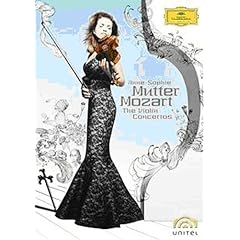
 Anne-Sophie Mutter's early recordings of the Mozart violin concertos are already legendary, and her recent concert films are just as good. In 2005, Ms. Mutter launched "The Mozart Project Story," in conjunction with the worldwide celebrations of Mozart's 250th birthday; the two-disc DVD set I recently watched, which contains the 5 Mozart concertos with the Camerata Salzburg led by Mutter, is only one element in the project. This music has clearly been a life-long passion for her, and the Camerata Salzburg plays with equal passion and grace. These recordings are a great curative if you've heard (or played) these pieces for too many auditions and grown bored with them -- they sound and feel like much-loved music, made with freshness and spontaneity among friends.
Showing posts with label recordings. Show all posts
Showing posts with label recordings. Show all posts
Friday, October 24, 2008
Anne-Sophie's Mozart
Anne-Sophie Mutter's early recordings of the Mozart violin concertos are already legendary, and her recent concert films are just as good. In 2005, Ms. Mutter launched "The Mozart Project Story," in conjunction with the worldwide celebrations of Mozart's 250th birthday; the two-disc DVD set I recently watched, which contains the 5 Mozart concertos with the Camerata Salzburg led by Mutter, is only one element in the project. This music has clearly been a life-long passion for her, and the Camerata Salzburg plays with equal passion and grace. These recordings are a great curative if you've heard (or played) these pieces for too many auditions and grown bored with them -- they sound and feel like much-loved music, made with freshness and spontaneity among friends.


Sunday, September 16, 2007
think globally, record locally
Recently at the CPO we recorded music for a television production of Nutcracker, to be aired at 8 pm on December 23, on CBC I think. My colleague Jeff did a nice job of chronicling our involvement over three entertaining days. I was right there alongside of him, experiencing both the highs ("We got the top of the harp gliss to sync with the tear drop falling!") and the lows ("Let's try those 300 measures of fff tremolo one more time, there was something ticking in the booth.")
At one point a producer came out to say hello, thank us for our fine work - and then he explained why the music hadn't been licensed from pre-existing recordings, or outsourced to some orchestra in Slovenia. I hadn't realized this, but that is where a lot of film and television scores get recorded, because Eastern European orchestras will work for lower wages. They don't advertise that fact - no movie poster ever boasts "Score recorded in Bucharest!" - but it's a way of cutting some of the costs.
This was the rare case in which a production team really does take pride in using local performers. The dancers, choreographer, and other artistic staff were all based in Alberta; they had insisted that the music should come from Calgary as well. And while most of the music was Tchaikovsky - numbers from Nutcracker as well as bits from the 5th and 6th Symphonies - quite a bit of transitional music was by a local composer, John Estacio, who was on stage with us for the entire session.
 Last month I read Barbara Kingsolver's latest book, Animal, Vegetable, Miracle, which was where I first heard of this term 'locavore'. It's a person who tries to consume only what is grown locally. So things like avocados, bananas, and olive oil, which are so common in our stores we might think they're local, are off the table. I'm not going to be that strict, but it's definitely altered my approach to shopping and eating. I won't bother looking at asparagus, since it's long out of season here, and a couple weeks ago I canned a huge box of tomatoes, thinking I'll save them for the winter when fresh tomatoes are a distant memory.
I wonder though, if any locavores will ever get as particular about their music as they are with their food. There certainly is a huge difference between live and recorded music - probably as big as the difference between fresh and canned spinach. And it seems important (to me anyway) to support a community of local artists and musicians, as well as farmers and food artisans. Ideally this would include local composers, conductors, instrument makers...
Of course, as this producer talked about these great local ideals, I began to feel a bit like that Ecuadoran banana in the supermarket. I've only lived here in Calgary a few weeks; and I've never played in this particular Nutcracker production; and I'd be hard pressed to name a single Albertan composer (besides John Estacio!). There's a case to be made for the occasional importthough, I think - no chocolate or coffee grows in Calgary, after all. And you can't have a Nutcracker without a few imported nuts.
At one point a producer came out to say hello, thank us for our fine work - and then he explained why the music hadn't been licensed from pre-existing recordings, or outsourced to some orchestra in Slovenia. I hadn't realized this, but that is where a lot of film and television scores get recorded, because Eastern European orchestras will work for lower wages. They don't advertise that fact - no movie poster ever boasts "Score recorded in Bucharest!" - but it's a way of cutting some of the costs.
This was the rare case in which a production team really does take pride in using local performers. The dancers, choreographer, and other artistic staff were all based in Alberta; they had insisted that the music should come from Calgary as well. And while most of the music was Tchaikovsky - numbers from Nutcracker as well as bits from the 5th and 6th Symphonies - quite a bit of transitional music was by a local composer, John Estacio, who was on stage with us for the entire session.
Last month I read Barbara Kingsolver's latest book, Animal, Vegetable, Miracle, which was where I first heard of this term 'locavore'. It's a person who tries to consume only what is grown locally. So things like avocados, bananas, and olive oil, which are so common in our stores we might think they're local, are off the table. I'm not going to be that strict, but it's definitely altered my approach to shopping and eating. I won't bother looking at asparagus, since it's long out of season here, and a couple weeks ago I canned a huge box of tomatoes, thinking I'll save them for the winter when fresh tomatoes are a distant memory.I wonder though, if any locavores will ever get as particular about their music as they are with their food. There certainly is a huge difference between live and recorded music - probably as big as the difference between fresh and canned spinach. And it seems important (to me anyway) to support a community of local artists and musicians, as well as farmers and food artisans. Ideally this would include local composers, conductors, instrument makers...
Of course, as this producer talked about these great local ideals, I began to feel a bit like that Ecuadoran banana in the supermarket. I've only lived here in Calgary a few weeks; and I've never played in this particular Nutcracker production; and I'd be hard pressed to name a single Albertan composer (besides John Estacio!). There's a case to be made for the occasional importthough, I think - no chocolate or coffee grows in Calgary, after all. And you can't have a Nutcracker without a few imported nuts.
Tuesday, September 04, 2007
is it lies, or is it Memorex?
Remember when some teacher said you only use 10% of your brain? She was probably just trying to make you feel lazy. But it's hard not to feel a little cheated, reading this:
That's from a recent article at SFGate.com: "MP3 music - it's better than it sounds" by Joel Selvin. I found my way there this weekend via this other rather contentious blog.
I suppose I'm a member of "the iPod generation" that writer refers to - especially since I transferred my entire CD collection onto a hard drive, just before moving up to Calgary. I had been pretty reticent to do this - my CDs have always been a major decorating feature, strewn all around my apartment. And I really do like to look at something while I'm listening to a CD, even if it's just a note from the performer thanking his Mom.
It was liberating to leave all those boxes behind, though. And if my listening experiences have been lacking in cathartic magic lately, I figured it was mostly because I haven't hooked up any good speakers yet. Well, maybe I need to rethink this - either send for those CDs I left at my parents' house, or give up this wicked compromise we call recorded music altogether.
Music is a bit of a shell game to begin with, I suppose. We love to guess what's coming, to make a deductive leap, and it's almost more thrilling to find we've been mistaken than to have our guess confirmed. There's an amazing deceptive cadence in the Bruckner 8 slow movement, and no matter how many times I hear it, it still gives me goosebumps. Though I haven't listened to it yet in MP3 - I wonder if they compressed out all the goosebumps?
Our imaginations can't do all the work - even the most dedicated audiophile is bound to discover something new by hearing it live. My question is, at what point is recorded sound not worth the microchips it's printed on? Are we consuming a bland, artificially flavored, frozen-food version of music? Al Schmitt describes what a listening experience should be:
Whether you know it or not, that compact disc you just copied to your MP3 player is only partially there.
...the music contained in these [MP3] computer files represents less than 10 percent of the original music on the CDs. In its journey from CD to MP3 player, the music has been compressed by eliminating data that computer analysis deems redundant, squeezed down until it fits through the Internet pipeline.When even the full files on the CDs contain less than half the information stored to studio hard drives during recording, these compressed MP3s represent a minuscule fraction of the actual recording. For purists, it's the dark ages of recorded sound.
"You can get used to awful," says record producer Phil Ramone. "You can appreciate nothing. We've done it with fast food."
That's from a recent article at SFGate.com: "MP3 music - it's better than it sounds" by Joel Selvin. I found my way there this weekend via this other rather contentious blog.
I suppose I'm a member of "the iPod generation" that writer refers to - especially since I transferred my entire CD collection onto a hard drive, just before moving up to Calgary. I had been pretty reticent to do this - my CDs have always been a major decorating feature, strewn all around my apartment. And I really do like to look at something while I'm listening to a CD, even if it's just a note from the performer thanking his Mom.
It was liberating to leave all those boxes behind, though. And if my listening experiences have been lacking in cathartic magic lately, I figured it was mostly because I haven't hooked up any good speakers yet. Well, maybe I need to rethink this - either send for those CDs I left at my parents' house, or give up this wicked compromise we call recorded music altogether.
"[Digitally compressed music] turns you into an observer," [John] Meyer [of Berkeley Labs] says. "It forces the brain to work harder to solve it all the time. Any compression system is based on the idea you can throw data away, and that's proved tricky because we don't know how the brain works."My impression is that record engineering is more of an art than a science - an art with many acknowledged masters, such as Phil Ramone and Al Schmitt whom the article quotes. In any art form, some of the hardest decisions are what gets minimized, compressed, or even left out. The performers struggle with those same decisions - we can't stretch out every chord or modulation we really love (especially if we're on a click track!). And the composer has already made many of those choices, giving us places where a note or phrase is just implied, and trusts the performer and audience to fill in the gaps.
Music is a bit of a shell game to begin with, I suppose. We love to guess what's coming, to make a deductive leap, and it's almost more thrilling to find we've been mistaken than to have our guess confirmed. There's an amazing deceptive cadence in the Bruckner 8 slow movement, and no matter how many times I hear it, it still gives me goosebumps. Though I haven't listened to it yet in MP3 - I wonder if they compressed out all the goosebumps?
Our imaginations can't do all the work - even the most dedicated audiophile is bound to discover something new by hearing it live. My question is, at what point is recorded sound not worth the microchips it's printed on? Are we consuming a bland, artificially flavored, frozen-food version of music? Al Schmitt describes what a listening experience should be:
"When you listen to a world-class symphony or a good jazz record," says Schmitt, "and you hear all the nuance in the voices, the fingers touching the string on the bass, the key striking the string on the piano, that's just a wonderful sensation."I don't think I've heard all that stuff in a recording for a long time. I miss it - and I get to hear the real thing every day!
Tuesday, February 20, 2007
pick a tempo
An anonymous commenter writes:
Just to review, I admitted playing a tempo of 72 in that excerpt - guilty as charged. And tempo can make a huge difference in an audition, since it is one of the quickest ways to reveal inexperience. Committees hear lots of basically solid candidates, and have to make subtle distinctions between players, so if you come in and play a wildly inaccurate tempo, you hand them an easy excuse to eliminate you. No one wants an ignorant player in their section.
And besides that, a faulty tempo can make an excerpt much more difficult to play. That's especially true of this excerpt, with its forte dynamic, long slurs, need for smooth string crossings. Once I got it up to tempo, all those things came off with much more facility.
So I'm taking my anonymous commenter's advice to heart. In preparing for my next audition, which is for the Calgary Philharmonic on March 31st, I've been collecting tempos for all the excerpts. I'll start with Beethoven 5:
Harnoncourt's recording was the only one that reached Beethoven's tempo, and that was only for certain sections. Like all the others, Harnoncourt went faster in the loud sections of the Scherzo, and relaxed in the softer ones. Probably the Haitink recording is the closest to a median in terms of tempi.
Here's what I found for the 1st movement of Mendelssohn's 4th Symphony:
All three interpretations seemed convincing to me - the differences were in the character and articulation of the repeated 8th notes. The winds really establish this sound, and so the wide range might reflect different styles of wind playing. I'm not sure, but I'd like to hear more recordings of this one. For a while the slower Bamberger tempo felt better to me, but lately I find Blomstedt's tempo works well.
We're in trouble here, Matt. The second movement of Beethoven 5 has a metronome mark from the composer of eighth=92. So why were you presenting it at an audition almost 25% more slowly than that? That's bad, dude, and it's no wonder the guy said what he did....
Just to review, I admitted playing a tempo of 72 in that excerpt - guilty as charged. And tempo can make a huge difference in an audition, since it is one of the quickest ways to reveal inexperience. Committees hear lots of basically solid candidates, and have to make subtle distinctions between players, so if you come in and play a wildly inaccurate tempo, you hand them an easy excuse to eliminate you. No one wants an ignorant player in their section.
And besides that, a faulty tempo can make an excerpt much more difficult to play. That's especially true of this excerpt, with its forte dynamic, long slurs, need for smooth string crossings. Once I got it up to tempo, all those things came off with much more facility.
So I'm taking my anonymous commenter's advice to heart. In preparing for my next audition, which is for the Calgary Philharmonic on March 31st, I've been collecting tempos for all the excerpts. I'll start with Beethoven 5:
- Beethoven 5th Symphony, 3rd movement
- Beethoven's tempo: dotted half = 96
- Barenboim / Staatskapelle Berlin: Scherzo=72 in pp, 78 in f; Trio=76
- Haitink / Concertgebuow: Scherzo=84 in pp, 90 in f; Trio=84
- Harnoncourt / Chamber Orchestra of Europe: Scherzo=82 in pp, 96 in f; Trio=80
- Karajan / Berlin Philharmonic: Scherzo=82 in pp, 90 in f; Trio=84
- Rattle / Vienna Philharmonic: Scherzo=80 in pp, 88 in f; Trio=90
- Thielemann / Philharmonia: Scherzo=74 in pp, 80 in f; Trio=74
- Vanska / Minnesota Orchestra: Scherzo=80 in pp, 90 in f; Trio=90
Harnoncourt's recording was the only one that reached Beethoven's tempo, and that was only for certain sections. Like all the others, Harnoncourt went faster in the loud sections of the Scherzo, and relaxed in the softer ones. Probably the Haitink recording is the closest to a median in terms of tempi.
Here's what I found for the 1st movement of Mendelssohn's 4th Symphony:
- Blomstedt / San Francisco: Dotted quarter=148
- Flor / Bamberger: 138
- Solti / Chicago: 156
All three interpretations seemed convincing to me - the differences were in the character and articulation of the repeated 8th notes. The winds really establish this sound, and so the wide range might reflect different styles of wind playing. I'm not sure, but I'd like to hear more recordings of this one. For a while the slower Bamberger tempo felt better to me, but lately I find Blomstedt's tempo works well.
Friday, April 22, 2005
in homage to Humperdinck
I just got the 1978 Sir Georg Solti recording of Hansel and Gretel with the Vienna Philharmonic, and I have been falling in love with this music all over again. Engelbert Humperdinck was something of a one-hit wonder as an opera compose - I can't name another piece he wrote besides Hansel. However, there is a great career's worth of gorgeous harmonies, charming tunes, and brilliant characterization in just this one opera. This was the first opera I ever saw performed live, in 1996 at the Met, and I've been smitten ever since.
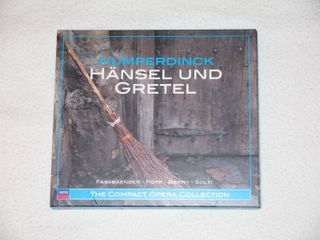
my new Hansel and Gretel cd
Hansel is a children's opera, which makes it all the more remarkable how entertaining and rich a dramatic experience it is for any age. The musical styles range from simple child-like tunes to dense Romantic counterpoint. The most angst-ridden harmonies are used to portray a character being really hungry, though, or missing her mom, rather than any sort of love-death theme. Anyone who has been around little kids much can confirm that they can get just as emotional as a Wagnerian tenor who just fell passionately in love with his sister. It is refreshing to hear such music used for run-of-the mill domestic disputes, rather than the twilight of the gods.
Which is not to say that the opera doesn't get pretty dark at times, touching on child abuse as well as child cannibalism. Those old fairy tales could get pretty grisly, I guess. I would definitely bring a 9 or 10-year old, though - maybe my newborn nephew will even be ready to go see it soon. The music is what brings it to life, and makes me recommend it to anyone curious about opera.

my new Hansel and Gretel cd
Hansel is a children's opera, which makes it all the more remarkable how entertaining and rich a dramatic experience it is for any age. The musical styles range from simple child-like tunes to dense Romantic counterpoint. The most angst-ridden harmonies are used to portray a character being really hungry, though, or missing her mom, rather than any sort of love-death theme. Anyone who has been around little kids much can confirm that they can get just as emotional as a Wagnerian tenor who just fell passionately in love with his sister. It is refreshing to hear such music used for run-of-the mill domestic disputes, rather than the twilight of the gods.
Which is not to say that the opera doesn't get pretty dark at times, touching on child abuse as well as child cannibalism. Those old fairy tales could get pretty grisly, I guess. I would definitely bring a 9 or 10-year old, though - maybe my newborn nephew will even be ready to go see it soon. The music is what brings it to life, and makes me recommend it to anyone curious about opera.
Subscribe to:
Posts (Atom)