Showing posts with label blogs. Show all posts
Showing posts with label blogs. Show all posts
Tuesday, June 09, 2009
hella frisch at the ISB
I've been posting some reports and commentary from the ISB convention at Penn State this week. Please check it out at my satellite site, here.


Saturday, November 08, 2008
discussing "Getting Musicians Involved"
Adaptistration blogger Drew McManus wrote a post this week under the title "Getting Musicians Involved" which addresses concerns I raised last week, in a post on orchestra websites which offer "contact a musician" features.
Drew very thoroughly outlines the steps that management and website administrators could take, to make this a meaningful and useful feature to patrons, and not an unwelcome burden to musicians. I actually think it might empower some musicians to communicate with audience members.
It's worth reading Drew's post as well as its comments, which raise some other interesting questions about this idea. In matters of audience communication, I think, it's not a question of whether we need to do more, but how to do it well -- Drew provides some excellent answers, and as always a forum to discuss them.
Drew very thoroughly outlines the steps that management and website administrators could take, to make this a meaningful and useful feature to patrons, and not an unwelcome burden to musicians. I actually think it might empower some musicians to communicate with audience members.
It's worth reading Drew's post as well as its comments, which raise some other interesting questions about this idea. In matters of audience communication, I think, it's not a question of whether we need to do more, but how to do it well -- Drew provides some excellent answers, and as always a forum to discuss them.
Tuesday, October 28, 2008
rating and writing to orchestras
Drew McManus published a ranking of US and Canadian orchestra websites last week at his Adaptistration blog -- here's his post summarizing the Canadian results, and below is a chart showing his scores for the Calgary Philharmonic website. The blue middle column shows this year's scores:

The one category of Drew's with which I take exception is "Orchestra Information". Here's Drew McManus' explanation of this category:
I don't think playing in a professional orchestra should obligate anyone to publish personal information on a website -- some of us may do this by choice, but it does come at a certain sacrifice of privacy, and sometimes sanity! The Calgary Philharmonic website does feature a series of video clips with members of the orchestra, which I think is an appropriate vehicle to showcase musicians. For visitors trying to know an orchestra better, I think this feature is far more useful than giving out e-mail addresses.

The one category of Drew's with which I take exception is "Orchestra Information". Here's Drew McManus' explanation of this category:
Category 4: Orchestra Information - 15 points maximum
- Learning about an orchestra and having easy access to contact information and educational program information is crucial to an orchestra’s ability to establish meaningful connections with its community.
- This category contains five sub-categories covering biographical and contact information for music directors and musicians. Staff and board listings with related individual contact info were also considered essential as well as providing copies of institutional transparency documents.
I don't think playing in a professional orchestra should obligate anyone to publish personal information on a website -- some of us may do this by choice, but it does come at a certain sacrifice of privacy, and sometimes sanity! The Calgary Philharmonic website does feature a series of video clips with members of the orchestra, which I think is an appropriate vehicle to showcase musicians. For visitors trying to know an orchestra better, I think this feature is far more useful than giving out e-mail addresses.
Saturday, October 25, 2008
the practice room cyborg
Jason Heath wrote a post recently called "Nine Dynamite Practice Room Accessories." He starts with some basics everyone should have: metronome, tuner, a pad of paper -- and then moves on to some more high-tech stuff: iPods, notation and editing software, a laptop computer.
Personally, I don't want a laptop computer anywhere near me when I'm practicing. It's just too much of a distraction visually. I can see how certain functions might be useful, and I know some people who can incorporate computer technology into their practice very effectively; I just don't see the point.
My deeper philosophical argument with all this stuff is that it makes you practice like a robot. If you constantly have a metronome, tuner, or computerized MIDI-file playing along in the practice room, you're training yourself to sound like an electronic device. That might mean more precision and clarity, but I think it's inevitably going to compromise the things a computer can't simulate:
Personally, I don't want a laptop computer anywhere near me when I'm practicing. It's just too much of a distraction visually. I can see how certain functions might be useful, and I know some people who can incorporate computer technology into their practice very effectively; I just don't see the point.
My deeper philosophical argument with all this stuff is that it makes you practice like a robot. If you constantly have a metronome, tuner, or computerized MIDI-file playing along in the practice room, you're training yourself to sound like an electronic device. That might mean more precision and clarity, but I think it's inevitably going to compromise the things a computer can't simulate:
- a warm, rich, resonant sound, with a varied palette of tonal colors
- a sensitivity to inner lines, and harmonic voicing
- a sense of bulding phrases, dynamic contours, and the larger architecture of the piece
You might make a case that these aren't so important, within the specific skill-set demanded to win an audition. I think they matter very much to anyone hoping to have an enjoyable, extended career, because these are some of the main qualities that make orchestra playing enjoyable and fulfilling.
So while I appreciate Jason's suggestions, my own contrarian advice to anyone looking to tech out their practice room is this: give it a try, but don't go crazy. Don't think you can't have a worthwhile practice session without plugging into ever power outlet in the room. And at least one day a week, turn all the gadgets off and just remember the simple joy of drawing sounds out of a big, resonant chunk of wood. No accessories required.
Tuesday, October 21, 2008
Jeff Weisner on brand loyalty

We each have a "brand" to our playing - a basic set of sound and style characteristics that hold true through everything we play. That brand is created from our core technique elements, the influence of our most important teachers and mentors, and our most basic musical preferences. I make the type of sound that I do on the bass because at some level I like it - it feels right to me, for reasons that I honestly can't even define exactly. It developed through my early years of study and my student days. Even as I have developed a more diverse palette of tone colors and styles in my playing, I still keep one foot (or at least a toe) in this core sound concept that I bring to my musical work.
-- excerpt from "Know Your Brand" by Jeff Weisner, Peabody Double Bass Blog
Drawing analogies to bass playing is a favorite pastime of mine, so I have to take up this recent post by Jeff Weisner. Jeff shares some very intriguing ideas about schools of playing, which he likens to political branding. He concludes that even the strongest players might benefit from an honest assessment of their own "brand", and might focus on projecting those qualities in auditions.
Jeff draws a careful distinction between monotonous, one-style-fits-all playing -- perhaps you could call the Steve Forbes school, taking one issue and hammering it mercilessly -- and playing with no real sense of integrity or authenticity, which he likens to John "Flip-Flop" Kerry. That's still a bit of a sore spot for me personally, having really believed in John Kerry in 2004. What we Kerry supporters called "nuance", many others labelled spinelessness -- though I guess we now have the satisfaction of saying, "I told you so."
The kind of playing that Jeff advocates is neither Forbes nor Kerry -- it can have sophistication, style, and nuance, but it never strays from an essential core sound. It's about playing to the audience, but not about saying, "I'll do anything to get your vote." It all comes back to integrity -- of sound, belief, and intention -- and integrity that comes from one's own highest standards, not the standards of some committee we know only from rumors and hearsay.
Jeff doesn't offer any political endorsements of his own -- maybe he's keeping his blog non-partisan, since it's the official mouthpiece of the Peabody Double Bass Department. I wonder how he judges the brand-salesmanship of these two presidential tickets, though. We have one candidate, Obama, who has worked to broaden the appeal of his party's brand, refining their historically polarizing positions on taxes, foreign policy, and social issues. The other styles himself as a "maverick" -- originally a term for un-branded cattle, it's become political-speak for someone willing to buck his party -- and yet he's run a rambling, divisive campaign that's alienated many independent voters as well.
In a year when the Democratic party brand has so many advantages -- largely because the Bush administration has tarnished the Republican brand, as well as the brand of the nation as a whole -- perhaps McCain's best strategy is to run with the brand of the maverick. As Jeff makes clear, though, there are certain advantages to a clear, recognizable brand -- you know what you're selling, and people know what they're getting. When it's a question of security, a clear and confident brand is sometimes enough to carry an audition or an election.
Thoughts?
Sunday, October 19, 2008
week of Oct. 19-25
Alberta Ballet
A Midsummer Night's Dream / music by Felix Mendelssohn
Peter Dala, conductor
Performances Oct. 23, 24, 25 at Southern Alberta Jubilee Auditorium
Tuesday, 21 Oct
10-12:30 rehearsal
2-4:30 rehearsal
Wednesday, 22 Oct
7:30-10 rehearsal
Thursday, 23 Oct
7:30 performance
Friday, 24 Oct
7:30 performance
Saturday, 25 Oct
7:30 performance
I decided to borrow/steal a feature from Michael Hovnanian's Bass Blog which I really like -- every week he'll post a schedule of what he's currently doing. Beyond the obvious value to stalkers, it's a neat way to show what day-to-day life as an orchestral musician is really like. I'm definitely not going to post any practice schedules here, though.
As it happens, I'm on stand-by for this week of ballet performances -- they'll use only 4 bass players for ballet as well as opera, since the Jubilee has a rather small pit. This means I almost certainly won't play any of these services, unless someone in the section is seriously sick or injured.
That means I probably won't be writing here about Mendelssohn or A Midsummer Night's Dream. Do stay tuned though, and please let me know if there's another subject you'd like me to write about!
A Midsummer Night's Dream / music by Felix Mendelssohn
Peter Dala, conductor
Performances Oct. 23, 24, 25 at Southern Alberta Jubilee Auditorium
Tuesday, 21 Oct
10-12:30 rehearsal
2-4:30 rehearsal
Wednesday, 22 Oct
7:30-10 rehearsal
Thursday, 23 Oct
7:30 performance
Friday, 24 Oct
7:30 performance
Saturday, 25 Oct
7:30 performance
I decided to borrow/steal a feature from Michael Hovnanian's Bass Blog which I really like -- every week he'll post a schedule of what he's currently doing. Beyond the obvious value to stalkers, it's a neat way to show what day-to-day life as an orchestral musician is really like. I'm definitely not going to post any practice schedules here, though.
As it happens, I'm on stand-by for this week of ballet performances -- they'll use only 4 bass players for ballet as well as opera, since the Jubilee has a rather small pit. This means I almost certainly won't play any of these services, unless someone in the section is seriously sick or injured.
That means I probably won't be writing here about Mendelssohn or A Midsummer Night's Dream. Do stay tuned though, and please let me know if there's another subject you'd like me to write about!
Wednesday, July 30, 2008
bass blog links
Hella Frisch has been hibernating, I guess, or perhaps outside enjoying Calgary's few months of warm weather. I've been taking a look at some other bass blogs I though, hoping they will get me inspired to write something original soon:
- Jason Heath's Double Bass Blog has a fresh clean look for the summer -- probably this happened months ago, but I usually read it through Google Reader, and so didn't notice. Jason has always been the king of bass-related content, it's just been difficult to wade through it all.
- PBDB, the Peabody Double Bass studio blog, links to a great video by Ira Glass which is relevant to anyone doing creative work. Playing the bass is creative work, right?
- Michael Hovnanian reports on a week of contrasts at Ravinia -- and how video screens tend to draw the audience's attention away from the action on stage:
The Sunday concert was a weird amalgamation of the Schreker Chamber Symphony... and Lang Lang playing a couple of warhorses, the entire lurid spectacle projected onto huge screens. As my attention inevitably wandered, I caught sight of audience members in the center section craning their necks to look at the screens rather than focusing on the stage straight ahead.
There's definitely something to this. I observed the same thing at the Calgary Folk Festival last weekend. Of course, most of us spend a lot of our time watching screens -- you'd think we'd want to take a break at a concert. But there's something instinctual about watching a performer's face, seeing how the expressions change with the music, that you often can't get from 50 rows back. (Though Lang Lang does his best to emote all the way to the back row.)
Tuesday, June 03, 2008
when gigging is a crime
The other day, Jason Heath posted a long confessional piece about his addiction to freelancing, and the often ridiculous lengths he goes to keep taking every gig he possibly can. It's fun reading for anyone who's burnt through some miles with the Freeway Philharmonic:
Instrumental Junkies, part I
I definitely can sympathize with Jason's irrational tendency to gig himself to death, and the emotional torpor of not having any gigs coming up. That's my situation right now, since the CPO season is wrapping up next Saturday -- and I'm legally required not to work for any other employers. That's what my Canadian work permit says, but it's still agonizingly hard to turn down a fun, interesting, or well-paying gig -- legal or not.
This last weekend I was offered a gig with the Player's Chamber Ensemble, a local chamber ensemble organized around the Lily String Quartet. They're a cool bunch of people, and it seemed like good times, the weekend after our season ends -- except for that nagging voice:
"Don't take that gig, you'll be depriving some worthy Canadian!"
That's the reason for that work permit restriction, and it makes a lot of sense. No one wants to see a foreigner swoop in and take good jobs, especially when he's just doing it because he's bored and needs to fill up his schedule. It's arguable how good a job this is ($100 for 4 services doesn't sound especially good) -- but the point is, some Canadian should get a fair chance at it, and I'm not a Canadian.
Luckily I found I had a convenient excuse -- a camping trip next week, which would have forced me to miss the first rehearsal -- and they seem to have found someone willing and legal to play instead. The whole episode made me realize how bad I am at turning down gigs, and how I almost need a really compelling reason to do so -- more than just not enough money, I have no way of getting there, or I dislike the repertoire. It usually has to be something pretty serious, if not life-threatening.
I decided to write a little Cosmo-style survey to help readers determine their own tolerance for turning down gigs. Give yourself one point if you would turn down a gig for each of the following reasons:
Instrumental Junkies, part I
I definitely can sympathize with Jason's irrational tendency to gig himself to death, and the emotional torpor of not having any gigs coming up. That's my situation right now, since the CPO season is wrapping up next Saturday -- and I'm legally required not to work for any other employers. That's what my Canadian work permit says, but it's still agonizingly hard to turn down a fun, interesting, or well-paying gig -- legal or not.
This last weekend I was offered a gig with the Player's Chamber Ensemble, a local chamber ensemble organized around the Lily String Quartet. They're a cool bunch of people, and it seemed like good times, the weekend after our season ends -- except for that nagging voice:
"Don't take that gig, you'll be depriving some worthy Canadian!"
That's the reason for that work permit restriction, and it makes a lot of sense. No one wants to see a foreigner swoop in and take good jobs, especially when he's just doing it because he's bored and needs to fill up his schedule. It's arguable how good a job this is ($100 for 4 services doesn't sound especially good) -- but the point is, some Canadian should get a fair chance at it, and I'm not a Canadian.
Luckily I found I had a convenient excuse -- a camping trip next week, which would have forced me to miss the first rehearsal -- and they seem to have found someone willing and legal to play instead. The whole episode made me realize how bad I am at turning down gigs, and how I almost need a really compelling reason to do so -- more than just not enough money, I have no way of getting there, or I dislike the repertoire. It usually has to be something pretty serious, if not life-threatening.
I decided to write a little Cosmo-style survey to help readers determine their own tolerance for turning down gigs. Give yourself one point if you would turn down a gig for each of the following reasons:
- over 30 miles (50 km) away
- over 60 miles (100 km) away
- over 90 miles (150 km) away
- less than $120 a service
- less than $60 a service
- less than $30 a service
- don't like the repertoire
- don't like the conductor
- don't like your stand partner / section colleagues
- would have to miss best friend's wedding
- would have to miss a great party
- would have to miss a new episode of "The Office"
- your car is in the shop, you'd have to take transit
- your instrument is in the shop, you'd have to borrow one
- you've been hospitalized, you'd have to break doctor's orders
Scoring:
10-15 points: a picky gigger-- you'll turn an orchestra down if it so much as looks at you funny
6-10 points: somewhat selective -- but you'll still juggle some priorities to do a gig
1-5 points: an instrumental junkie -- time to get help
Wednesday, May 28, 2008
the CPO gets Titanic
 This week at the CPO we're playing Mahler 1 with members of the Calgary Youth Symphony -- not the whole CYSO, but still enough to add extra heft to the orchestra. We have 9 basses, 11 horns, 7 oboes (!), and 2 timpanists. The low brass is one of the only non-augmented sections, but telling them that is only going to encourage them to play louder.
So far we haven't rehearsed in the hall, partly because the huge inflatable whale, shown above, was taking up that space. She was part of last week's Kids' Fest, and on Tuesday she got a sponge bath and some other maintenance done indoors. I rushed in to take a photo before they finished, but only had time to catch this dim but suggestive rear-end view.
A couple weeks ago Michael Hovnanian posted on Mahler 1 fatigue, prompting a whole slew of comments and then a follow-up response. I'm not a Mahler 1-hater personally, though that 5-minute C pedal is not one my favorite moments in music. It's certainly one of the most expansive symphonies, in terms of length, the variety of musical ideas, and of course all the Sturm und Drang of the finale.
What I find extraordinary about this symphony, though, are the moments of quirky intimacy -- like that bizarre bass solo, accompanied only by timpani, and answered by tuba, bassoon, and eventually the whole orchestra. It's a bit like crawling up inside a whale (either end) and finding a little old man with a sad story to tell. The other night Chuck played the solo in the final 3 minutes of rehearsal, with the timpani about 50 meters away, and to my ears he got the odd, plaintive expressiveness of the tune just about right. We were rehearsing in an immense Jewish temple in south Calgary, so extra schmaltz seemed appropriate.
Sounding weird is partially the point, I think -- amid all the pageantry and fanfares, it's the weird stuff that keeps me interested in Mahler. Michael praises Haitink's ability to "keep vulgarity from creeping into passages where it has no business," which is very useful for a piece which risks deafening the audience with every huge, ear-splitting climax. Just as important, though, is to get the spiky, contorted, and genuinely vulgar stuff right -- so that all those blistering, euphoric peaks have some gnarled, murky valleys to tower over.
Tuesday, May 06, 2008
silvery muffs
I just discovered that I had been tagged by Michael Hovnanian on his Bass Blog last Friday. He lists the rules of the tag:
The nearest book was Opera as Drama by Joseph Kerman, but I'd sort of rather not be caught out as such a music nerd. Also, page 123 contains a long musical example from a duet between Otello and Desdemona, making the already bizarre and arbitrary rules sort of awkward to follow.
Another relatively nearby book was The Calgary Gardener, published by the Calgary Horticultural Society, which reads as follows:
Jeff White
Lauren Robinson
Mark Kevin Hall
Jason Heath
Denise Cheung and/or Brad Ottesen
I'll be pretty impressed if any of these people even reads this post, since my blog's been chronically sporadic of late. Still, a tag's a tag. And I already broke the first couple rules.
Rules:
1. Pick up the nearest book.
2. Open to page 123.
3. Find the fifth sentence.
4. Post the next three sentences.
5. Tag five people, and acknowledge who tagged you.
The nearest book was Opera as Drama by Joseph Kerman, but I'd sort of rather not be caught out as such a music nerd. Also, page 123 contains a long musical example from a duet between Otello and Desdemona, making the already bizarre and arbitrary rules sort of awkward to follow.
Another relatively nearby book was The Calgary Gardener, published by the Calgary Horticultural Society, which reads as follows:
The leaves are long and tongue shaped, densely covered with white silky hairs and downy to the touch. Quiet and unobtrusive in their silvery muffs, the small purplish flowers are borne in whorls atop long woolly spikes. 'Silver Carpet' is a nonflowering variety.I hope that is satisfactory for your purposes, Mr. Hip Internet Tagger Guy. I in turn will tag:
Jeff White
Lauren Robinson
Mark Kevin Hall
Jason Heath
Denise Cheung and/or Brad Ottesen
I'll be pretty impressed if any of these people even reads this post, since my blog's been chronically sporadic of late. Still, a tag's a tag. And I already broke the first couple rules.
Tuesday, April 08, 2008
Take a Friend to the Orchestra
 Drew McManus, who writes the excellent site Adaptistration - the best place on the web for news, opinion, and inside stuff on orchestras - invited me to write an essay for his annual "Take A Friend To The Orchestra Month" series. My contribution is posted up today - I wrote about inviting my yoga teachers Jeff and Harmony to a CPO concert. They've actually come back for another concert since then, and I'm optimistic I may have hooked some new audience members!
Check out my essay on the Adaptistration website, and be sure to read Maestro Carlos Kalmar's essay as well.
Sunday, December 09, 2007
bass blogroll and Schumann video
I've been delinquent in blogging lately, preoccupied with moving to a new place and trying to find a tenant to take over my lease. In the meantime though, Stan Haskins has started a series of copycat video posts, messing around with weird camera angles and obscure Mendelssohn excerpts! It's an honor to help spread bass geekery around the blogosphere.
And Michael Hovnanian wrote a very entertaining post about orchestral seating arrangements, titled "Bass-Ackward". Just like at a wedding reception, you can never please everyone -- no matter how hard you try, someone's going to get stuck with a trumpet bell aimed at their head, a violin turned the wrong way, or a bass pizzicato going off like a bomb behind their ear.
Since I'm too distracted to write much, I'll post another video of my own. This is a movement from Schumann's Five Pieces in Folk Style, originally for cello and piano, which I worked on with Donald Palma as an undergrad at NEC. Each week, Don would try subtly to dissuade me from playing the piece, pointing out all the awkward compromises in the transcription, but I wouldn't listen. I finally performed it on my junior recital, to the muffled applause of a very charitable audience.
This movement is marked 'Mit Humor', and what could be more humorous than cello music played on the bass? I'll leave it up to my readers to decide whether it's worth bringing it back before the public, or I had better keep it confined to poorly-lit locker rooms.
And Michael Hovnanian wrote a very entertaining post about orchestral seating arrangements, titled "Bass-Ackward". Just like at a wedding reception, you can never please everyone -- no matter how hard you try, someone's going to get stuck with a trumpet bell aimed at their head, a violin turned the wrong way, or a bass pizzicato going off like a bomb behind their ear.
Since I'm too distracted to write much, I'll post another video of my own. This is a movement from Schumann's Five Pieces in Folk Style, originally for cello and piano, which I worked on with Donald Palma as an undergrad at NEC. Each week, Don would try subtly to dissuade me from playing the piece, pointing out all the awkward compromises in the transcription, but I wouldn't listen. I finally performed it on my junior recital, to the muffled applause of a very charitable audience.
This movement is marked 'Mit Humor', and what could be more humorous than cello music played on the bass? I'll leave it up to my readers to decide whether it's worth bringing it back before the public, or I had better keep it confined to poorly-lit locker rooms.
Sunday, November 18, 2007
winterizing hella frisch
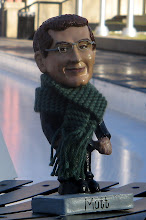
 I've been hoping to give hella frisch a bit more of a Calgary feel - and trying to figure out a good location to photograph the bobble-head.
This was taken at Olympic Plaza, right in front of the Epcor Centre where the Jack Singer Concert Hall is located. That's the best I've come up with so far. It's a bit tricky to capture a mountain range and a 10-inch high ceramic statue in the same shot, but if anyone has suggestions for other locations, please let me know!
If anyone is curious, the bobble-head was made by the people at BobbleMe.com. At their wedding, my sister Zoe and her husband Elliot had the whole wedding party Bobble-ized. The scarf was custom knitted by Calgary Phil violinist Laura Reid (thanks, Laura!)
Tuesday, September 18, 2007
infinite Jason
Most mornings at 7:15 am, I won't have 5 ideas in preparation for blog posts. In fact, I probably won't even remember I have a blog. That's one difference between me and Jason Heath.
Amid Jason's ongoing quest to chronicle, link, interview, video tape, and generally charm the pants off every bass player in existence, it's sometimes possible to forget that Jason is a wickedly awesome bass player himself. Consider this a reminder.
Jason and I go way back - he tells the stories better than I do, though I'm not sure he's done the one about the melting alarm clock yet. Or the late night bass abduction in St. Petersburg. Maybe I'll have to write some content of my own after all.
 Jason was also the one who introduced me to the David Foster Wallace novel Infinite Jest - this huge, kaleidoscopic book about psychedelic drugs, film-making, a tennis academy, and I'm not sure what else. In retrospect, the book seems like a sort of model for Jason's blog (though he hasn't started footnoting his footnotes yet). If Jason ever feels the need to rename his blog, I might respectfully suggest "Infinite Bass."
I don't often link to Jason's blog, not for lack of content (obviously) but mostly assuming that anyone reading here is already familiar with his site. If you're not, hurry on over - you've got a lot of catching up to do.
Amid Jason's ongoing quest to chronicle, link, interview, video tape, and generally charm the pants off every bass player in existence, it's sometimes possible to forget that Jason is a wickedly awesome bass player himself. Consider this a reminder.
Jason and I go way back - he tells the stories better than I do, though I'm not sure he's done the one about the melting alarm clock yet. Or the late night bass abduction in St. Petersburg. Maybe I'll have to write some content of my own after all.
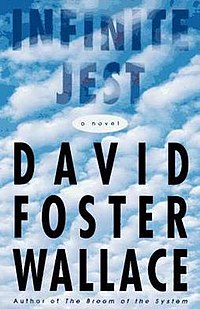 Jason was also the one who introduced me to the David Foster Wallace novel Infinite Jest - this huge, kaleidoscopic book about psychedelic drugs, film-making, a tennis academy, and I'm not sure what else. In retrospect, the book seems like a sort of model for Jason's blog (though he hasn't started footnoting his footnotes yet). If Jason ever feels the need to rename his blog, I might respectfully suggest "Infinite Bass."
I don't often link to Jason's blog, not for lack of content (obviously) but mostly assuming that anyone reading here is already familiar with his site. If you're not, hurry on over - you've got a lot of catching up to do.
Tuesday, September 04, 2007
is it lies, or is it Memorex?
Remember when some teacher said you only use 10% of your brain? She was probably just trying to make you feel lazy. But it's hard not to feel a little cheated, reading this:
That's from a recent article at SFGate.com: "MP3 music - it's better than it sounds" by Joel Selvin. I found my way there this weekend via this other rather contentious blog.
I suppose I'm a member of "the iPod generation" that writer refers to - especially since I transferred my entire CD collection onto a hard drive, just before moving up to Calgary. I had been pretty reticent to do this - my CDs have always been a major decorating feature, strewn all around my apartment. And I really do like to look at something while I'm listening to a CD, even if it's just a note from the performer thanking his Mom.
It was liberating to leave all those boxes behind, though. And if my listening experiences have been lacking in cathartic magic lately, I figured it was mostly because I haven't hooked up any good speakers yet. Well, maybe I need to rethink this - either send for those CDs I left at my parents' house, or give up this wicked compromise we call recorded music altogether.
Music is a bit of a shell game to begin with, I suppose. We love to guess what's coming, to make a deductive leap, and it's almost more thrilling to find we've been mistaken than to have our guess confirmed. There's an amazing deceptive cadence in the Bruckner 8 slow movement, and no matter how many times I hear it, it still gives me goosebumps. Though I haven't listened to it yet in MP3 - I wonder if they compressed out all the goosebumps?
Our imaginations can't do all the work - even the most dedicated audiophile is bound to discover something new by hearing it live. My question is, at what point is recorded sound not worth the microchips it's printed on? Are we consuming a bland, artificially flavored, frozen-food version of music? Al Schmitt describes what a listening experience should be:
Whether you know it or not, that compact disc you just copied to your MP3 player is only partially there.
...the music contained in these [MP3] computer files represents less than 10 percent of the original music on the CDs. In its journey from CD to MP3 player, the music has been compressed by eliminating data that computer analysis deems redundant, squeezed down until it fits through the Internet pipeline.When even the full files on the CDs contain less than half the information stored to studio hard drives during recording, these compressed MP3s represent a minuscule fraction of the actual recording. For purists, it's the dark ages of recorded sound.
"You can get used to awful," says record producer Phil Ramone. "You can appreciate nothing. We've done it with fast food."
That's from a recent article at SFGate.com: "MP3 music - it's better than it sounds" by Joel Selvin. I found my way there this weekend via this other rather contentious blog.
I suppose I'm a member of "the iPod generation" that writer refers to - especially since I transferred my entire CD collection onto a hard drive, just before moving up to Calgary. I had been pretty reticent to do this - my CDs have always been a major decorating feature, strewn all around my apartment. And I really do like to look at something while I'm listening to a CD, even if it's just a note from the performer thanking his Mom.
It was liberating to leave all those boxes behind, though. And if my listening experiences have been lacking in cathartic magic lately, I figured it was mostly because I haven't hooked up any good speakers yet. Well, maybe I need to rethink this - either send for those CDs I left at my parents' house, or give up this wicked compromise we call recorded music altogether.
"[Digitally compressed music] turns you into an observer," [John] Meyer [of Berkeley Labs] says. "It forces the brain to work harder to solve it all the time. Any compression system is based on the idea you can throw data away, and that's proved tricky because we don't know how the brain works."My impression is that record engineering is more of an art than a science - an art with many acknowledged masters, such as Phil Ramone and Al Schmitt whom the article quotes. In any art form, some of the hardest decisions are what gets minimized, compressed, or even left out. The performers struggle with those same decisions - we can't stretch out every chord or modulation we really love (especially if we're on a click track!). And the composer has already made many of those choices, giving us places where a note or phrase is just implied, and trusts the performer and audience to fill in the gaps.
Music is a bit of a shell game to begin with, I suppose. We love to guess what's coming, to make a deductive leap, and it's almost more thrilling to find we've been mistaken than to have our guess confirmed. There's an amazing deceptive cadence in the Bruckner 8 slow movement, and no matter how many times I hear it, it still gives me goosebumps. Though I haven't listened to it yet in MP3 - I wonder if they compressed out all the goosebumps?
Our imaginations can't do all the work - even the most dedicated audiophile is bound to discover something new by hearing it live. My question is, at what point is recorded sound not worth the microchips it's printed on? Are we consuming a bland, artificially flavored, frozen-food version of music? Al Schmitt describes what a listening experience should be:
"When you listen to a world-class symphony or a good jazz record," says Schmitt, "and you hear all the nuance in the voices, the fingers touching the string on the bass, the key striking the string on the piano, that's just a wonderful sensation."I don't think I've heard all that stuff in a recording for a long time. I miss it - and I get to hear the real thing every day!
Tuesday, August 28, 2007
more about MoM
For another take on Sunday's concert - and a new blog worth bookmarking - check out "Fiasco! (?)" by Jeff White. Jeff's blog The Philharmonist promises more context and criticism (plus cartoons!) than I'm prepared to give about the CPO. I'm still learning my way around the building!
Sunday, August 26, 2007
Juliet winced

When she read the letter, Juliet winced, as anybody does on discovering the preserved and disconcerting voice of some past fabricated self. She wondered at the sprightly cover-up, contrasting with the pain of her memories. Then she thought that some shift must have taken place, at that time, which she had not remembered. Some shift concerning where home was...I've been reading the Canadian author Alice Munro lately - all these incredibly nuanced stories of closely held secrets and privately lived lives. She makes you see the ultimate absurdity of how we conceal so much within ourselves, just to go on living in our ordinary, tolerable way. And when things become intolerable, how quickly our secrets can collapse in on us!
Because it's what happens at home that you try to protect, as best you can, for as long as you can.
- Alice Munro, from the short story "Soon", collected in Runaway, p. 125
I don't want to overdramatize my own little secrets - probably I have nothing quite worthy of an Alice Munro story, so far. But since several people made such thoughtful and understanding comments to my post the other day, I wanted to write a little about why I enjoy this sometimes silly hobby, and what I see as this blog's mission, just supposing it were worthy of anything so grand-sounding as a "mission".
The most astonishing thing about blogging is the people who read me - I'm continually amazed at the depth and care put into responses on this blog. While I don't always directly answer each comment, they always seem to make me laugh, wonder, or think again about what I wrote. How often I've just written something on a whim, on any sort of obscure subject matter I might imagine, and then quickly found an answer from some passionate authority on that very subject - Martinu's chamber music, or Schoenberg's personal relationships, or bowings in the Bach cello suites - and realized there's no subject too obscure, too bizarre (or even too personal) - that it won't strike a chord in someone.
Of course, as amazing as can be to reach into cyberspace and discover some kindred soul out there in the void, I don't really write this for strangers or fanatics. (Sorry, strangers and fanatics!) Mostly I think about those readers who I already know well, either from real-life acquaintances or from reading and following their own blogs, sometimes both. It's fascinating to develop that kind of multi-level relationship with someone - discovering that a person you really like in person has whole other dimensions in cyberspace.
And I suppose that writing here gives me a chance to explore dimensions I don't readily show in person. Or even quite realize were there. I love that Walt Whitman line -
Do I contradict myself?and I think that blogging is an opportunity to air one's multitudes, try them out on an understanding or indifferent audience.
Very well, then I contradict myself,
I am large, I contain multitudes.
I suppose that's what makes blogging a bit scary, too. You never know when you might air some aspect of yourself that irritates, displeases, or offends someone. And as much of a pleasure it is to receive a comment, either from an old friend or a complete stranger, as I start to read them I'm always a bit wary that maybe I've rubbed someone the wrong way, or bared a little too much of my soul this time. Thankfully I've very seldom had that experience, but I know many people who have found themselves the target of nasty and personal attacks - and I can understand the chilling effect those voices might have.
I suppose any time we write to express ourselves, it's a more or less fabricated self we express. Even a writer as gifted as Alice Munro can only hint at what goes on inside of us. Still though, I think the writing of which I'm most proud, and wince the least at, is when I've honestly made that effort. It's not easy, and you sometimes have to fight every self-protective instinct to press "publish", but still it can be worth it.
So I think I'll keep writing - maybe I'll have change some names or be coy with some details, but there's no point having an outlet if you can't actually let things out. And if I write enough long, self-conscious posts like this, I might just bore all the critics away! One can hope.
Wednesday, May 16, 2007
letters, stories, and housekeeping
Thanks to everyone who has been reading and commenting on my Calgary audition story! I'll have another installment later today, and then maybe one more to wrap it up before the weekend.
In the meantime, check out Michael Hovnanian's CSO Bass Blog, for the latest part of our inter-blog dialogue on transitioning to life in a professional orchestra. This week, Michael answers my question about standards of preparation and sight-reading - I was really curious about this topic, because I am trying to become a better sight-reader, without sacrificing all that intense and detailed practice we do for auditions. Michael has a great answer, and manages to reference art forgery, rock climbing, and a cringe-worthy audition story of his own.
Jason Heath's Double Bass Blog also linked to an older post I wrote, "eavesdropping on a French horn god." I had forgotten I wrote this, but I think it has some excellent advice - and as one reader pointed, even the typos are pretty good.
 One last piece of housekeeping news: I'm going to the ISB Bass Convention in Oklahoma City next month! It's being held at Oklahoma City University's Bass School of Music - just in case you needed a little more bass. I'm looking forward to meeting some people, hearing some performances and talks, and probably blogging about it as well. If you're planning on coming, please drop me a message or say hello if you see me. Thanks!
In the meantime, check out Michael Hovnanian's CSO Bass Blog, for the latest part of our inter-blog dialogue on transitioning to life in a professional orchestra. This week, Michael answers my question about standards of preparation and sight-reading - I was really curious about this topic, because I am trying to become a better sight-reader, without sacrificing all that intense and detailed practice we do for auditions. Michael has a great answer, and manages to reference art forgery, rock climbing, and a cringe-worthy audition story of his own.
Jason Heath's Double Bass Blog also linked to an older post I wrote, "eavesdropping on a French horn god." I had forgotten I wrote this, but I think it has some excellent advice - and as one reader pointed, even the typos are pretty good.
 One last piece of housekeeping news: I'm going to the ISB Bass Convention in Oklahoma City next month! It's being held at Oklahoma City University's Bass School of Music - just in case you needed a little more bass. I'm looking forward to meeting some people, hearing some performances and talks, and probably blogging about it as well. If you're planning on coming, please drop me a message or say hello if you see me. Thanks!
Saturday, May 05, 2007
Finales, sandwiches and pickles
Tonight is the final New World Symphony concert of the season:
Dvorak Carnival Overture, conducted by Steven Jarvi
Strauss Four Last Songs, with Renee Fleming
Sibelius 2nd Symphony
The Strauss and Sibelius are conducted by MTT, and I couldn't have asked for a more wonderful and moving concert to be my last! I don't have much time to write now, but I want to draw your attention to some interesting recent posts at the CSO Double Bass Blog by Michael Hovnanian - he writes about new music programming and the tendency to package those less familiar pieces besides, or even within, the standard rep warhorses.
And Jason Heath's Double Bass Blog, always pushing the frontiers of technology and interaction for the bassist community, has just made a new inroad - onto the sidebar of hella frisch! You'll find something called a "Podcast Pickle", which will play you Jason's fantastic interviews and tastefully chosen recordings as you skim for readable portions of my blog!
More to come soon, including the next installment of my Calgary audition story!
Dvorak Carnival Overture, conducted by Steven Jarvi
Strauss Four Last Songs, with Renee Fleming
Sibelius 2nd Symphony
The Strauss and Sibelius are conducted by MTT, and I couldn't have asked for a more wonderful and moving concert to be my last! I don't have much time to write now, but I want to draw your attention to some interesting recent posts at the CSO Double Bass Blog by Michael Hovnanian - he writes about new music programming and the tendency to package those less familiar pieces besides, or even within, the standard rep warhorses.
And Jason Heath's Double Bass Blog, always pushing the frontiers of technology and interaction for the bassist community, has just made a new inroad - onto the sidebar of hella frisch! You'll find something called a "Podcast Pickle", which will play you Jason's fantastic interviews and tastefully chosen recordings as you skim for readable portions of my blog!
More to come soon, including the next installment of my Calgary audition story!
Wednesday, April 25, 2007
Charles Noble, blogging the audition circuit
These past couple of days I have been enjoying "daily observations", the blog of Oregon Symphony violist Charles Noble. My friend and fellow bassist blogger Jason Heath drew my attention to Charles' account of the Seattle Symphony Assistant Principal Viola audition, which he took a couple of weeks ago. I won't give away the outcome here - Charles did a fantastic job of developing all the suspense and intrigue, as well as the humor and mishaps in his audition story. As he notes in his last post,
I love reading about how another musician has struggled with all these steps in the process - and realizing that maybe there is another round I hadn't considered. Maybe call it the "framing your story" round, and it happens after you leave the hall, get home, unpack your bags. Of course you're going to have to tell a lot of people how it went, what you played, who you saw, what you learned... Most important though is what you tell yourself - how honestly you can appraise your own attitudes and performance, and use those insights to build your hopes and confidence, not destroy them.
It's worth reading Charles' posts as he wrote them - but once you read one, you probably won't be able to stop until you've finished all four! Here they are in order:
I have also just added a couple of blogs to my list over at the right - if you haven't visited them yet, please check out Michael Hovnanian's CSO Bass Blog and Gabrielle's Lone Oboe blog!
It was good to be in this position again and realized that every one of those anonymous players behind the screen is a real person with dreams and obligations. They desperately want the job that they’re here for, and as a past and future audition committee member, it is absolutely essential that I keep that in mind the next time I’m listening to a long round of auditions and get impatient or arrogant.Each of those anonymous candidates has a unique story - and reading Charles' account was an inspiration. My experience of auditioning has been that, even when you don't get past the prelims, you go through lots of rounds: there's the "convincing yourself you can win" round; the "making travel plans round"; the "not getting too freaked out by all the other candidates" round. Any one of these can knock a person out, sabotage our audition hopes before we've played a single note!
I love reading about how another musician has struggled with all these steps in the process - and realizing that maybe there is another round I hadn't considered. Maybe call it the "framing your story" round, and it happens after you leave the hall, get home, unpack your bags. Of course you're going to have to tell a lot of people how it went, what you played, who you saw, what you learned... Most important though is what you tell yourself - how honestly you can appraise your own attitudes and performance, and use those insights to build your hopes and confidence, not destroy them.
It's worth reading Charles' posts as he wrote them - but once you read one, you probably won't be able to stop until you've finished all four! Here they are in order:
1. auditioning for middle-farts
2. auditioning for middle-farts, part deux
3. auditioning for middle-farts, part troix
4. a.f.m.f - climax and dénouement
I have also just added a couple of blogs to my list over at the right - if you haven't visited them yet, please check out Michael Hovnanian's CSO Bass Blog and Gabrielle's Lone Oboe blog!
Subscribe to:
Posts (Atom)