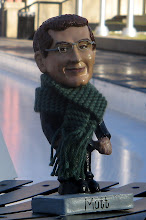
This weekend the CPO performs Don Quixote, the Strauss tone poem that is really more like a tone-novel. It's hard to think of another piece of symphonic music that ties together so many stories, characters, and conversations -- all while maintaining a fairly straightforward theme and variations structure, though with some odd twists.
Among the odd things in the bass part of Don Quixote is the indication on page 1 that the section should put on mutes. The mutes remain on through two pages of loud, melodic bass lines, covering a wide register. You would think he made a mistake, as we're asked to play fff (basically as loud as humanly possible), but he repeats the instruction, two more times: mit dampfer, meaning keep the mutes on!
Unlike brass mutes, bass mutes often won't cut the sound a great deal. What they do is to alter and impede the vibrations of the bridge, and so they have a greater effect on the color of the instrument. When played softly, as they most commonly are, mutes give the bass a somewhat subdued, veiled tone. When a bass is played loudly with a mute, however, there's an almost comical quality of struggle and tension, like a duck squawking madly. During loud playing, the vibration of the bridge may actually dislodge a wood mute and send it flying off the instrument. More often, we use rubber mutes which stay on the bridge a little better, but won't change the sound as much.
I think that Strauss was looking for that quality of hapless squawking, the orchestrational equivalent of tilting at windmills -- and so I'm a bit disappointed when we ignore the mute indication and just play it normally. Sure, it's a strange and senseless think to demand, and only the most perceptive and informed listeners will notice the difference -- and yet it's a brilliant way of depicting a strange, senseless person who makes a habit of struggling against inanimate objects. (Which would be a fairly accurate description of bass players in general...)
The concert tonight features a fantastic soloist, our own principal cellist Phil Hansen. Tickets may still be available, check out the CPO website for more information!
Showing posts with label Calgary Philharmonic. Show all posts
Showing posts with label Calgary Philharmonic. Show all posts
Friday, March 20, 2009


Tuesday, October 28, 2008
rating and writing to orchestras
Drew McManus published a ranking of US and Canadian orchestra websites last week at his Adaptistration blog -- here's his post summarizing the Canadian results, and below is a chart showing his scores for the Calgary Philharmonic website. The blue middle column shows this year's scores:

The one category of Drew's with which I take exception is "Orchestra Information". Here's Drew McManus' explanation of this category:
I don't think playing in a professional orchestra should obligate anyone to publish personal information on a website -- some of us may do this by choice, but it does come at a certain sacrifice of privacy, and sometimes sanity! The Calgary Philharmonic website does feature a series of video clips with members of the orchestra, which I think is an appropriate vehicle to showcase musicians. For visitors trying to know an orchestra better, I think this feature is far more useful than giving out e-mail addresses.

The one category of Drew's with which I take exception is "Orchestra Information". Here's Drew McManus' explanation of this category:
Category 4: Orchestra Information - 15 points maximum
- Learning about an orchestra and having easy access to contact information and educational program information is crucial to an orchestra’s ability to establish meaningful connections with its community.
- This category contains five sub-categories covering biographical and contact information for music directors and musicians. Staff and board listings with related individual contact info were also considered essential as well as providing copies of institutional transparency documents.
I don't think playing in a professional orchestra should obligate anyone to publish personal information on a website -- some of us may do this by choice, but it does come at a certain sacrifice of privacy, and sometimes sanity! The Calgary Philharmonic website does feature a series of video clips with members of the orchestra, which I think is an appropriate vehicle to showcase musicians. For visitors trying to know an orchestra better, I think this feature is far more useful than giving out e-mail addresses.
Sunday, October 26, 2008
week of Oct. 26 - Nov. 1
Classics # 2: Fauré's Requiem
Gustav Mahler: Rückert Lieder
Richard Strauss: Five Songs; Ständchen, An Die Nacht, Wiegenlied, Cäcilie, Morgen
Gabriel Fauré: Requiem, op. 48
Joseph Flummerfelt, conductor
Erin Wall, soprano
Philip Torre, baritone
Calgary Philharmonic Chorus
Performances: Friday, Oct. 31st and Saturday, Nov. 1st, 8 pm at Jack Singer Concert Hall
Tuesday, 28 October
10-12:30 rehearsal
2-4:30 rehearsal
Wednesday, 29 October
10-12 rehearsal
7-9:30 rehearsal
Thursday, 30 October
10-12 rehearsal
7-9:30 rehearsal
Friday, 31 October
8 pm concert
Saturday, 1 November
8 pm concert
This is one of the programs for which I wrote a blurb in the season brochure. Here's my original copy:
Here's the final, much improved version:
Gustav Mahler: Rückert Lieder
Richard Strauss: Five Songs; Ständchen, An Die Nacht, Wiegenlied, Cäcilie, Morgen
Gabriel Fauré: Requiem, op. 48
Joseph Flummerfelt, conductor
Erin Wall, soprano
Philip Torre, baritone
Calgary Philharmonic Chorus
Performances: Friday, Oct. 31st and Saturday, Nov. 1st, 8 pm at Jack Singer Concert Hall
Tuesday, 28 October
10-12:30 rehearsal
2-4:30 rehearsal
Wednesday, 29 October
10-12 rehearsal
7-9:30 rehearsal
Thursday, 30 October
10-12 rehearsal
7-9:30 rehearsal
Friday, 31 October
8 pm concert
Saturday, 1 November
8 pm concert
This is one of the programs for which I wrote a blurb in the season brochure. Here's my original copy:
Savour Faure's exquisite Requiem, a transcendent meditation on life, death, and the beyond. Faure envisioned death as "a happy deliverance, an aspiration towards happiness above." Grammy Award-winning conductor Joseph Flummerfelt leads the CPO, chorus, and distinguished soloists in this stirring autumnal masterpiece.When you have a 40-word limit, every word has to be well-chosen. It was probably a mistake to use the word "death" twice, though I may have been going for a Halloween tie-in. Note also my use of the Canadian spelling for "savour", which also did not clear the editing process.
Here's the final, much improved version:
Fauré's exquisite Requiem expresses the feeling of human faith in eternal rest. Grammy Award-winning conductor Joseph Flummerfelt leads this stirring concert of vocal splendour with soprano Erin Wall and baritone Philip Torre.
Wednesday, October 22, 2008
keeping score at the symphony
I have a dream: it's the end of the 2nd period at a Calgary Flames home game in late November. Some people in the crowd start to get up to stretch or use the washroom, but they stop and turn as the scoreboard lights up with a huge logo:
 People return to their seats as a voice announces: "We now take you live to the Jack Singer Concert Hall, where the Calgary Philharmonic under Roberto Minczuk are midway through the 3rd movement of Beethoven's 5th Symphony..."
The sound of a somber A-flat chord rises on the PA system, as the screen goes to video of a violin section playing a hesitant figure, then the conductor sculpting a questioning phrase. There's a palpable air of suspense, as the screen moves to a close-up shot of the timpanist's hand, playing a repeated low G. Hockey players from both teams are skating onto the ice to get a better view, as the harmony shifts to a dominant chord and with an incredible swell, finally arrives at a big beautiful C Major chord -- the finale has begun! -- the crowd is on their feet, cheering wildly, as all the hockey players exchange high-fives.
Okay, so it's not very likely -- still, it's nice to fantasize. Orchestra concerts inevitable go head-to-head against major sporting events, and so we face a conundrum: should we announce the score from the stage, and risk alienating the people who came to the concert specifically to avoid hearing about sports? Or should we ignore the big game, and let the sports addicts pull out their BlackBerries and portable radios?
I personally don't mind if a conductor wants to give the score after intermission, though I'd rather not hear updates after every piece. Members of the orchestra are often just as interested -- I've heard anecdotes about musicians playing with ear-bud headphones in, or radios attached to tuning pegs, and whispering across the stage after a home run or goal. I hope I never get that obsessive about a sporting event, though I can't begrudge others their addictions.
What I would really like to see, though, is some equity -- why not give hockey or baseball fans a little taste of what they're missing, or a preview of what they could hear tomorrow night? I think Beethoven could hold his own against one of those silly mascot races any day.
 People return to their seats as a voice announces: "We now take you live to the Jack Singer Concert Hall, where the Calgary Philharmonic under Roberto Minczuk are midway through the 3rd movement of Beethoven's 5th Symphony..."
The sound of a somber A-flat chord rises on the PA system, as the screen goes to video of a violin section playing a hesitant figure, then the conductor sculpting a questioning phrase. There's a palpable air of suspense, as the screen moves to a close-up shot of the timpanist's hand, playing a repeated low G. Hockey players from both teams are skating onto the ice to get a better view, as the harmony shifts to a dominant chord and with an incredible swell, finally arrives at a big beautiful C Major chord -- the finale has begun! -- the crowd is on their feet, cheering wildly, as all the hockey players exchange high-fives.
Okay, so it's not very likely -- still, it's nice to fantasize. Orchestra concerts inevitable go head-to-head against major sporting events, and so we face a conundrum: should we announce the score from the stage, and risk alienating the people who came to the concert specifically to avoid hearing about sports? Or should we ignore the big game, and let the sports addicts pull out their BlackBerries and portable radios?
I personally don't mind if a conductor wants to give the score after intermission, though I'd rather not hear updates after every piece. Members of the orchestra are often just as interested -- I've heard anecdotes about musicians playing with ear-bud headphones in, or radios attached to tuning pegs, and whispering across the stage after a home run or goal. I hope I never get that obsessive about a sporting event, though I can't begrudge others their addictions.
What I would really like to see, though, is some equity -- why not give hockey or baseball fans a little taste of what they're missing, or a preview of what they could hear tomorrow night? I think Beethoven could hold his own against one of those silly mascot races any day.
Sunday, June 08, 2008
rained out in the Badlands
Yesterday's concert in Drumheller was cancelled due to the weather -- always a huge disappointment, especially since it was to be the last concert of the season, and the last concert of their CPO careers for retiring violinists Alana Gralen and Susan Light, and cellist Yuri Gindin. Also, Jim Scott was going to perform a trombone concerto by Launy Grondahl -- that will hopefully be rescheduled in the fall. I shot some video while waiting to see if the thunderstorms would clear. Finally, management decided it was unsafe to proceed with the concert, so I also have a shot of some audience members heading home. Hopefully we can make it up to them next season.
Thursday, June 05, 2008
bread and butter Beethoven
This Saturday's Beethoven in the Badlands concert in being conducted by CPO resident conductor Pierre Simard -- but the parts for the main piece on the program, Beethoven's 2nd Symphony, were heavily edited by our baroque series conductor, Ivars Taurins. I've written about Ivars' markings before -- some might criticize him as overly fussy, but they tend to get him what he wants, right away. The main ones are as follows:
Pierre remarked that he was going for more of a 'bread and butter' Beethoven, which quickly got turned back at him with all sorts of variations -- after he suggested some ornamentation in the opening Adagio, a bassoonist said, "I thought you wanted meat and potatoes," then others suggested rice and beans, beer and pretzels, black and tan, etc. I would have preferred lox and schmear, though that might be the Ivars markings talking.
After reading through the first movement, Pierre quickly realized that he was working with a pre-installed interpretation, and a bit of rehearsal time was spent cleaning up some of the squiggles and dashes. Most of them make sense musically -- a lot of them would probably be done automatically, without being marked. But having them in the part leads to a bit of an exaggerated effect, as though I were to write my BLOG with all the IMPORTANT words marked for EMPHASIS!!
/ -- Ivars calls this one a stress
u -- a 'de-stress', a saucer shape often confused for an up-bow
^^^^ -- a squiggly line meaning 'do something interesting'; I like to call it a schmearando
Pierre remarked that he was going for more of a 'bread and butter' Beethoven, which quickly got turned back at him with all sorts of variations -- after he suggested some ornamentation in the opening Adagio, a bassoonist said, "I thought you wanted meat and potatoes," then others suggested rice and beans, beer and pretzels, black and tan, etc. I would have preferred lox and schmear, though that might be the Ivars markings talking.
Wednesday, June 04, 2008
cowboys and obscure Indian music
This week the CPO is wrapping up the season with a few run-out concerts -- Pops in the Park at the Heritage Park Historical Village yesterday evening and today, then Beethoven in the Badlands in Drumheller on Saturday. (We kind of have an alliteration addiction at the CPO.) You can find more details at the CPO's website.
One of the pieces on the Pops in the Park program is the third movement from the Edward MacDowell Indian Suite. Looking the piece up on Google, there's not a whole lot -- though there is this review of a New York Philharmonic performance in 1914:
For our Pops concert, the piece fit into a Western, cowboy-themed program. Conductor Pierre Simard tends to sneak in works that are bizarrely obscure, though thematically connected, on pops programs. (For example, there was his infamous sheep program.) Introducing MacDowell's "Indian Suite", Pierre didn't bring up the whole legacy of white oppression and cultural appropriation. Instead, he mentioned that he had never heard the piece before that morning, nor had anyone in the orchestra. It seemed like a slightly embarrassing thing to admit, though I'm not sure if it's more embarrassing for us or for Edward MacDowell, who seems to have fallen somewhat out of fashion since 1914. The audience may have been a little astonished that we'd thrown it together on so little rehearsal. Still, they seemed to enjoy hearing the piece, in a measured, discriminate sort of way.
One of the pieces on the Pops in the Park program is the third movement from the Edward MacDowell Indian Suite. Looking the piece up on Google, there's not a whole lot -- though there is this review of a New York Philharmonic performance in 1914:
I suppose a piece based on the music of an entire race -- or many races, since 'Indian' covers a huge variety of people and cultures -- is bound to be a bit racist. Or at least attract some racist music reviews. Worth noting here, though, is the use of the barbed compliment, that critic's trick of starting out positive then slipping in a nasty little aside. Usually it's some disparaging remark about the horn section, but here an entire civilization gets slammed.MacDowell's suite was heard with interest and pleasure. It does not, in the course of time, seem quite to justify the unmeasured praises of his indiscriminate admirers; but it is perhaps his best piece of orchestral writing. In nothing else has he written with so sure a touch and with so ample a command of rich, delicate, and varied color. The suite is especially valuable as a demonstration of what can be done with "Indian music" as artistic material. Indian music is mostly not very musical -- hard, rude, and unyielding to treatment. It was not, in truth, very plastic in MacDowell's hands; but nobody else has treated it with so much skill or so much success. He has molded it into something really musical, and has given the several movements something of the character that he sought and expressed in their titles. But it is to be observed that after this suite he did not throw himself heart and soul into making "American music" out of Indian tunes, and seems to have thought this experiment in ethnology sufficiently successful to leave without a successor.
-- from the New York Times archives online: "Philharmonic Concert: MacDowell's Indian Suite Heard", December 7, 1914
For our Pops concert, the piece fit into a Western, cowboy-themed program. Conductor Pierre Simard tends to sneak in works that are bizarrely obscure, though thematically connected, on pops programs. (For example, there was his infamous sheep program.) Introducing MacDowell's "Indian Suite", Pierre didn't bring up the whole legacy of white oppression and cultural appropriation. Instead, he mentioned that he had never heard the piece before that morning, nor had anyone in the orchestra. It seemed like a slightly embarrassing thing to admit, though I'm not sure if it's more embarrassing for us or for Edward MacDowell, who seems to have fallen somewhat out of fashion since 1914. The audience may have been a little astonished that we'd thrown it together on so little rehearsal. Still, they seemed to enjoy hearing the piece, in a measured, discriminate sort of way.
Monday, June 02, 2008
young people today
Among young-ish orchestral musicians, "youth orchestra" can sometimes sound like an insult. We don't want to be confused with the students, eager but unseasoned, which that phrase suggests. At the New World Symphony especially, people would get quite angry over the idea that we were just another youth orchestra -- "America's Orchestral Training Academy" sounded, to some sensitive ears, like a fancy way of saying exactly that.
This is all despite the fact that youth orchestras can be quite wonderful things. For most orchestra players, our earliest inspiration to pursue this career came in a youth orchestra. There's an amazing chemistry in a room full of young people, interpreting a piece of music as though it's just been written, even though it's much older than they are. And some of the most exciting orchestras performing today -- like the Verbier Festival Orchestra, the Simon Bolivar Youth Orchestra, and New World Symphony itself (sorry, guys) -- are essentially youth orchestras.
This weekend the CPO played Mahler 1 with the Calgary Youth Orchestra, as a side-by-side deal -- the concert received a very positive review in the Herald, and also a human interest story on some parents and children taking the stage together. There was a warm feeling of generational camaraderie; the CYO kids performed with a lot of dignity and professionalism, while the CPO played with more energy and enthusiasm than we might muster on an average night.
After the Saturday concert, we had a season-ending party honoring several veteran members of the CPO, three retiring this year and another two receiving their 25-year pins. These kinds of milestones tend to make people feel philosophical, pondering all those passages of time, energy, wisdom, and tricky accidental-strewn Mahler we undergo in the course of a career. One after the other, they all said very kind, gracious things about the younger musicians who've joined the CPO in the last few years, and how they'd been motivated to give a little extra themselves, meeting all these new, enthusiastic players.
I suppose I'm one of those new members -- though already there are a lot of CPO musicians younger than me! -- and it's cool to hear that we've made a positive difference for the more senior membership. Just like there's a stereotype of young players -- raw, brash, rushing, overplaying -- there's one for older players too, and it's no less denigrating. The CPO has a lot of long-time members who are still very active musically, technically proficient and passionate about orchestral playing though. Maybe it's time to toss out the stereotypes.
This is all despite the fact that youth orchestras can be quite wonderful things. For most orchestra players, our earliest inspiration to pursue this career came in a youth orchestra. There's an amazing chemistry in a room full of young people, interpreting a piece of music as though it's just been written, even though it's much older than they are. And some of the most exciting orchestras performing today -- like the Verbier Festival Orchestra, the Simon Bolivar Youth Orchestra, and New World Symphony itself (sorry, guys) -- are essentially youth orchestras.
This weekend the CPO played Mahler 1 with the Calgary Youth Orchestra, as a side-by-side deal -- the concert received a very positive review in the Herald, and also a human interest story on some parents and children taking the stage together. There was a warm feeling of generational camaraderie; the CYO kids performed with a lot of dignity and professionalism, while the CPO played with more energy and enthusiasm than we might muster on an average night.
After the Saturday concert, we had a season-ending party honoring several veteran members of the CPO, three retiring this year and another two receiving their 25-year pins. These kinds of milestones tend to make people feel philosophical, pondering all those passages of time, energy, wisdom, and tricky accidental-strewn Mahler we undergo in the course of a career. One after the other, they all said very kind, gracious things about the younger musicians who've joined the CPO in the last few years, and how they'd been motivated to give a little extra themselves, meeting all these new, enthusiastic players.
I suppose I'm one of those new members -- though already there are a lot of CPO musicians younger than me! -- and it's cool to hear that we've made a positive difference for the more senior membership. Just like there's a stereotype of young players -- raw, brash, rushing, overplaying -- there's one for older players too, and it's no less denigrating. The CPO has a lot of long-time members who are still very active musically, technically proficient and passionate about orchestral playing though. Maybe it's time to toss out the stereotypes.
Wednesday, May 28, 2008
the CPO gets Titanic
 This week at the CPO we're playing Mahler 1 with members of the Calgary Youth Symphony -- not the whole CYSO, but still enough to add extra heft to the orchestra. We have 9 basses, 11 horns, 7 oboes (!), and 2 timpanists. The low brass is one of the only non-augmented sections, but telling them that is only going to encourage them to play louder.
So far we haven't rehearsed in the hall, partly because the huge inflatable whale, shown above, was taking up that space. She was part of last week's Kids' Fest, and on Tuesday she got a sponge bath and some other maintenance done indoors. I rushed in to take a photo before they finished, but only had time to catch this dim but suggestive rear-end view.
A couple weeks ago Michael Hovnanian posted on Mahler 1 fatigue, prompting a whole slew of comments and then a follow-up response. I'm not a Mahler 1-hater personally, though that 5-minute C pedal is not one my favorite moments in music. It's certainly one of the most expansive symphonies, in terms of length, the variety of musical ideas, and of course all the Sturm und Drang of the finale.
What I find extraordinary about this symphony, though, are the moments of quirky intimacy -- like that bizarre bass solo, accompanied only by timpani, and answered by tuba, bassoon, and eventually the whole orchestra. It's a bit like crawling up inside a whale (either end) and finding a little old man with a sad story to tell. The other night Chuck played the solo in the final 3 minutes of rehearsal, with the timpani about 50 meters away, and to my ears he got the odd, plaintive expressiveness of the tune just about right. We were rehearsing in an immense Jewish temple in south Calgary, so extra schmaltz seemed appropriate.
Sounding weird is partially the point, I think -- amid all the pageantry and fanfares, it's the weird stuff that keeps me interested in Mahler. Michael praises Haitink's ability to "keep vulgarity from creeping into passages where it has no business," which is very useful for a piece which risks deafening the audience with every huge, ear-splitting climax. Just as important, though, is to get the spiky, contorted, and genuinely vulgar stuff right -- so that all those blistering, euphoric peaks have some gnarled, murky valleys to tower over.
Tuesday, May 06, 2008
musical couches
I recently had the opportunity to meet with Dr. Chris Wuerscher, the psychologist, choir member, and CPO board member who offered his services to orchestra members in January -- inspiring conductor Bill Eddins to write about "Calgary's Brilliant Move":
It turns out Dr. Chris isn't primarily interested in treating musicians' neuroses -- though he's not opposed to it -- but more in talking about music and how it functions in our lives. We talked about the ephemeral qualities that make for a great performance, the ways music can take us out of ourselves and bring a higher awareness, and the joys and frustrations of working with a large, diverse group of people. Some of those neurotic tendencies may have come up, but that really isn't Chris' focus in these conversations.
He's actually trying to figure out how musicians might be able to help people in other fields to work in more inspired, harmonious ways. His working theory is that the intuitive abilities and non-verbal communication we need to play well in an orchestra aren't unique to musicians, but could have great benefits in a business meeting or negotiation, for example. His approach reminds me a lot of conductor Ben Zander, who has written a very spirited and inspiring book with Rosamund Stone Zander, The Art of Possibility.
It's a rare enough thing to find a musician who can really convey what music-making is all about -- Ben Zander does this very well in his book, but so well as he can in person. It seems like the whole magic of what music does for us, and what we do for music, is that it can't really be described in words. "Talking about music is like dancing about architecture," someone wrote. That's never stopped people from writing and talking exhaustively about music, and I had a great time talking about it with Chris. Even if we didn't reach any major breakthroughs, he still made me want to come back soon and talk some more -- which I guess is what a good psychologist does.
It's a widely known fact - musicians are a little "different." Actually most of us are bloody nuts, and that has consequences for both orchestras and musician's families. So what's going to happen when an orchestra actually does something about it?It was a cold, blustery Friday afternoon when I took the train to Dr. Wuerscher's office. His secretary poured me a cup of tea to warm up, but Chris seemed eager to start right away. His questions sort of poured out in mighty clumps -- I'd start to answer one of them, and realize I'd left all the rest hanging. Still, they were all intriguing questions -- about where music takes us, emotionally and intellectually, and how as professional musicians we experience and sometimes insulate ourselves from music's effects.
I've said for years that the best move any orchestra could ever make is to hire a staff psychiatrist...
It turns out Dr. Chris isn't primarily interested in treating musicians' neuroses -- though he's not opposed to it -- but more in talking about music and how it functions in our lives. We talked about the ephemeral qualities that make for a great performance, the ways music can take us out of ourselves and bring a higher awareness, and the joys and frustrations of working with a large, diverse group of people. Some of those neurotic tendencies may have come up, but that really isn't Chris' focus in these conversations.
He's actually trying to figure out how musicians might be able to help people in other fields to work in more inspired, harmonious ways. His working theory is that the intuitive abilities and non-verbal communication we need to play well in an orchestra aren't unique to musicians, but could have great benefits in a business meeting or negotiation, for example. His approach reminds me a lot of conductor Ben Zander, who has written a very spirited and inspiring book with Rosamund Stone Zander, The Art of Possibility.
It's a rare enough thing to find a musician who can really convey what music-making is all about -- Ben Zander does this very well in his book, but so well as he can in person. It seems like the whole magic of what music does for us, and what we do for music, is that it can't really be described in words. "Talking about music is like dancing about architecture," someone wrote. That's never stopped people from writing and talking exhaustively about music, and I had a great time talking about it with Chris. Even if we didn't reach any major breakthroughs, he still made me want to come back soon and talk some more -- which I guess is what a good psychologist does.
Monday, March 31, 2008
in praise of well-placed squiggles
This past weekend the CPO joined the Alberta Ballet for a series of performances of the Mozart Requiem. This is one of those pieces I've been waiting my whole life to play, and I hadn't envisioned my first time happening in a pit, with lots of dancers cavorting above me. Still, it was a blast to play and we got a mostly gracious review by Bob Clark in the Calgary Herald:
Requiem for the magic of Mozart's music
It might be interesting to note that, while the performance was conducted by Peter Dala, the parts were liberally marked and edited by CPO baroque series conductor Ivars Taurins. Ivars has his own language of squiggles and emphasis marks, which make his orchestral parts very distinctive. (I'll have to post a guide to Ivars' markings some time.) Since the CPO performs with Ivars all the time, we've learned to decipher all these markings, and it can streamline the rehearsal process and help everyone towards a unanimous, Ivars-approved interpretation -- even when Ivars doesn't happen to be conducting!
At one point I was rather squeamish about marking things in parts -- even changing a bowing or writing in a fingering seemed like a minor desecration, like changing the key signature or something. I've gotten way over that though, and at this point I think that well-marked parts are really the well-kept secret of great ensemble playing. Without them, we'll waste tremendous amounts of time in rehearsal, arguing over bowings and trying to correct notes. But when everything is clearly, thoughtfully marked, the orchestra can sound fantastic already at the first rehearsal. We're not hampered by all those dumb reading mistakes that poor parts can create.
Even more vitally, an orchestra's set of parts, and the markings they contain, will perpetuate a certain style and traditions of performing those pieces. Whether or not Mozart marked a rit. (or Sussmayer, or whichever other composer finished the Requiem...) we'll tend to react to a judiciously placed squiggle or backward arrow, and the conductor will have to make a point not to slow down.
In this respect the orchestra librarian is one of the most influential musicians in the orchestra, even more so than the conductor sometimes. You may be able to find his name hidden somewhere in the program, but the audience will never give a dedicated round of applause to the guy who does all that erasing, correcting, photocopying, and re-marking of parts. He'll probably never get praised in a critic's review of a performance either, even though his work can make or break that performance.
In the CPO our librarian's name is Rob Grewcock, and he definitely deserves some praise and applause.
Requiem for the magic of Mozart's music
It might be interesting to note that, while the performance was conducted by Peter Dala, the parts were liberally marked and edited by CPO baroque series conductor Ivars Taurins. Ivars has his own language of squiggles and emphasis marks, which make his orchestral parts very distinctive. (I'll have to post a guide to Ivars' markings some time.) Since the CPO performs with Ivars all the time, we've learned to decipher all these markings, and it can streamline the rehearsal process and help everyone towards a unanimous, Ivars-approved interpretation -- even when Ivars doesn't happen to be conducting!
At one point I was rather squeamish about marking things in parts -- even changing a bowing or writing in a fingering seemed like a minor desecration, like changing the key signature or something. I've gotten way over that though, and at this point I think that well-marked parts are really the well-kept secret of great ensemble playing. Without them, we'll waste tremendous amounts of time in rehearsal, arguing over bowings and trying to correct notes. But when everything is clearly, thoughtfully marked, the orchestra can sound fantastic already at the first rehearsal. We're not hampered by all those dumb reading mistakes that poor parts can create.
Even more vitally, an orchestra's set of parts, and the markings they contain, will perpetuate a certain style and traditions of performing those pieces. Whether or not Mozart marked a rit. (or Sussmayer, or whichever other composer finished the Requiem...) we'll tend to react to a judiciously placed squiggle or backward arrow, and the conductor will have to make a point not to slow down.
In this respect the orchestra librarian is one of the most influential musicians in the orchestra, even more so than the conductor sometimes. You may be able to find his name hidden somewhere in the program, but the audience will never give a dedicated round of applause to the guy who does all that erasing, correcting, photocopying, and re-marking of parts. He'll probably never get praised in a critic's review of a performance either, even though his work can make or break that performance.
In the CPO our librarian's name is Rob Grewcock, and he definitely deserves some praise and applause.
Tuesday, March 25, 2008
Mozart's Requiem
This week the CPO is performing as pit band for a new Alberta Ballet production of Mozart's Requiem. What an amazing piece, and a wickedly hard bass part. At the beginning of the show, individual orchestra members are to play little passages from famous Mozart instrumental works -- the clarinet concerto, violin sonatas, etc. Maybe someone in our section will feel like tossing off some "Per Questa Bella Mano" (and singing along would be bonus points). I'll probably have my hands full learning that devilish "Domine Jesu" movement. Yikes!


Friday, February 15, 2008
fishing for complements
The other week On the Media had a fascinating interview with Clive Thomson, talking about connectors and trend-setters. One of the most catchy ideas in the marketing world has been that a tiny group of highly influential people exists -- Malcolm Gladwell's book The Tipping Point calls them 'connectors' -- and that these connectors can basically determine what jeans you'll be wearing or music you'll be listening to next year. Thomson argues that this whole influence business is a lot more dispersed, and a lot more random, than that model would suggest:
I've been thinking a lot about marketing lately, since I was asked to help out writing program blurbs for the CPO's brochures next year. We were given the full season schedule, or as much of it as has been finalized, and asked to title each of the programs and write a 40-word description to be used on posters and ads. If you go to the CPO website you'll see the one for this week:
It's quite a trick writing one of these things -- so little space to work with, and you need something that will catch people's attention, with some style and sparkle, but still accessible and aimed towards a general audience. And oh yeah, it might be nice to actually convey some factual information about the music!
This one works pretty well I think -- it certainly gets the 'romantic' message across. My only criticism is that I think 'complimented' should have been 'complemented'. That's not a huge thing, but I know people who get very annoyed by misuse of the word 'complimented.' And many of them are very passionate, romantic people who I hope would still want to attend this concert!
I won't put any of my blurbs here yet, but maybe if they're approved and published I'll take responsibility for my work. That way everyone can complement me, or just make fun of me.
[T]here were no all-important Connector hubs. Only five percent of the messages went through highly connected people. The rest of them just went, oh, sort of democratically through people that were weakly connected together. The data seem to show that those Connectors really are not out there in the way that they're supposed to be.It's kind of a powerful idea, and way more empowering than this whole connector business. Anyone can start the next big thing, and lift a fashion, book, or band into the spotlight -- you just need to have the right ideas at the right time. And beyond that, you don't have to look to some flashy elitist media type to know what's cool -- the answer might be anywhere, on your friend's iPod, or your mom's bookshelf, or maybe the idea you just came up with in the shower. We're all connectors, or rather we're conduits for ideas that are bigger than us, and those ideas don't play favorites.What [Columbia network researcher Duncan] Watts seems to have found and what he argues is that it’s not how influential each person is. It’s how influenceable everyone else is. So to put it another way, if society is sort of ready to embrace a trend, almost anyone can start it.
I've been thinking a lot about marketing lately, since I was asked to help out writing program blurbs for the CPO's brochures next year. We were given the full season schedule, or as much of it as has been finalized, and asked to title each of the programs and write a 40-word description to be used on posters and ads. If you go to the CPO website you'll see the one for this week:
Romeo & Juliet
Tchaikovsky, Romeo and Juliet: Overture-Fantasy
Schumann, Piano Concerto in A minor, Op. 54
Elgar, Enigma Variations, Op. 36A Valentine bouquet of symphonic delights! Tchaikovsky’s soaring Romeo and Juliet is complimented by Elgar’s Enigma Variations, a fascinating masterpiece that was an expression of affection towards his wife and friends. Pianist Jean Louis Steuermann joins the CPO in Schumann’s passionate and romantic Piano Concerto in A Minor.
It's quite a trick writing one of these things -- so little space to work with, and you need something that will catch people's attention, with some style and sparkle, but still accessible and aimed towards a general audience. And oh yeah, it might be nice to actually convey some factual information about the music!
This one works pretty well I think -- it certainly gets the 'romantic' message across. My only criticism is that I think 'complimented' should have been 'complemented'. That's not a huge thing, but I know people who get very annoyed by misuse of the word 'complimented.' And many of them are very passionate, romantic people who I hope would still want to attend this concert!
I won't put any of my blurbs here yet, but maybe if they're approved and published I'll take responsibility for my work. That way everyone can complement me, or just make fun of me.
Thursday, January 17, 2008
nu!
Our program this week is conducted by Bill Eddins, music director of the Edmonton Symphony:
 Bill Eddins has been co-writing a blog, Sticks and Drones, with lots of cute topics like "Butts in the Seats" and "Does this 4/4 pattern make me look fat?" It's been fun reading his contributions to the blog, especially in the last couple days. He's written about getting to Calgary, the first rehearsals, and the CPO's new staff psychologist -- which he describes as "the best move any orchestra could ever make." Read his posts here:
On the Calgary Trail
Calgary's Brilliant Move...
Surprisingly, this is Bill Eddins' first time conducting the Calgary Philharmonic. A few of us got to work with him in the Civic Orchestra of Chicago, and already have an appreciation for his charismatic and hyper-energetic style, and his bizarre pop-cultural references. He rotates through 4 or 5 different languages to count off, and he'll point out rehearsal letters using characters from Lord of the Rings - "Let's start at B for Bilbo!"
He had a special request for the bass section today - in the second movement of Rachmaninoff's Symphonic Dances, where we have a pianissimo downbeat, he asked for a very particular kind of gesture. "Is anyone in the section Yiddish? It's like the way they say, 'nu!'" - and he made this odd little sound, something between a grunt and a groan, and gave our principal a little nudge in the arm to demonstrate
Mozart, Overture from The Abduction from the Seraglio
Kelly Marie Murphy, Colour of My Dreams
Saint-Saëns, Cello Concerto No. 1 in A Minor, Op. 33
Rachmaninoff, Symphonic Dances, Op. 45
 Bill Eddins has been co-writing a blog, Sticks and Drones, with lots of cute topics like "Butts in the Seats" and "Does this 4/4 pattern make me look fat?" It's been fun reading his contributions to the blog, especially in the last couple days. He's written about getting to Calgary, the first rehearsals, and the CPO's new staff psychologist -- which he describes as "the best move any orchestra could ever make." Read his posts here:
On the Calgary Trail
Calgary's Brilliant Move...
Surprisingly, this is Bill Eddins' first time conducting the Calgary Philharmonic. A few of us got to work with him in the Civic Orchestra of Chicago, and already have an appreciation for his charismatic and hyper-energetic style, and his bizarre pop-cultural references. He rotates through 4 or 5 different languages to count off, and he'll point out rehearsal letters using characters from Lord of the Rings - "Let's start at B for Bilbo!"
He had a special request for the bass section today - in the second movement of Rachmaninoff's Symphonic Dances, where we have a pianissimo downbeat, he asked for a very particular kind of gesture. "Is anyone in the section Yiddish? It's like the way they say, 'nu!'" - and he made this odd little sound, something between a grunt and a groan, and gave our principal a little nudge in the arm to demonstrate
Saturday, November 24, 2007
orchestral puppy love
A couple of months ago a video began circulating on the internet of the Simon Bolivar Youth Orchestra at the London Proms, turning the "Mambo" from West Side Story into a ridiculous free-for-all fiesta - shouting, choreographed and spontaneous dancing, trumpets and basses spinning -
Watching that clip, people who had never seen an orchestra must have been saying, "Wow, that looks like so much fun - maybe I should try it!" And when it was e-mailed around the CPO, and I heard some of my veteran colleagues comment about it, their reaction was also: "Wow, that looks like so much fun - maybe I should try it!"
It's not that playing in an orchestra stops being fun once you have done it for a while, or done it professionally. But it does become a workplace, rather than just a huge floating party - which means we're unlikely to break into spontaneous dancing during rehearsals, unless specifically instructed to do so by the composer. Orchestra members have families and outside obligations, and it's not easy to act like a goofy teenager among people who have teenage kids of their own.
Which is not to say my CPO colleagues are all a bunch of jaded, grumpy grown-ups - far from it. Most rehearsals are filled with jokes, gags, and teasing, and not all of it at the expense of the conductor. There's a level of intensity and commitment, in our more serious moments, in which everyone is completely focused on the musical product. And I've even caught one of my fellow bass players, in an unguarded moment (we were playing Firebird), saying, "I love my job."
On the whole, it's a little like people who have been married for 20 years - it's not that they value the marriage less, but you're more likely to hear her complaining about where he leaves his socks, or find him wondering if she'll ever be done in the bathroom, than you are to catch them making out in public.
Which is why a week like this one, with music director emeritus Hans Graf returning to conduct Don Juan, Mozart Violin Concerto No. 4 (with Corey Cerovsek), and Dvorak 8, is such a treat. The orchestra adores Hans, and you hear musicians at break or in the locker room marveling at his clarity, his precision, or his sensitivity and graciousness. Midway through the first rehearsal, four or five experienced colleagues asked me what I thought of him, sort of like giddy school-kids admiring a crush, and I told them that I had actually worked with him before (he conducted Bartok's Concerto for Orchestra in Miami), but I still found him wonderful.
Having Hans on the podium has been like catching a glimmer of the exuberant, wonder-struck adolescent still hiding in every member of the orchestra, beneath the hardened exterior. Everyone on stage was at least as goofy and fun-loving as those Venezuelan kids, at one time or another. And though we might not get up and start dancing through Don Juan tonight, it feels like an orchestra remembering how to fall in love.
Watching that clip, people who had never seen an orchestra must have been saying, "Wow, that looks like so much fun - maybe I should try it!" And when it was e-mailed around the CPO, and I heard some of my veteran colleagues comment about it, their reaction was also: "Wow, that looks like so much fun - maybe I should try it!"
It's not that playing in an orchestra stops being fun once you have done it for a while, or done it professionally. But it does become a workplace, rather than just a huge floating party - which means we're unlikely to break into spontaneous dancing during rehearsals, unless specifically instructed to do so by the composer. Orchestra members have families and outside obligations, and it's not easy to act like a goofy teenager among people who have teenage kids of their own.
Which is not to say my CPO colleagues are all a bunch of jaded, grumpy grown-ups - far from it. Most rehearsals are filled with jokes, gags, and teasing, and not all of it at the expense of the conductor. There's a level of intensity and commitment, in our more serious moments, in which everyone is completely focused on the musical product. And I've even caught one of my fellow bass players, in an unguarded moment (we were playing Firebird), saying, "I love my job."
On the whole, it's a little like people who have been married for 20 years - it's not that they value the marriage less, but you're more likely to hear her complaining about where he leaves his socks, or find him wondering if she'll ever be done in the bathroom, than you are to catch them making out in public.
Which is why a week like this one, with music director emeritus Hans Graf returning to conduct Don Juan, Mozart Violin Concerto No. 4 (with Corey Cerovsek), and Dvorak 8, is such a treat. The orchestra adores Hans, and you hear musicians at break or in the locker room marveling at his clarity, his precision, or his sensitivity and graciousness. Midway through the first rehearsal, four or five experienced colleagues asked me what I thought of him, sort of like giddy school-kids admiring a crush, and I told them that I had actually worked with him before (he conducted Bartok's Concerto for Orchestra in Miami), but I still found him wonderful.
Having Hans on the podium has been like catching a glimmer of the exuberant, wonder-struck adolescent still hiding in every member of the orchestra, beneath the hardened exterior. Everyone on stage was at least as goofy and fun-loving as those Venezuelan kids, at one time or another. And though we might not get up and start dancing through Don Juan tonight, it feels like an orchestra remembering how to fall in love.
Saturday, November 17, 2007
wild and woolly
The title "Nights in the Gardens of Spain" doesn't quite do today's CPO program justice: it's one of the oddest I've ever played, a hodge-podge grab-bag of music related to sheep.
All week in rehearsal the sheep jokes have been flying fast and furious. My stand partner Graeme is from a Scottish family, so he's got a whole flock of good ones. I won't repeat them, but here's an online site for Scottish sheep jokes.
As odd as this program is, it's always refreshing to play some new and unfamiliar music; I hope that audience members will enjoy it, too. I think that musicians sometimes get overly worried that our audience won't understand a program, or that they'll go running away in tears if they don't recognize anything; my former teacher Michael Hovnanian wrote about the "s.s.", noting that orchestra members can be as narrow-minded as our more conservative audience members.
I don't know what kind of sandwich you'd call this - it reminds me of the salads we'd get at Pizza Rustica in Miami, where they give you a check-list and let you pick the ingredients, often leading to bizarre combinations. Here you've got some dance music and nationalistic Czech music, with the Smetana and Janáček; an impressionistic piece with piano soloist by de Falla; contemporary Canadian music by Tobin Stokes, a suite of rhythmic music depicting endurance sports; a romanticized Bach transcription by Leopold Stokowski; topped off with a weird little jig by Percy Grainger. You can't have a Rustica salad without some cheese.
My favorite piece on today's program is a movement from Smetana's Ma vlast. My friends Brad and Denise went to Prague earlier this fall, and got to see a production of The Bartered Bride, including an extended choral homage to beer. Smetana's father was "a master brewer and amateur violinist", according to liner notes to this recording of Ma vlast. I haven't been to the Czech countryside yet myself, but based on this piece there seem to be rolling hills, a lot of shepherds singing fugues, and maybe some drunken partying.
This movement we're playing begins with the strings playing these legato arpeggiations, which are pretty awkward on a bass tuned in fourths. (warning: extreme bass-geekdom ahead)
My colleague Jeff was saying that this could have easily come from a Simandl etude - all those tricky string crossings and left hand bars. I haven't joined the Canadian Tune-Your-Bass-in-Fifths mafia yet (I'll entertain offers, if they want to buy my loyalty!) But sometimes you play a passage and think, there has to be an easier way -
Here's the same passage with the A string tuned down a step - so the strings are G-D-G-D, with the extension closed on a D. It's a nice resonance, having those two sets of octave open strings - Paul Ellison retuned my bass this way in a master class, to demonstrate how fluidly you can play the beginning of the Bach 1st Suite Prelude. You get to use the string crossing patterns a cellist would, instead of our hodge-podge of tricks and compromises.
For this evening though, I'll be sticking with the hodge-podge method.
| Grainger | Shepherd's Hey | |
| Smetana | From Bohemia's Meadows and Forests | |
| de Falla | Nights in the Gardens of Spain | |
| Bach | Sheep May Safely Graze | |
| Stokes | Mind Over Mountain | |
| Janáček | Lachian Dances |
All week in rehearsal the sheep jokes have been flying fast and furious. My stand partner Graeme is from a Scottish family, so he's got a whole flock of good ones. I won't repeat them, but here's an online site for Scottish sheep jokes.
As odd as this program is, it's always refreshing to play some new and unfamiliar music; I hope that audience members will enjoy it, too. I think that musicians sometimes get overly worried that our audience won't understand a program, or that they'll go running away in tears if they don't recognize anything; my former teacher Michael Hovnanian wrote about the "s.s.", noting that orchestra members can be as narrow-minded as our more conservative audience members.
I don't know what kind of sandwich you'd call this - it reminds me of the salads we'd get at Pizza Rustica in Miami, where they give you a check-list and let you pick the ingredients, often leading to bizarre combinations. Here you've got some dance music and nationalistic Czech music, with the Smetana and Janáček; an impressionistic piece with piano soloist by de Falla; contemporary Canadian music by Tobin Stokes, a suite of rhythmic music depicting endurance sports; a romanticized Bach transcription by Leopold Stokowski; topped off with a weird little jig by Percy Grainger. You can't have a Rustica salad without some cheese.
My favorite piece on today's program is a movement from Smetana's Ma vlast. My friends Brad and Denise went to Prague earlier this fall, and got to see a production of The Bartered Bride, including an extended choral homage to beer. Smetana's father was "a master brewer and amateur violinist", according to liner notes to this recording of Ma vlast. I haven't been to the Czech countryside yet myself, but based on this piece there seem to be rolling hills, a lot of shepherds singing fugues, and maybe some drunken partying.
This movement we're playing begins with the strings playing these legato arpeggiations, which are pretty awkward on a bass tuned in fourths. (warning: extreme bass-geekdom ahead)
My colleague Jeff was saying that this could have easily come from a Simandl etude - all those tricky string crossings and left hand bars. I haven't joined the Canadian Tune-Your-Bass-in-Fifths mafia yet (I'll entertain offers, if they want to buy my loyalty!) But sometimes you play a passage and think, there has to be an easier way -
Here's the same passage with the A string tuned down a step - so the strings are G-D-G-D, with the extension closed on a D. It's a nice resonance, having those two sets of octave open strings - Paul Ellison retuned my bass this way in a master class, to demonstrate how fluidly you can play the beginning of the Bach 1st Suite Prelude. You get to use the string crossing patterns a cellist would, instead of our hodge-podge of tricks and compromises.
For this evening though, I'll be sticking with the hodge-podge method.
Sunday, September 16, 2007
think globally, record locally
Recently at the CPO we recorded music for a television production of Nutcracker, to be aired at 8 pm on December 23, on CBC I think. My colleague Jeff did a nice job of chronicling our involvement over three entertaining days. I was right there alongside of him, experiencing both the highs ("We got the top of the harp gliss to sync with the tear drop falling!") and the lows ("Let's try those 300 measures of fff tremolo one more time, there was something ticking in the booth.")
At one point a producer came out to say hello, thank us for our fine work - and then he explained why the music hadn't been licensed from pre-existing recordings, or outsourced to some orchestra in Slovenia. I hadn't realized this, but that is where a lot of film and television scores get recorded, because Eastern European orchestras will work for lower wages. They don't advertise that fact - no movie poster ever boasts "Score recorded in Bucharest!" - but it's a way of cutting some of the costs.
This was the rare case in which a production team really does take pride in using local performers. The dancers, choreographer, and other artistic staff were all based in Alberta; they had insisted that the music should come from Calgary as well. And while most of the music was Tchaikovsky - numbers from Nutcracker as well as bits from the 5th and 6th Symphonies - quite a bit of transitional music was by a local composer, John Estacio, who was on stage with us for the entire session.
 Last month I read Barbara Kingsolver's latest book, Animal, Vegetable, Miracle, which was where I first heard of this term 'locavore'. It's a person who tries to consume only what is grown locally. So things like avocados, bananas, and olive oil, which are so common in our stores we might think they're local, are off the table. I'm not going to be that strict, but it's definitely altered my approach to shopping and eating. I won't bother looking at asparagus, since it's long out of season here, and a couple weeks ago I canned a huge box of tomatoes, thinking I'll save them for the winter when fresh tomatoes are a distant memory.
I wonder though, if any locavores will ever get as particular about their music as they are with their food. There certainly is a huge difference between live and recorded music - probably as big as the difference between fresh and canned spinach. And it seems important (to me anyway) to support a community of local artists and musicians, as well as farmers and food artisans. Ideally this would include local composers, conductors, instrument makers...
Of course, as this producer talked about these great local ideals, I began to feel a bit like that Ecuadoran banana in the supermarket. I've only lived here in Calgary a few weeks; and I've never played in this particular Nutcracker production; and I'd be hard pressed to name a single Albertan composer (besides John Estacio!). There's a case to be made for the occasional importthough, I think - no chocolate or coffee grows in Calgary, after all. And you can't have a Nutcracker without a few imported nuts.
At one point a producer came out to say hello, thank us for our fine work - and then he explained why the music hadn't been licensed from pre-existing recordings, or outsourced to some orchestra in Slovenia. I hadn't realized this, but that is where a lot of film and television scores get recorded, because Eastern European orchestras will work for lower wages. They don't advertise that fact - no movie poster ever boasts "Score recorded in Bucharest!" - but it's a way of cutting some of the costs.
This was the rare case in which a production team really does take pride in using local performers. The dancers, choreographer, and other artistic staff were all based in Alberta; they had insisted that the music should come from Calgary as well. And while most of the music was Tchaikovsky - numbers from Nutcracker as well as bits from the 5th and 6th Symphonies - quite a bit of transitional music was by a local composer, John Estacio, who was on stage with us for the entire session.
 Last month I read Barbara Kingsolver's latest book, Animal, Vegetable, Miracle, which was where I first heard of this term 'locavore'. It's a person who tries to consume only what is grown locally. So things like avocados, bananas, and olive oil, which are so common in our stores we might think they're local, are off the table. I'm not going to be that strict, but it's definitely altered my approach to shopping and eating. I won't bother looking at asparagus, since it's long out of season here, and a couple weeks ago I canned a huge box of tomatoes, thinking I'll save them for the winter when fresh tomatoes are a distant memory.
I wonder though, if any locavores will ever get as particular about their music as they are with their food. There certainly is a huge difference between live and recorded music - probably as big as the difference between fresh and canned spinach. And it seems important (to me anyway) to support a community of local artists and musicians, as well as farmers and food artisans. Ideally this would include local composers, conductors, instrument makers...
Of course, as this producer talked about these great local ideals, I began to feel a bit like that Ecuadoran banana in the supermarket. I've only lived here in Calgary a few weeks; and I've never played in this particular Nutcracker production; and I'd be hard pressed to name a single Albertan composer (besides John Estacio!). There's a case to be made for the occasional importthough, I think - no chocolate or coffee grows in Calgary, after all. And you can't have a Nutcracker without a few imported nuts.
Tuesday, August 28, 2007
more about MoM
For another take on Sunday's concert - and a new blog worth bookmarking - check out "Fiasco! (?)" by Jeff White. Jeff's blog The Philharmonist promises more context and criticism (plus cartoons!) than I'm prepared to give about the CPO. I'm still learning my way around the building!
Subscribe to:
Posts (Atom)