Among young-ish orchestral musicians, "youth orchestra" can sometimes sound like an insult. We don't want to be confused with the students, eager but unseasoned, which that phrase suggests. At the New World Symphony especially, people would get quite angry over the idea that we were just another youth orchestra -- "America's Orchestral Training Academy" sounded, to some sensitive ears, like a fancy way of saying exactly that.
This is all despite the fact that youth orchestras can be quite wonderful things. For most orchestra players, our earliest inspiration to pursue this career came in a youth orchestra. There's an amazing chemistry in a room full of young people, interpreting a piece of music as though it's just been written, even though it's much older than they are. And some of the most exciting orchestras performing today -- like the Verbier Festival Orchestra, the Simon Bolivar Youth Orchestra, and New World Symphony itself (sorry, guys) -- are essentially youth orchestras.
This weekend the CPO played Mahler 1 with the Calgary Youth Orchestra, as a side-by-side deal -- the concert received a very positive review in the Herald, and also a human interest story on some parents and children taking the stage together. There was a warm feeling of generational camaraderie; the CYO kids performed with a lot of dignity and professionalism, while the CPO played with more energy and enthusiasm than we might muster on an average night.
After the Saturday concert, we had a season-ending party honoring several veteran members of the CPO, three retiring this year and another two receiving their 25-year pins. These kinds of milestones tend to make people feel philosophical, pondering all those passages of time, energy, wisdom, and tricky accidental-strewn Mahler we undergo in the course of a career. One after the other, they all said very kind, gracious things about the younger musicians who've joined the CPO in the last few years, and how they'd been motivated to give a little extra themselves, meeting all these new, enthusiastic players.
I suppose I'm one of those new members -- though already there are a lot of CPO musicians younger than me! -- and it's cool to hear that we've made a positive difference for the more senior membership. Just like there's a stereotype of young players -- raw, brash, rushing, overplaying -- there's one for older players too, and it's no less denigrating. The CPO has a lot of long-time members who are still very active musically, technically proficient and passionate about orchestral playing though. Maybe it's time to toss out the stereotypes.
Showing posts with label New World. Show all posts
Showing posts with label New World. Show all posts
Monday, June 02, 2008
Tuesday, October 09, 2007
New World webcast this Saturday
This weekend the New World Symphony will be webcasting a concert from the Lincoln Theatre, featuring Richard Strauss' Don Juan and Gil Shaham playing the Mendelssohn Violin Concerto. Here's the press release:
This will be the second live webcast by the New World Symphony - last spring we performed Stravinsky's ballet Petrouchka, and I think it's great that they're continuing the project. I've met a lot of people in Calgary who are curious about the orchestra, and alumni like me who are eager to reconnect, and to see and hear our friends play.
MICHAEL TILSON THOMAS AND VIOLINIST GIL SHAHAM,
LIVE FROM THE LINCOLN THEATRE, MIAMI BEACH
NEW WORLD SYMPHONY TO INCREASE FREQUENCY OF WEBCASTS
AS A MEANS OF ENGAGING AUDIENCES,
MAKING CLASSICAL MUSIC MORE ACCESSIBLE
MIAMI BEACH, FL – New World Symphony, America’s Orchestral Academy (NWS), will webcast the Opening Night performance of its 20th Anniversary Season, Saturday, October 13 at 7:35 P.M. EST, featuring founding artistic director / conductor Michael Tilson Thomas and violinist Gil Shaham, from the Lincoln Theatre on Miami Beach (541 Lincoln Road).
The webcast will include Richard Strauss’ Don Juan and Mendelssohn’s Violin Concerto in E minor, Op. 64.
The vision of the New World Symphony is to be known as the nation’s premier educational laboratory for innovations in the teaching and experience of classical music. NWS is intent on exploring ways to use the internet to distribute contextualized performances and preparing for a time when video and audio playback equipment will provide the highest levels of sight and sound, even at the level of the personal computer.
The October 13th performance will include pre-performance comments from Michael Tilson Thomas. Mr. Tilson Thomas is acutely aware of the value of informing audiences in an effort to enhance their experience of the music. The New World Symphony, under the artistic leadership of MTT, has been experimenting with new forms of audience engagement for the past 10 years. Working with architect Frank Gehry, NWS is designing a 21st century rehearsal/performance/ webcast laboratory to further its efforts.
Those wishing to view the webcast should visit www.nws.edu prior to 7:35 P.M. (Eastern Standard Time), and click the banner on the bottom of the page promoting the webcast. Webcast patrons will be automatically re-directed to the webcast page. Additional information about the New World Symphony may be found at www.nws.edu.
This will be the second live webcast by the New World Symphony - last spring we performed Stravinsky's ballet Petrouchka, and I think it's great that they're continuing the project. I've met a lot of people in Calgary who are curious about the orchestra, and alumni like me who are eager to reconnect, and to see and hear our friends play.
Monday, May 21, 2007
that conduciveness thing
 The New World Symphony just got written up in the Toronto Star, by classical music critic William Littler: "An attitude conducive to music-making". Littler found some Toronto natives to outline the program's assets:
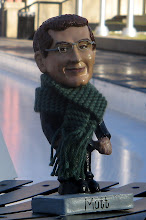
That should be Robert Woolfrey (shown here), and I guess he and Ann are both better at sticking to talking points than I am! Or maybe Dan Wakin worked harder to dig past all the application-brochure stuff. Littler goes on:
I have heard MTT describe this before - he sometimes sounds a bit like Peter Pan, wondering why all the other children had to grow up and get so jaded. I'm ususally pretty idealistic myself - I wonder if that got me in? - yet I had never thought of New World as specifically addressing this issue, or selecting for positive outlook and attitude. It sort of gives a new meaning to 'affirmative action', doesn't it?
I wouldn't make too much of the attitude factor though, or suggest applicants start walking into their New World auditions with grins plastered on their faces. I doubt Tom Hadley will be impressed, and as he knows, it's very hard to accurately screen for a love of music making. We all have that love, but the audition process itself can often grind it away and obscure it - and here at New World, where the audition process never ends. If you're not taking one, the girl next door is, and she probably wants to play some excerpts for you and hear what you think. So we depend on our fellow musicians to give us encouragement - in addition to corrections and criticism - and to help us maintain a positive attitude.
Often, I feel like that's the most important thing I can offer someone, especially a harp or clarinet player whose techniques and excerpts I barely understand. I still love to listen to them, and I try to ask helpful questions - what kind of character and color do you want to create here, what is the committee looking for there, do you have an image or a story that helps you start this one? Okay, maybe your rhythm went haywire there, but what is the style and groove you want to project overall?
For the past few weeks since the season ended, New World has felt less like an orchestra than a support group for audition-afflicted musicians! I feel much less afflicted than I have in the past, though I also have a lot of new goals and plans I'm trying to realize. Even if none of them work out though, I hope that I always maintain the qualities of joy and inspiration that MTT talks about, even when I'm far from Florida and way past Peter Pan age!
Saturday, May 05, 2007
Finales, sandwiches and pickles
Tonight is the final New World Symphony concert of the season:
Dvorak Carnival Overture, conducted by Steven Jarvi
Strauss Four Last Songs, with Renee Fleming
Sibelius 2nd Symphony
The Strauss and Sibelius are conducted by MTT, and I couldn't have asked for a more wonderful and moving concert to be my last! I don't have much time to write now, but I want to draw your attention to some interesting recent posts at the CSO Double Bass Blog by Michael Hovnanian - he writes about new music programming and the tendency to package those less familiar pieces besides, or even within, the standard rep warhorses.
And Jason Heath's Double Bass Blog, always pushing the frontiers of technology and interaction for the bassist community, has just made a new inroad - onto the sidebar of hella frisch! You'll find something called a "Podcast Pickle", which will play you Jason's fantastic interviews and tastefully chosen recordings as you skim for readable portions of my blog!
More to come soon, including the next installment of my Calgary audition story!
Dvorak Carnival Overture, conducted by Steven Jarvi
Strauss Four Last Songs, with Renee Fleming
Sibelius 2nd Symphony
The Strauss and Sibelius are conducted by MTT, and I couldn't have asked for a more wonderful and moving concert to be my last! I don't have much time to write now, but I want to draw your attention to some interesting recent posts at the CSO Double Bass Blog by Michael Hovnanian - he writes about new music programming and the tendency to package those less familiar pieces besides, or even within, the standard rep warhorses.
And Jason Heath's Double Bass Blog, always pushing the frontiers of technology and interaction for the bassist community, has just made a new inroad - onto the sidebar of hella frisch! You'll find something called a "Podcast Pickle", which will play you Jason's fantastic interviews and tastefully chosen recordings as you skim for readable portions of my blog!
More to come soon, including the next installment of my Calgary audition story!
Monday, April 23, 2007
when puppets attack, and artists ignite
Above is an 'e-flyer' for the webcast this coming Sunday, which will feature Stravinsky's ballet Petrouchka.
I'm really excited to be playing Petrouchka with MTT and the NWS, and in this kind of innovative forum. It's the story of a puppet coming to life, but to me it's all about discovery, bold gestures, new ideas. Stravinsky had already written the ballet The Firebird, but I imagine him writing Petrouchka as a young, still emerging composer with something to prove - Firebird was like his graduation piece, showing off his mastery of all the orchestrational tricks Rimsky-Korsakov had taught him. It showed a lot more as well, of course - but in Petrouchka, he surpasses his models with this incredible new voice, dispelling any doubt that an utterly original talent is at work. The music invites us into all these new places, funny, tragic, sometimes grotesque, always fantastic.
There is an outer world, full of life and spirit and commotion, which is where the piece begins, and there is also a miraculous inner world - where we find the puppet Petrouchka, imprisoned. He has spent his life getting pulled around and and twisted, and as a result he is coiled with rage. He summons up all his strength and will, to escape his captor and live as himself - and in a burst of violence, the inner world rips open and spills into the outer world, provoking gasps and astonishment, before the sorcerer can try and reassure everyone that it was just a fantasy after all.
It often seems like an artist emerges from nowhere and takes the world by storm, provoking a flurry of reactions, criticism, imitation... That was definitely the case of Stravinsky, and I wonder if he used Petrouchka as his proxy in this score. The misformed, mistreated loner, bound by strings and shut off in his cell, but still striving mightily for love, beauty, grace - and finally ripping through the curtain, astounding and horrifying everyone around! For me this is one of the amazing things about the New World Symphony too, being around all of these musicians on the cusps of their careers - and everyone seems like they are one breakthrough away from bursting out and making a grand entrance into the musical world. Maybe we're not about to start a riot at the Champs-Elysees, but the force of artistic revelation is no less intense in each individual case.
That's what excites me about organizing and running New World's mock auditions - which I will be doing again tomorrow evening - this discovery of someone taking the initiative, throwing off those puppet strings, and announcing himself or herself as a performing artist. I imagine this same thrill is what people long for in actual auditions, the performer who no longer asks if he is ready, he proclaims it. We're lucky if we experience this once in an audition, or a lifetime - but I have seen it over and over again at New World. I definitely hear it in Stravinsky's Petrouchka!
The two musicians blogging for this week's webcast, Michael Gordon and Yukiko Senino, both have their first posts up today. Check them out, and please visit here too for even more symphonic blogging!
I'm really excited to be playing Petrouchka with MTT and the NWS, and in this kind of innovative forum. It's the story of a puppet coming to life, but to me it's all about discovery, bold gestures, new ideas. Stravinsky had already written the ballet The Firebird, but I imagine him writing Petrouchka as a young, still emerging composer with something to prove - Firebird was like his graduation piece, showing off his mastery of all the orchestrational tricks Rimsky-Korsakov had taught him. It showed a lot more as well, of course - but in Petrouchka, he surpasses his models with this incredible new voice, dispelling any doubt that an utterly original talent is at work. The music invites us into all these new places, funny, tragic, sometimes grotesque, always fantastic.
There is an outer world, full of life and spirit and commotion, which is where the piece begins, and there is also a miraculous inner world - where we find the puppet Petrouchka, imprisoned. He has spent his life getting pulled around and and twisted, and as a result he is coiled with rage. He summons up all his strength and will, to escape his captor and live as himself - and in a burst of violence, the inner world rips open and spills into the outer world, provoking gasps and astonishment, before the sorcerer can try and reassure everyone that it was just a fantasy after all.
It often seems like an artist emerges from nowhere and takes the world by storm, provoking a flurry of reactions, criticism, imitation... That was definitely the case of Stravinsky, and I wonder if he used Petrouchka as his proxy in this score. The misformed, mistreated loner, bound by strings and shut off in his cell, but still striving mightily for love, beauty, grace - and finally ripping through the curtain, astounding and horrifying everyone around! For me this is one of the amazing things about the New World Symphony too, being around all of these musicians on the cusps of their careers - and everyone seems like they are one breakthrough away from bursting out and making a grand entrance into the musical world. Maybe we're not about to start a riot at the Champs-Elysees, but the force of artistic revelation is no less intense in each individual case.
That's what excites me about organizing and running New World's mock auditions - which I will be doing again tomorrow evening - this discovery of someone taking the initiative, throwing off those puppet strings, and announcing himself or herself as a performing artist. I imagine this same thrill is what people long for in actual auditions, the performer who no longer asks if he is ready, he proclaims it. We're lucky if we experience this once in an audition, or a lifetime - but I have seen it over and over again at New World. I definitely hear it in Stravinsky's Petrouchka!
The two musicians blogging for this week's webcast, Michael Gordon and Yukiko Senino, both have their first posts up today. Check them out, and please visit here too for even more symphonic blogging!
Wednesday, February 21, 2007
MTT's cinematic Shostakovich
Until recently, I had no idea that MTT was such a film buff. Whether he's quoting Cher from Moonstruck ("Snap out of it!), complimenting our Polish trombone player Maciej on his cowboy solo in Copland's "Buckaroo Holiday" ("The best tribute to the United States since Borat"), or recommending we check out director Andrei Tarkovsky for a flavor of Russian cinema, this week has been full of film references.
We're rehearsing Shostakovich's 5th Symphony, which we'll play this Friday in Lincoln Theatre, then Saturday in the Carnival Center (along with Shostakovich's Second Cello Concerto with Yo-Yo Ma) before taking all of it on tour to New York. MTT points out how Shostakovich structures the symphony using all sorts of film editing techniques: cross-cutting, fading in and out, dissolves, close-ups, etc. In the very beginning of the symphony, an angular, leaping figure cries out furiously in the strings, before moving off into the distance. MTT acted the whole thing out for us, becoming this angry, contorted figure first in close-up then out on the horizon. Those far-off howls and grimaces are heard in the lower strings, fading into the background as a new character emerges in the violins.
MTT will speak in detail about the symphony at the Discovery Concert on Friday (and next Wednesday in New York). Tomorrow evening at the Lincoln Theatre you can see a documentary film on the same topic, "Shostakovich Against Stalin: The War Symphonies". Check out the New World website for more information.
We're rehearsing Shostakovich's 5th Symphony, which we'll play this Friday in Lincoln Theatre, then Saturday in the Carnival Center (along with Shostakovich's Second Cello Concerto with Yo-Yo Ma) before taking all of it on tour to New York. MTT points out how Shostakovich structures the symphony using all sorts of film editing techniques: cross-cutting, fading in and out, dissolves, close-ups, etc. In the very beginning of the symphony, an angular, leaping figure cries out furiously in the strings, before moving off into the distance. MTT acted the whole thing out for us, becoming this angry, contorted figure first in close-up then out on the horizon. Those far-off howls and grimaces are heard in the lower strings, fading into the background as a new character emerges in the violins.
MTT will speak in detail about the symphony at the Discovery Concert on Friday (and next Wednesday in New York). Tomorrow evening at the Lincoln Theatre you can see a documentary film on the same topic, "Shostakovich Against Stalin: The War Symphonies". Check out the New World website for more information.
Monday, February 19, 2007
Spot's take on "The Academy"
 A former New World colleague who blogs at "Spot's Doghouse" wrote a very thoughtful post reacting to the NY Times article, and putting the New World experience in perspective:
Being in NWS is like being in a really great relationship. She's fun, she's hot, she's young, and she's fantastic at what she does.
But at the end, whether that's three years or four, she is going to dump you for someone younger; someone new. You can't marry her. It's not an option. She was up front with you about that when you signed your letter, packed up your stuff, hopped in the car, and drove to Miami.
She'll let you move in. She won't charge you rent. She'll even be your sugar mommy while you're there. But no marriage.
And so you are left with two choices: she can dump you. Or you can dump her. There are no in-betweens. So in that regard, I am glad that I got to be the dumper.
While many fall into the habit of comparing NWS to a type of postgraduate residency, it isn't like medical school. Nobody's waiting at the end of the rainbow to hand you a job. There is no guarantee of employment.
It's more like being handed a parachute and being told to jump out of a plane. The ride is exhilarating, and the parachute will definitely open - but you've still got to guide it to the target. Being in NWS improves your ability to aim, but it's still up to you to find your way as close to the bullseye as you can.
I like both of Spot's analogies - both are definite improvements over "death row", Aaron Merritt's quote in the article. (He was a bit sorry that got in there!) We all land somewhere - it's just a matter of where, and how soon. A lot of the drama in the article, and in our lives, is that feeling of being in limbo, and watching all sorts of possible outcomes unfold. It seems like Spot's experience was mostly a positive one, and I'm glad he landed safely - and can write about it with such eloquence!
"Live from Miami Beach!"
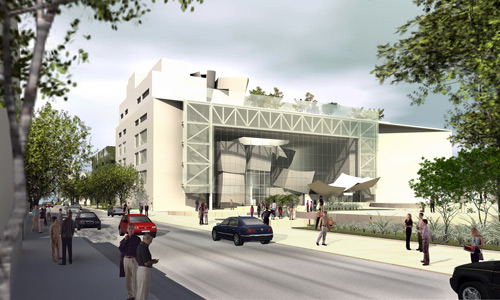
This week New World Symphony's musicians are unusually busy - preparing for a Shostakovich festival and concerts on Friday and Saturday, a master class with Yo-Yo Ma on Thursday, and a tour to New York's Carnegie Hall next week. It's hard to look beyond the next week when you have so much stuff to do.
The administration and staff are looking much further though, launching an ambitious project to build a new hall, designed by Frank Gehry. They've been planning the hall for several years, and occasionally inviting musicians upstairs to show off these fantastic blueprints and artist's renderings, like the one above. Last week, they brought the show and tell to the Miami Beach City Commission chambers, on 17th and Convention Center Dr., for a workshop meeting over a proposed $15 million grant. Tomorrow at 5 pm, the City Commission will meet there again and vote on the proposal.
As the Miami Herald reported yesterday, last week's meeting featured speeches by president Howard Herring, project manager Grant Stevens, and board chairman Howard Frank (the Herald mistakenly called him "Frank Howard"). The most illuminating speech, though, was by artistic director Michael Tilson Thomas, and wasn't mentioned in the Herald's piece.
MTT acknowledged congratulations for the two Grammy awards he had won the previous evening, then tied that into the larger missions of both the San Francisco Symphony (which received those Grammys for a recording of Mahler's 7th Symphony) and the New World Symphony. Both organizations are developing new relationships between classical music and the larger culture, and empowering their orchestral musicians to take an active role.
He described how the new hall would develop and enhance that role. He contrasted the Lincoln Theater, which for all its charm and history (music and porn, as Dan Wakin noted) is basically a "one-room schoolhouse." The new space would offer possibilities for broadcasting, multimedia, and engagement that we probably can barely imagine. He mentioned the use of video projections and Internet 2, and the dream of hearing "Live from Miami Beach!" all around the world. The design of the space is like a traditional concert hall turned inside-out, facing the community and the world through the use of new technology, and a very old tradition.
The whole presentation was really impressive - I was one of those NWS musicians packing the balcony with handmade signs - and it made me realize that what we do here does have a larger impact. Most of us won't be around in 2010-11, when the hall is slated to open, but I still came away thinking orchestral music might be about changing the world, not just earning a pension. When the hall does open, I'll definitely be tuning into my iPhone, VistaDoohickey, or whatever other newfangled gizmo is broadcasting that first "Live from Miami Beach!"
Sunday, February 04, 2007
New World's new website
 The New World Symphony has a new website up, with lots of musician information and bizarrely cropped photos. I unfortunately haven't turned my survey in yet, so my profile is empty and generic. I'll get on that right away though.
Sunday, January 21, 2007
Kirchner and Borromeo
 Before conducting his Concerto for Violin, Cello, Ten Winds and Percussion, Leon Kirchner swivelled around grudgingly on his stool and addressed the audience. "I've been told to say a few words about the next piece," he said, as though talking about himself was some great burden. Kirchner (shown right, photo courtesy the website of publisher G. Schirmer, Inc.) is 87, and sometimes appears his age, behaving as though every extraneous word or gesture were depleting a fast-diminishing supply.
Then again, once he began to speak, he couldn't have been more charming, insightful, and engaging - if a little mysterious. Because he didn't really talk about the piece to be performed, but just recited a few short poems, by Blake, Yeats, and this one by Goethe:
He who has Art and Science, has also religion;All his comments were a bit enigmatic, alluding to his philosophical ideas about mathematics, music, and life, without getting into any long philosophical discussions. He did a very good job of introducing himself to the audience - if not the piece he was about to lead. Maybe that's the best way to introduce a complex, unfamiliar 20th-century piece, though. I think most of the audience sat up a little higher in our seats, as I did, intrigued by this slightly curmudgeonly but very eloquent old man, and we listened with great interest to a piece of 'difficult' chamber music which turned out to be fascinating, elegant, and wise - just like its creator.
He who has neither Art nor Science, needs religion.
 Also on the program was a Schumann piano trio, and the Brahms Sextet with the Borromeo Quartet (shown in a photo from their website). I used to hear the Borromeo regularly when I went to NEC, and they were the quartet in residence there (as they still are, I believe). The group has changed a bit - a new violist, Mai Motobuchi, and a violinist who I played with in the Verbier Orchestra several years ago, Kristopher Tong. Together with founding members Yeesun Kim, cellist, and Nicholas Kitchen, first violinist, they've kept the same brilliant and thoughtful style of chamber music making though, and hearing them brought back pleasant memories of First Monday concerts in Jordan Hall.
It's funny how a group can replace half its members, and yet still maintain its unique qualities and traditions - the New World Symphony is probably the rare orchestra that turns over a third or more of its members each year, but every ensemble deals with personnel changes to some extent. The Borromeo played Brahms with two New World members, violist Chris Fischer and cellist Soo Jee Yang, and it really did seem like one fantastically augmented string quartet - the same impression I often get when hearing the Cleveland Orchestra's string section play. I suppose it's a sign that music is not only one of the noblest of arts, as Leon Kirchner said, but also a especially communicable one!
Thursday, December 14, 2006
education and emphasis
So much of performing is a matter of emphasis - how to distinguish one note from another, which voice to bring out of the texture, where to culminate a phrase. One of the very wise observations Robert Levin made in his Mozart wind concerto class last week was that 97% of phrasing is renunciation - it's deciding what can be said without emphasis, so that every syllable is not accented, and each note isn't smothered with excess meaning. And the really important moments have the weight and impact to capture our attention.
The past couple of days we have been performing education concerts to large crowds of elementary school students. Each performance lasted about an hour, and our conducting fellow Steven Jarvi tried to squeeze a lot into that time: from the names of all the instruments and their means of sound production, to principles of orchestration; the transformation of Pictures at an Exhibition from piano solo to orchestral piece; how a concerto works; and how much instrumentalists need to practice(!) Of course you never want to bore kids, but I've been wondering about what these kids will be left with, after the sounds of the orchestra have faded and they've forgotten the titles of all the pieces we played.
I think focusing on mechanical principles can be a very nice approach, but it has to get to something deeper to really resonate. It would be like going to the art museum and being shown a bunch of paint and blank canvas. You get an understanding of the materials and the challenges of putting them to use, but then you're left with so many questions. How were all those decisions made? Are these composers gifted with some kind of amazing intuition, or was there a process of experimenting and rejection involved? And if these things are all so difficult to play, why bother?
Hopefully the sound of the orchestra and the brilliance of the music we played will answer that last question, since it's very hard to explain satisfactorily in words! Steve Jarvi handled a lot of these questions very well. He asked the kids to listen for some specific things, connect the sounds and colors of several pieces and predict how instruments might be used. Even though his talk began on a very basic level, the basic wood and metal that makes up the instruments we play, he got onto some fairly sophisticated ideas. Still, I found myself frustrated by how much was not explained.
I think my own tendency in talking to audiences is to offer all the facts, ideas, and speculation I can manage to recall, sort of like those essay tests I used to take in college. I would squeeze as much from my memory into the little blue book as I could within the time limit, and hope that most of it was correct and relevant! I'm realizing that the much more sophisticated way, the Robert Levin way, is to have a few deeply held ideas and points, and express those with the utmost passion. The rest you let the audience figure out for themselves, or maybe just wonder and be curious until the next concert.
Perhaps that's not just the more sophisticated way, but also the more respectful way. You trust the audience to create their own thoughts, ideas, and impressions, and not just absorb the facts you've prepared to recite to them. And you trust your own musicianship, so that you don't need to be that know-it-all.
I think if I could have added something to these education concerts, I would have asked the kids to notice and think about how an orchestra uses silence. While we were playing the Tchaikovsky Serenade for Strings, almost every pause and cadence seemed to trigger a burst of applause, which makes me think they not only didn't know what to expect but felt uncomfortable in their role as appreciative audience. Maybe some of these kids have never heard a work of music in which the sound stops for several seconds and didn't know how to react. I don't want to be the classical music ogre who glares at every misplaced clap, but to me it seems worthwhile to recognize that sometimes part of the canvas is intentionally left blank, and think about how that empty moment can affect us.
Of course, in music as in life, as in blogging and so much else, you have to pick the right battles. Maybe my silence idea would work well with a Bruckner symphony, though I'm not sure a bunch of 2nd graders could sit through much of that. Lately I feel like I have so much to write about, and so much to think and read and meditate about, and so little time to accomplish it all! I think maybe if I write every day, and use my time well, I'll eventually catch up with all my good intentions - but then I just seem to open up more possibilities I can never follow up. I guess at times like these, I should take Robert Levin's advice and renounce all the excess clutter!
The past couple of days we have been performing education concerts to large crowds of elementary school students. Each performance lasted about an hour, and our conducting fellow Steven Jarvi tried to squeeze a lot into that time: from the names of all the instruments and their means of sound production, to principles of orchestration; the transformation of Pictures at an Exhibition from piano solo to orchestral piece; how a concerto works; and how much instrumentalists need to practice(!) Of course you never want to bore kids, but I've been wondering about what these kids will be left with, after the sounds of the orchestra have faded and they've forgotten the titles of all the pieces we played.
I think focusing on mechanical principles can be a very nice approach, but it has to get to something deeper to really resonate. It would be like going to the art museum and being shown a bunch of paint and blank canvas. You get an understanding of the materials and the challenges of putting them to use, but then you're left with so many questions. How were all those decisions made? Are these composers gifted with some kind of amazing intuition, or was there a process of experimenting and rejection involved? And if these things are all so difficult to play, why bother?
Hopefully the sound of the orchestra and the brilliance of the music we played will answer that last question, since it's very hard to explain satisfactorily in words! Steve Jarvi handled a lot of these questions very well. He asked the kids to listen for some specific things, connect the sounds and colors of several pieces and predict how instruments might be used. Even though his talk began on a very basic level, the basic wood and metal that makes up the instruments we play, he got onto some fairly sophisticated ideas. Still, I found myself frustrated by how much was not explained.
I think my own tendency in talking to audiences is to offer all the facts, ideas, and speculation I can manage to recall, sort of like those essay tests I used to take in college. I would squeeze as much from my memory into the little blue book as I could within the time limit, and hope that most of it was correct and relevant! I'm realizing that the much more sophisticated way, the Robert Levin way, is to have a few deeply held ideas and points, and express those with the utmost passion. The rest you let the audience figure out for themselves, or maybe just wonder and be curious until the next concert.
Perhaps that's not just the more sophisticated way, but also the more respectful way. You trust the audience to create their own thoughts, ideas, and impressions, and not just absorb the facts you've prepared to recite to them. And you trust your own musicianship, so that you don't need to be that know-it-all.
I think if I could have added something to these education concerts, I would have asked the kids to notice and think about how an orchestra uses silence. While we were playing the Tchaikovsky Serenade for Strings, almost every pause and cadence seemed to trigger a burst of applause, which makes me think they not only didn't know what to expect but felt uncomfortable in their role as appreciative audience. Maybe some of these kids have never heard a work of music in which the sound stops for several seconds and didn't know how to react. I don't want to be the classical music ogre who glares at every misplaced clap, but to me it seems worthwhile to recognize that sometimes part of the canvas is intentionally left blank, and think about how that empty moment can affect us.
Of course, in music as in life, as in blogging and so much else, you have to pick the right battles. Maybe my silence idea would work well with a Bruckner symphony, though I'm not sure a bunch of 2nd graders could sit through much of that. Lately I feel like I have so much to write about, and so much to think and read and meditate about, and so little time to accomplish it all! I think maybe if I write every day, and use my time well, I'll eventually catch up with all my good intentions - but then I just seem to open up more possibilities I can never follow up. I guess at times like these, I should take Robert Levin's advice and renounce all the excess clutter!
Tuesday, December 12, 2006
Robert Levin's class on Mozart
Last week I listened to pianist Robert Levin give a master class on Mozart's wind concerti, at which several New World fellows played. I didn't take notes unfortunately, but a few things stick in my mind.
First, he listed three books on performance practice that every musician should own:
 Leopold Mozart's A Treatise on the Fundamental Principles of Violin Playing
J.J. Quantz' On Playing the Flute
C.P.E. Bach's Essay on the True Art of Playing Keyboard Instruments
I haven't read any of these completely yet - I'm thinking of making it a new year's resolution. I did begin Leopold Mozart's book last summer, having found it in a university library. I really enjoy the stuffy old-fashioned language of pedagogical treatises, and the funny stories and observations about performing life that get told in passing. Leopold Mozart definitely goes on some silly tangents - even reading his chapter on basic notational principles was hilarious. It might not look like light holiday reading, but I'm pretty sure you'll find this stuff as amusing as it is worthwhile.
Robert Levin was constantly challenging the wind players to articulate the character of the music. I sometimes feel constricted in music of the classical style - even the word classical feels constrictive! But watching Levin sing, sigh, giggle, and hum through a Mozart concerto really opened my ears to some of the possibilities of this music. His whole body just seemed set free when he demonstrated a passage - demonstrations which were as often with singing and gestures as playing on the piano. On a few occasions I have seen Michael Tilson Thomas 'perform' an orchestral score in this way, acting as though he's been possessed by all those symphonic themes and rhythms.
One of the thoughts Robert Levin left us with was this: the problem with Mozart's music is that it's too easy for children, and too hard for adults! Lately I feel like one of those adults, furiously obsessing over all the complexities and complications of making music. Sometimes I wish I could forget all this stuff, and just go back to the child-like wonder of putting together beautiful sounds. Somehow a musician like Robert Levin balances the two, or finds a way around the paradox. He has so thoroughly analyzed all this music, and studied its history down to specific manuscripts and performances, and reached his very thoughtful conclusions. But then in front of an audience, or just a bunch of fellow musicians, he makes it come alive in a way I can't possibly convey in words.
First, he listed three books on performance practice that every musician should own:
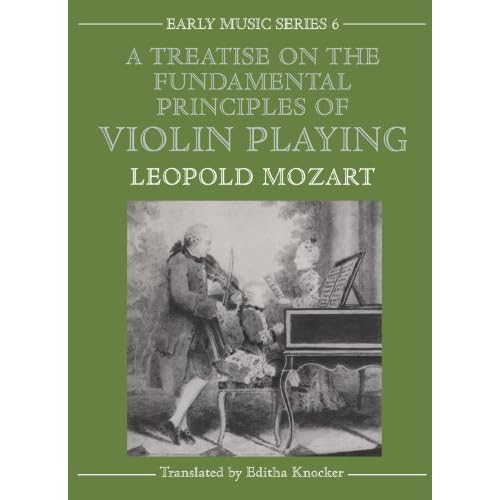 Leopold Mozart's A Treatise on the Fundamental Principles of Violin Playing
J.J. Quantz' On Playing the Flute
C.P.E. Bach's Essay on the True Art of Playing Keyboard Instruments
I haven't read any of these completely yet - I'm thinking of making it a new year's resolution. I did begin Leopold Mozart's book last summer, having found it in a university library. I really enjoy the stuffy old-fashioned language of pedagogical treatises, and the funny stories and observations about performing life that get told in passing. Leopold Mozart definitely goes on some silly tangents - even reading his chapter on basic notational principles was hilarious. It might not look like light holiday reading, but I'm pretty sure you'll find this stuff as amusing as it is worthwhile.
Robert Levin was constantly challenging the wind players to articulate the character of the music. I sometimes feel constricted in music of the classical style - even the word classical feels constrictive! But watching Levin sing, sigh, giggle, and hum through a Mozart concerto really opened my ears to some of the possibilities of this music. His whole body just seemed set free when he demonstrated a passage - demonstrations which were as often with singing and gestures as playing on the piano. On a few occasions I have seen Michael Tilson Thomas 'perform' an orchestral score in this way, acting as though he's been possessed by all those symphonic themes and rhythms.
One of the thoughts Robert Levin left us with was this: the problem with Mozart's music is that it's too easy for children, and too hard for adults! Lately I feel like one of those adults, furiously obsessing over all the complexities and complications of making music. Sometimes I wish I could forget all this stuff, and just go back to the child-like wonder of putting together beautiful sounds. Somehow a musician like Robert Levin balances the two, or finds a way around the paradox. He has so thoroughly analyzed all this music, and studied its history down to specific manuscripts and performances, and reached his very thoughtful conclusions. But then in front of an audience, or just a bunch of fellow musicians, he makes it come alive in a way I can't possibly convey in words.
Monday, December 11, 2006
checking back in...
It's been a busy and very enlightening week at the New World Symphony - conductor Roger Norrington was in town to conduct an all-Schumann program, along with pianist Robert Levin. Then the past couple of days, the bassist Paul Ellison has been giving lessons to our section. These might not be household names outside the orchestral world - I'm never quite sure how opaque my little bubble is! - but they are all brilliant and extremely thoughtful musicians, with a lot to impart.
So a lot of ideas have been fermenting in my mind (if that metaphor works.) I tend to think of my mind as a vat of swirling liquids, insoluble matter and mysterious gases. At some point, I always hope, some chemical reaction will transform it into a nice, cohesive solution, and all my confusion and doubts will dissolve and escape. Unfortunately, I'm not sure if this metaphor has any basis in chemistry, or in reality!
Facing reality seems to be a problem for me lately. I'm just sort of coming to the realization that I've been depressed for some time now - lethargic, unmotivated, just generally down. I have this friend, he's often very depressed, and whenever I ask him how he is, he responds "About the same." I never know how to answer that, whether it's a good thing or I should express sympathy! I know what he means though, in a sense, since I think most people's moods are calibrated to remain at a certain level. We might have good days and bad days, great victories or awful setbacks, but somehow we always return to our default mood. Within that, though, there are definite cycles, and for whatever reason lately I've been at a low point.
Depression takes different forms for everyone, and we all have our own ways of overcoming it. Still, it was inspiring for me to hear Roger Norrington talk about Schumann's depressions, and how studying Back and then writing his 2nd Symphony allowed him to recover. Schumann had two definite characters within himself: one energetic, forceful, masculine persona he called Florestan, and a reserved, pensive, feminine persona he named Eusebius. The whole symphony can be heard as a dialogue between Florestan and Eusebius, each imbalanced and destructive in their own way. Then there are these episodes of Bach-inspired counterpoint that seem to bring him back in balance, and to lead the two sides into a healthy synthesis.
I love the idea that creativity and work can make us whole and heal us. Maybe because I don't want to go through therapy or take medication, and work is the biggest and most pressing thing in my life right now! It's difficult to imagine reaching some cathartic breakthrough as in Schumann's 2nd - then again, that success story must have been short-lived, since later he returned to a deep depression and finally committed suicide.
At the concert the other evening, I sat in the audience to listen to Robert Levin play the Schumann piano concerto, which was spectacular. A man sitting next to me, as Levin was beginning his encore, noticed that I was a musician in the orchestra and began talking to me. "I sometimes wonder what you'll all do next, after being part of something so fabulous, whether anything else you do will ever compare." I didn't respond, since the encore had already begun, one of Schumann's virtuosic solo piano pieces. Still, I was thinking about his statement - how right he was in a sense, since we are all fortunate to be doing this, playing wonderful music together in a fantastic place. And yet for young musicians, or for any musician, I'm finding, it's never enough. We all have goals, hopes and dreams that we depend on to drive us forward to better things - while at the same time they threaten to crush us in failure. So there's this uneasy equilibrium, in which on any given day I might swell with hope or crumble into despair.
I didn't say any of this to my fellow audience member. I just listened to the rest of Robert Levin's brilliant encore, which overflowed with character. Then I turned to the man and said, "Thank you," and answered his questions about where I'm from and what I play, and went back on stage to warm up during intermission. Sometimes expressing all this stuff can be overwhelming and emotionally draining work, I guess - just like playing Schumann's big manic depressive Second Symphony!
So a lot of ideas have been fermenting in my mind (if that metaphor works.) I tend to think of my mind as a vat of swirling liquids, insoluble matter and mysterious gases. At some point, I always hope, some chemical reaction will transform it into a nice, cohesive solution, and all my confusion and doubts will dissolve and escape. Unfortunately, I'm not sure if this metaphor has any basis in chemistry, or in reality!
Facing reality seems to be a problem for me lately. I'm just sort of coming to the realization that I've been depressed for some time now - lethargic, unmotivated, just generally down. I have this friend, he's often very depressed, and whenever I ask him how he is, he responds "About the same." I never know how to answer that, whether it's a good thing or I should express sympathy! I know what he means though, in a sense, since I think most people's moods are calibrated to remain at a certain level. We might have good days and bad days, great victories or awful setbacks, but somehow we always return to our default mood. Within that, though, there are definite cycles, and for whatever reason lately I've been at a low point.
Depression takes different forms for everyone, and we all have our own ways of overcoming it. Still, it was inspiring for me to hear Roger Norrington talk about Schumann's depressions, and how studying Back and then writing his 2nd Symphony allowed him to recover. Schumann had two definite characters within himself: one energetic, forceful, masculine persona he called Florestan, and a reserved, pensive, feminine persona he named Eusebius. The whole symphony can be heard as a dialogue between Florestan and Eusebius, each imbalanced and destructive in their own way. Then there are these episodes of Bach-inspired counterpoint that seem to bring him back in balance, and to lead the two sides into a healthy synthesis.
I love the idea that creativity and work can make us whole and heal us. Maybe because I don't want to go through therapy or take medication, and work is the biggest and most pressing thing in my life right now! It's difficult to imagine reaching some cathartic breakthrough as in Schumann's 2nd - then again, that success story must have been short-lived, since later he returned to a deep depression and finally committed suicide.
At the concert the other evening, I sat in the audience to listen to Robert Levin play the Schumann piano concerto, which was spectacular. A man sitting next to me, as Levin was beginning his encore, noticed that I was a musician in the orchestra and began talking to me. "I sometimes wonder what you'll all do next, after being part of something so fabulous, whether anything else you do will ever compare." I didn't respond, since the encore had already begun, one of Schumann's virtuosic solo piano pieces. Still, I was thinking about his statement - how right he was in a sense, since we are all fortunate to be doing this, playing wonderful music together in a fantastic place. And yet for young musicians, or for any musician, I'm finding, it's never enough. We all have goals, hopes and dreams that we depend on to drive us forward to better things - while at the same time they threaten to crush us in failure. So there's this uneasy equilibrium, in which on any given day I might swell with hope or crumble into despair.
I didn't say any of this to my fellow audience member. I just listened to the rest of Robert Levin's brilliant encore, which overflowed with character. Then I turned to the man and said, "Thank you," and answered his questions about where I'm from and what I play, and went back on stage to warm up during intermission. Sometimes expressing all this stuff can be overwhelming and emotionally draining work, I guess - just like playing Schumann's big manic depressive Second Symphony!
Saturday, December 02, 2006
rethinking Frankenstein!!
I'm a little ashamed to have written so dismissively of the Gruber piece earlier in the week - after rehearsing it for a few more days, and performing the piece this evening, I think it's much more than just squeaky toys and nonsense poetry. I would probably need a lot more study and listening to understand the piece completely, but I think its intent is something quite profound. It's trying to create this whole world of child-like impressions, naivety, and wonder, and at the same time express a lot of dark and unsettling emotions. There are moments when it's really uncomfortable to listen to these bizarre sounds, grumbling and shrieking and all kinds of human noises which we're not accustomed to hearing in the concert hall. And so the audience has to laugh or react, to relieve some of this tension. As simple and fun as the piece first appears, it has this incredible way of calculating the audience's emotions, and pushing them just so far that they have to squirm, and then laugh.
After the performance I got to speak with Kevin Hall, who writes Hidden City, and a friend who writes sex and the beach (I think she may be semi-anonymous). It was very cool to see some familiar faces in the audience, and feel a part of this little cultural scene in Miami - I think part of my decision to suspend blogging for a while was the feeling of sliding into irrelevance. It now seems to me kind of a self-fulfilling notion: once you think you have nothing significant to say, it becomes the truth. But really, concerts like this make me feel music is very meaningful, and as a performer I'm right in the thick of all that meaningfulness. So the challenge is to find the sense of the music for myself, and then to make sure that the audience can find it as well.
If that's my goal, probably the first thing I should do is to admit that I'm confused and lost a lot of the time too. (Not in the sense of losing my place on the page, which I can usually find, but losing the larger message). When I first open a new score, there's all this unfamiliar notation, strange instructions, a weird title - the superficial stuff which the audience also struggles with. I try and cling to the things I can easily read, the pitches and rhythms, and at least have these organized for the first rehearsal. A piece like Gruber's Frankenstein!!, there is simply so much going on, I can barely keep up with the part on my stand, and a few important signals and cues which will help me keep my place.
But as the rehearsal period goes on, I gain some familiarity, as I start to remember and look forward to certain moments - a strange chord, a rhythm that makes me feel like dancing. I'm still not sure I understand what the piece is about, at least not enough that I could stand up and give a lecture about it. Somehow though, in the process of learning its gestures, blending myself into its sonorities and harmonic language, I think I do reach some unconscious grasp of its meaning. I feel like my body contains something essential about the piece, even if my brain can't distill it into words. At least I tell myself this, so that I can feel ready to perform it!
Often, like tonight, the composer has something fascinating to say about the piece right before the performance. Gruber said that this piece, as silly as it may sound, has some very serious purposes, and made it clear that he wasn't merely showing off toy sounds. Speeches like this are for the benefit of the audience, but of course he knows the orchestra is listening too - I wonder sometimes if the conductor has planned it this way, saving those words until the moment right before we play so that they will be foremost in the minds of the musicians as well as the audience.
And so I try and play with as much understanding as possible - tonight I thought some lovely things happened, as well as some strange and not completely expected things. Even in new music, we can quickly form a set idea of how things must go, and it can be unnerving when the performance strays a bit, as it always will. Gruber was fun to perform with, because he seemed genuinely open to whatever strange new features might appear in his piece - he kept referring to our run-throughs as "versions". So no single version can be complete and authoritative, I suppose, which makes both the hearing and the performing an adventure. I can't say I completely "got" the piece Frankenstein!!, but after performing tonight's version for a very appreciative audience, I at least got an experience of it.
After the performance I got to speak with Kevin Hall, who writes Hidden City, and a friend who writes sex and the beach (I think she may be semi-anonymous). It was very cool to see some familiar faces in the audience, and feel a part of this little cultural scene in Miami - I think part of my decision to suspend blogging for a while was the feeling of sliding into irrelevance. It now seems to me kind of a self-fulfilling notion: once you think you have nothing significant to say, it becomes the truth. But really, concerts like this make me feel music is very meaningful, and as a performer I'm right in the thick of all that meaningfulness. So the challenge is to find the sense of the music for myself, and then to make sure that the audience can find it as well.
If that's my goal, probably the first thing I should do is to admit that I'm confused and lost a lot of the time too. (Not in the sense of losing my place on the page, which I can usually find, but losing the larger message). When I first open a new score, there's all this unfamiliar notation, strange instructions, a weird title - the superficial stuff which the audience also struggles with. I try and cling to the things I can easily read, the pitches and rhythms, and at least have these organized for the first rehearsal. A piece like Gruber's Frankenstein!!, there is simply so much going on, I can barely keep up with the part on my stand, and a few important signals and cues which will help me keep my place.
But as the rehearsal period goes on, I gain some familiarity, as I start to remember and look forward to certain moments - a strange chord, a rhythm that makes me feel like dancing. I'm still not sure I understand what the piece is about, at least not enough that I could stand up and give a lecture about it. Somehow though, in the process of learning its gestures, blending myself into its sonorities and harmonic language, I think I do reach some unconscious grasp of its meaning. I feel like my body contains something essential about the piece, even if my brain can't distill it into words. At least I tell myself this, so that I can feel ready to perform it!
Often, like tonight, the composer has something fascinating to say about the piece right before the performance. Gruber said that this piece, as silly as it may sound, has some very serious purposes, and made it clear that he wasn't merely showing off toy sounds. Speeches like this are for the benefit of the audience, but of course he knows the orchestra is listening too - I wonder sometimes if the conductor has planned it this way, saving those words until the moment right before we play so that they will be foremost in the minds of the musicians as well as the audience.
And so I try and play with as much understanding as possible - tonight I thought some lovely things happened, as well as some strange and not completely expected things. Even in new music, we can quickly form a set idea of how things must go, and it can be unnerving when the performance strays a bit, as it always will. Gruber was fun to perform with, because he seemed genuinely open to whatever strange new features might appear in his piece - he kept referring to our run-throughs as "versions". So no single version can be complete and authoritative, I suppose, which makes both the hearing and the performing an adventure. I can't say I completely "got" the piece Frankenstein!!, but after performing tonight's version for a very appreciative audience, I at least got an experience of it.
Thursday, May 04, 2006
doleful countenances
'. . . . Think of the people who go to the market for food: during the day they eat; at night they sleep, talk nonsense, marry, grow old, piously follow their dead to the cemetery; one never sees or hears those who suffer, and all the horror of life goes on somewhere behind the scenes. Everything is quiet, peaceful, and against it all there is only the silent protest of statistics; so many go mad, so many gallons are drunk, so many children die of starvation. . . . And such a state of things is obviously what we want; apparently a happy man only feels so because the unhappy bear their burden in silence, but for which happiness would be impossible. It is a general hypnosis. Every happy man should have some one with a little hammer at his door to knock and remind him that there are unhappy people, and that, however happy he may be, life will sooner or later show its claws, and some misfortune will befall him -- illness, poverty, loss, and then no one will see or hear him, just as he now neither sees nor hears others. But there is no man with a hammer, and the happy go on living, just a little fluttered with the petty cares of every day, like an aspen-tree in the wind -- and everything is all right.'
- from "Gooseberries", a story by Anton Chekhov
Today I want to write a bit in praise of misery, but I'm sure I can't improve on Chekhov. If you don't know the story excerpted above, it's one of the most powerful appeals to the human conscience I know - and one of the saddest. Writers like Chekhov may be the closest thing most of us have to that 'man with a little hammer' at the door, our literary consciences there to invoke all the suffering which surrounds and awaits us.
For all the timelessness of great literature, though, music provides perhaps the most direct expression of human despair - and few composers wrote despair as expressively as Sibelius. His Fourth Symphony is, in a word, dark. It cries out with a sense of terror and oppression, of inconsolable longing and vast empty spaces. Playing this symphony feels a bit like wielding that little hammer, constantly pounding out a refrain of endless misery. It's a perverse paradox that doing this should be so enjoyable - I find dark music terrifically uplifting, and pieces like this one leave me with a strange sort of hope. If someone can set these emotions in sound, form them in time and share them with thousands of people, perhaps we're not condemned to lonely unhappiness after all!
Sorry to cut this post so short - our concerts are tomorrow and Saturday night, featuring Strauss' Don Quixote as well as Sibelius' Fourth. We're counting on the Strauss to lift everyone out of their Sibelius-induced suicidal depression; and if not, there may be an encore to do the trick. Please visit nws.org for more information!
Monday, December 12, 2005
next weekend's Shostakovich: "We can hardly wait"
This is from a Talk of the Town piece that appeared in The New Yorker magazine of July 18, 1942, the week that Shostakovich's 'Leningrad' Symphony no. 7 was given its North American premiere by Toscanini and the NBC Symphony. (Mr. Belviso is Thomas Belviso, the orchestra's librarian):
At the time of our call, Mr. Belviso happened to have in his office an extra score of the first violin part. We opened its green covers with due reverence, noting that it was thirty-five pages long and seemed to be CNMPOHNR No. 7. Anyway, it was Op. 60, and the tempo markings of the four movements were in the orthodox Italian: allegretto, moderato poco allegretto, adagio, and allegro non troppo. Mr. H. Leopold Spitalny, the N.B.C.'s Director of Orchestra Personnel, happened in, and we asked him if he could describe the symphony for us, since he had read it. "Well," he said, "it starts with deceptive softness -- a roll of a single snare drum. But it ends, ninety minutes later, with all hell breaking loose." We can hardly wait.Interestingly, due to the intricacies of rental agreements and copyright law, we seem to be playing on those same green parts, or something very nearly as old. You can visit the New World Symphony website to learn more.
- The New Yorker, June 18, 1942, p. 9; available in The Complete New Yorker
Friday, October 14, 2005
on Beethoven's art and heroism
 I sometimes think that in approaching Beethoven, we emphasize his greatness so much that we forget his humanity. This week the New World Symphony has been rehearsing Beethoven's Third Symphony, the "Eroica," and our music director Michael Tilson Thomas made some comments about the composer's Heiligenstadt Testament that got me thinking about the emotional alchemy of artistic creation.
Beethoven wrote the Heiligenstadt Testament at the age of 32, in a state of nearly suicidal despair. His hearing had been in steep decline for four years - yet Beethoven's lament was not for his abilities to perform and improvise, or the fame that came with them. MTT emphasized a subtler reading, and a loss that Beethoven felt even more keenly:
My misfortune is doubly painful to me because I am bound to be misunderstood; for me there can be no relaxation with my fellow men, no refined conversations, no mutual exchange of ideas. I must live almost alone, like one who has been banished. I can mix with society only as much as true necessity demands. If I approach near to people a hot terror seizes upon me, and I fear being exposed to the danger that my condition might be noticed.We don't shout our innermost thoughts and wishes - we whisper them intimately to someone we trust completely. I think of being at a loud party, or with a hearing-impaired grandparent, and how in speaking at the top of my voice I seem to be limited to the most banal and boring subjects. Even then, there is no guarantee that any real connection has been made, or that any sort of communication has transpired. For me this may be a trivial frustration, but for Beethoven it was to be his life - banished to wretched isolation even among friends, forced to pretend he had heard what he couldn't, and to hide what he most longed to express.
Of course, he did find an outlet for that expression through his art, and a means to communicate not only with his immediate contemporaries but with people of all times and places. His music was fiercely original, passionate, and uncompromising - it is also deeply, stirringly human. He wrote his "Eroica" symphony soon after the Heiligenstadt Testament, and to hear the one and read the other is a startling reminder: he may have addressed those lines to his brothers, but he was writing for all humankind, and his message was very much intended for people of the future like ourselves.
Tuesday, May 03, 2005
bassists come, and go
This past week was an eventful one in the New World Symphony bass section. For the alumni reunion concert last Thursday, we had two guest bass players: Tony Manzo (1994-96), a current member of the National Symphony in Washington, D.C.; and Mike Valerio (1997-1999), who is a studio and freelance musician in Los Angeles.
Tony and Mike were both very generous with their time, from coaching our audition excerpts to hanging out at local bars. Apparently South Beach's bar scene has greatly diminished since they were residents here, and they shared sad reminiscences about all the fun places which have since been boarded up or knocked down to build new condos. The tone of the week was rarely somber, though, as we all had a great time getting to know Tony and Mike and playing Mahler Symphony no. 1 with them.
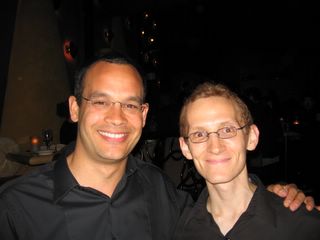
Tony Manzo and me
Our section is normally 7 bassists, a bit on the small side, so it was particularly nice to have 9 for Mahler. Everyone was inspired to play their best, not only by Tony and Mike but all the fantastic alumni joining the orchestra, and the sound was noticeably more powerful than normal. We got nice reviews for the Mahler from two local music reviewers, the Larry's Johnson and Budmen.
Mahler 1 was a famous bass solo, and Mike Valerio was justly praised in one of the reviews for creating an incredible opening to the 3rd movement. He did it using my second bass, which of course wasn't mentioned in the review but was doubly impressive as far as I was concerned. Michael Tilson Thomas asked for the solo incredibly soft, leaving the audience wondering what strange instrument could be playing and from what far off place - I had never heard it so quiet, yet with such firm intonation and expressive substance in the sound.
Mike Valerio and Sean O'Hara, post-Mahler
In addition to Mahler's 1st, we had a chance to play through some other big repertory pieces like Symphonie Fantastique and Don Juan. MTT was in great spirits all week, enjoying seeing old friends and conducting the enhanced NWS orchestra. It was touching to see the kind of rapport and communication taking place between all of the past and current orchestra members. It's no secret that some very talented people have passed through New World, but it was a testament to the quality of the institution that so many engaged, exciting, and expressive musicians chose to return, and told us directly what a beneficial experience NWS was for them.
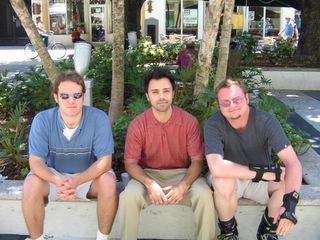
three little bassists, all in a row...
Yesterday was the bass audition for the St. Louis Symphony, and two NWS bass players won the two openings there - Sarah Hogan, who has been playing in St. Louis on a one-year contract, and Dave DeRiso, who has been in our section this year. Dave played in the mock audition on Saturday, and played with such precision and power that I was not at all surprised to hear he won the job. It's been an inspiration to hear him play all year, and I'm sure he and Sarah will both have a great time in their new bass section.
Tony and Mike were both very generous with their time, from coaching our audition excerpts to hanging out at local bars. Apparently South Beach's bar scene has greatly diminished since they were residents here, and they shared sad reminiscences about all the fun places which have since been boarded up or knocked down to build new condos. The tone of the week was rarely somber, though, as we all had a great time getting to know Tony and Mike and playing Mahler Symphony no. 1 with them.

Tony Manzo and me

Our section is normally 7 bassists, a bit on the small side, so it was particularly nice to have 9 for Mahler. Everyone was inspired to play their best, not only by Tony and Mike but all the fantastic alumni joining the orchestra, and the sound was noticeably more powerful than normal. We got nice reviews for the Mahler from two local music reviewers, the Larry's Johnson and Budmen.
Mahler 1 was a famous bass solo, and Mike Valerio was justly praised in one of the reviews for creating an incredible opening to the 3rd movement. He did it using my second bass, which of course wasn't mentioned in the review but was doubly impressive as far as I was concerned. Michael Tilson Thomas asked for the solo incredibly soft, leaving the audience wondering what strange instrument could be playing and from what far off place - I had never heard it so quiet, yet with such firm intonation and expressive substance in the sound.
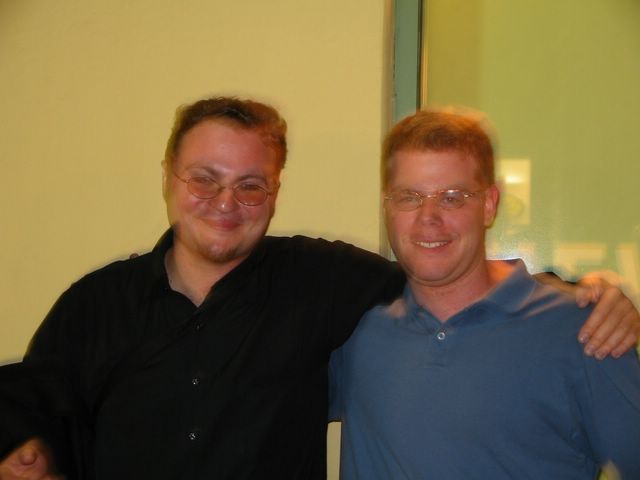
Mike Valerio and Sean O'Hara, post-Mahler
In addition to Mahler's 1st, we had a chance to play through some other big repertory pieces like Symphonie Fantastique and Don Juan. MTT was in great spirits all week, enjoying seeing old friends and conducting the enhanced NWS orchestra. It was touching to see the kind of rapport and communication taking place between all of the past and current orchestra members. It's no secret that some very talented people have passed through New World, but it was a testament to the quality of the institution that so many engaged, exciting, and expressive musicians chose to return, and told us directly what a beneficial experience NWS was for them.

three little bassists, all in a row...
Yesterday was the bass audition for the St. Louis Symphony, and two NWS bass players won the two openings there - Sarah Hogan, who has been playing in St. Louis on a one-year contract, and Dave DeRiso, who has been in our section this year. Dave played in the mock audition on Saturday, and played with such precision and power that I was not at all surprised to hear he won the job. It's been an inspiration to hear him play all year, and I'm sure he and Sarah will both have a great time in their new bass section.
Thursday, March 31, 2005
Top Gun nickname election
Voting closed yesterday in the election to choose Top Gun nicknames for members of the New World Symphony bass section. Like any good Miami-Dade county election, this one included ample opportunities for fraud and miscreance. Two different and somewhat confusing ballots were used, and completed ballots were kept secure by a swatch of packing tape stuck to a manila envelope on my locker.
The election process was completely unregulated and went on for a couple of weeks, though most people only knew about it the last couple of days. Anyone able to operate a pencil was eligible to vote, and 20 ballots were cast, 2 of which were incomplete or illegible. Despite all this, results were fairly conclusive, as follows:
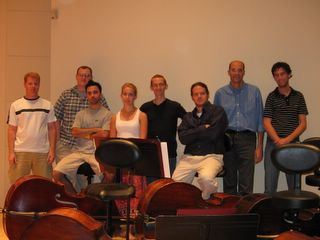
Viper, Merlin, Maverick, Hollywood, Iceman, Wolfman, Steve, and Goose
Dacy Gillespie - Hollywood
Dacy was chosen as Hollywood by the largest majority of any nickname, 11 votes out of 18 recorded. In the actual movie, Hollywood may have been a big black guy (no one can remember for sure), but Dacy earned his call sign with her sense of style and grace.
Dave DeRiso - Maverick
Eight voters nominated Dave as the short, dark, and handsome hero of Top Gun. As we like to continually remind Dave, "You're dangerous, Maverick - it's not your flying, it's your attitude."
Scott Dixon - Goose
Also with eight votes, Scott was chosen as Maverick's lovable but ill-fated wingman Goose. While the nickname could potentially be pejorative, in Scott's case it seems to reflect an appreciation of him as a great pal rather than a tendency to make squonking noises and bite small children.
Andy Giller - Wolfman
The voters favored Andy decisively with eight votes, possibly reflecting his take-no-prisoners attitude or his nocturnal habits. I don't really know what Andy's nocturnal habits are, it just seems like a Wolfman should have some.
Aaron White - Merlin
Though four voters nominated Aaron as Jester, a majority of six made him our Merlin, based perhaps on his wizened status as our eldest bass player or his magical execution of the finale of Mozart 40.
Matt Heller - Iceman
Matt was likened to the annoying antagonist played by Val Kilmer by a narrow majority of five votes, just one more than voted him as Goose. This would seem to reflect a deeply divided electorate which tilts slightly towards finding Matt a creep.
Sean O'Hara - Viper
In an even closer election, Sean was given this reptilian nickname with five votes, with four each for Jester and Iceman. Perhaps voters were attracted to the silent but deadly connotations, though Sean is not known to be particularly deadly.
Thanks to everyone who voted! Campaigning for cello section Care Bear nicknames will begin soon.
The election process was completely unregulated and went on for a couple of weeks, though most people only knew about it the last couple of days. Anyone able to operate a pencil was eligible to vote, and 20 ballots were cast, 2 of which were incomplete or illegible. Despite all this, results were fairly conclusive, as follows:

Viper, Merlin, Maverick, Hollywood, Iceman, Wolfman, Steve, and Goose
Dacy Gillespie - Hollywood
Dacy was chosen as Hollywood by the largest majority of any nickname, 11 votes out of 18 recorded. In the actual movie, Hollywood may have been a big black guy (no one can remember for sure), but Dacy earned his call sign with her sense of style and grace.
Dave DeRiso - Maverick
Eight voters nominated Dave as the short, dark, and handsome hero of Top Gun. As we like to continually remind Dave, "You're dangerous, Maverick - it's not your flying, it's your attitude."
Scott Dixon - Goose
Also with eight votes, Scott was chosen as Maverick's lovable but ill-fated wingman Goose. While the nickname could potentially be pejorative, in Scott's case it seems to reflect an appreciation of him as a great pal rather than a tendency to make squonking noises and bite small children.
Andy Giller - Wolfman
The voters favored Andy decisively with eight votes, possibly reflecting his take-no-prisoners attitude or his nocturnal habits. I don't really know what Andy's nocturnal habits are, it just seems like a Wolfman should have some.
Aaron White - Merlin
Though four voters nominated Aaron as Jester, a majority of six made him our Merlin, based perhaps on his wizened status as our eldest bass player or his magical execution of the finale of Mozart 40.
Matt Heller - Iceman
Matt was likened to the annoying antagonist played by Val Kilmer by a narrow majority of five votes, just one more than voted him as Goose. This would seem to reflect a deeply divided electorate which tilts slightly towards finding Matt a creep.
Sean O'Hara - Viper
In an even closer election, Sean was given this reptilian nickname with five votes, with four each for Jester and Iceman. Perhaps voters were attracted to the silent but deadly connotations, though Sean is not known to be particularly deadly.
Thanks to everyone who voted! Campaigning for cello section Care Bear nicknames will begin soon.


Saturday, March 26, 2005
Russian new music concert
Tonight our orchestra is playing a program of new music by Russian composers - we've just finished our dress rehearsal, so I thought I would write my thoughts about the concert, and then I can link to the newspaper if it gets reviewed so you can get the critic's take.
The first piece on the program is for solo violin and a chamber orchestra without violins - it is called Aftersight, by a composer named Kissine, and I don't play on it. I listened to a bit of the rehearsal though, and it sounded good. The soloist, Alexander Barantschik who is concertmaster of the San Francisco Symphony, plays it very convincingly and there are a lot of interesting orchestration effects to listen to.
In our system of string seating rotation, I got to be principal bass for the next piece, called Stufen by Sofia Gubaidulina. I was initially a little concerned, because much of the bass part is divided into 8 parts, and we only have 7 bass players. I quickly realized, though, that the intent was less like a Bach 8-part invention and more like a bunch of insects chirping on a summer evening. The effect is to sound just random and independent enough that there could be an infinite amount of people playing. While the notes and rhythms are a bit tricky, the effect is actually quite easy to pull off, I was pleasantly surprised to discover. I think the piece should come off very effectively, as long as the tape of Russian poetry starts when it is supposed to. The end of the piece features seven deep male voices reciting the same poem with different speeds and intonations, so that you can barely pick out more than short phrases, even if you understand Russian. It is kind of a spooky, mysterious way to end a piece, as long as the orchestra doesn't crack up listening to it.
The other piece for full orchestra is by Alfred Schnittke, and it is called In memoriam. In memoriam to whom, I'm not sure, though playing it I can't help thinking about Shostakovich all the time. It has a simple little theme that recurs in each of the five movements, including a beautiful waltz movement with solo clarinet. Another movement has a little aleatoric section - MTT, the conductor, said today in rehearsal that the reason for this is that "everyone goes ape a little differently", which I thought was a strangely profound thought. The bass section doesn't really do much, other than some solo harmonics and low B's. Our lowest note is normally a low C, so in cases like this we have to tune our lowest string down an extra half step, and try to remember so we don't play the wrong pitches in the rest of the piece. This isn't too difficult in this case, though - in one of the movements, we only play a single note. I was joking with my stand partner that I really disagreed with our interpretation of this movement, we need to sit with a slight more forward tilt to express the intensity of our 47 bars of rest. The last movement is a beautiful passacaglia with a 14-bar organ theme repeated 14 times.
The first piece on the program is for solo violin and a chamber orchestra without violins - it is called Aftersight, by a composer named Kissine, and I don't play on it. I listened to a bit of the rehearsal though, and it sounded good. The soloist, Alexander Barantschik who is concertmaster of the San Francisco Symphony, plays it very convincingly and there are a lot of interesting orchestration effects to listen to.
In our system of string seating rotation, I got to be principal bass for the next piece, called Stufen by Sofia Gubaidulina. I was initially a little concerned, because much of the bass part is divided into 8 parts, and we only have 7 bass players. I quickly realized, though, that the intent was less like a Bach 8-part invention and more like a bunch of insects chirping on a summer evening. The effect is to sound just random and independent enough that there could be an infinite amount of people playing. While the notes and rhythms are a bit tricky, the effect is actually quite easy to pull off, I was pleasantly surprised to discover. I think the piece should come off very effectively, as long as the tape of Russian poetry starts when it is supposed to. The end of the piece features seven deep male voices reciting the same poem with different speeds and intonations, so that you can barely pick out more than short phrases, even if you understand Russian. It is kind of a spooky, mysterious way to end a piece, as long as the orchestra doesn't crack up listening to it.
The other piece for full orchestra is by Alfred Schnittke, and it is called In memoriam. In memoriam to whom, I'm not sure, though playing it I can't help thinking about Shostakovich all the time. It has a simple little theme that recurs in each of the five movements, including a beautiful waltz movement with solo clarinet. Another movement has a little aleatoric section - MTT, the conductor, said today in rehearsal that the reason for this is that "everyone goes ape a little differently", which I thought was a strangely profound thought. The bass section doesn't really do much, other than some solo harmonics and low B's. Our lowest note is normally a low C, so in cases like this we have to tune our lowest string down an extra half step, and try to remember so we don't play the wrong pitches in the rest of the piece. This isn't too difficult in this case, though - in one of the movements, we only play a single note. I was joking with my stand partner that I really disagreed with our interpretation of this movement, we need to sit with a slight more forward tilt to express the intensity of our 47 bars of rest. The last movement is a beautiful passacaglia with a 14-bar organ theme repeated 14 times.
Subscribe to:
Posts (Atom)