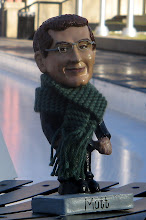
This weekend the CPO performs Don Quixote, the Strauss tone poem that is really more like a tone-novel. It's hard to think of another piece of symphonic music that ties together so many stories, characters, and conversations -- all while maintaining a fairly straightforward theme and variations structure, though with some odd twists.
Among the odd things in the bass part of Don Quixote is the indication on page 1 that the section should put on mutes. The mutes remain on through two pages of loud, melodic bass lines, covering a wide register. You would think he made a mistake, as we're asked to play fff (basically as loud as humanly possible), but he repeats the instruction, two more times: mit dampfer, meaning keep the mutes on!
Unlike brass mutes, bass mutes often won't cut the sound a great deal. What they do is to alter and impede the vibrations of the bridge, and so they have a greater effect on the color of the instrument. When played softly, as they most commonly are, mutes give the bass a somewhat subdued, veiled tone. When a bass is played loudly with a mute, however, there's an almost comical quality of struggle and tension, like a duck squawking madly. During loud playing, the vibration of the bridge may actually dislodge a wood mute and send it flying off the instrument. More often, we use rubber mutes which stay on the bridge a little better, but won't change the sound as much.
I think that Strauss was looking for that quality of hapless squawking, the orchestrational equivalent of tilting at windmills -- and so I'm a bit disappointed when we ignore the mute indication and just play it normally. Sure, it's a strange and senseless think to demand, and only the most perceptive and informed listeners will notice the difference -- and yet it's a brilliant way of depicting a strange, senseless person who makes a habit of struggling against inanimate objects. (Which would be a fairly accurate description of bass players in general...)
The concert tonight features a fantastic soloist, our own principal cellist Phil Hansen. Tickets may still be available, check out the CPO website for more information!
Showing posts with label bassists. Show all posts
Showing posts with label bassists. Show all posts
Friday, March 20, 2009


Friday, November 14, 2008
Joel Quarrington master class
Before the National Arts Centre Orchestra's tour date in Calgary last Friday, bassist Joel Quarrington gave a master class at the University of Calgary School of Music. Three young bassists played for Joel: two of Charles Garrett's students at the U of C, and a 13-year-old student of Sheila Garrett.
Joel's approach to teaching, like his playing, is irreverent, inventive, and joyful. After the first student played the first movement of Hindemith's Sonata, he suggested that maybe she could have more fun with the bow -- a clever way to talk about technique without being pedantic about it. He demonstrated an exercise for starting notes distinctly, playing a scale with 4 notes hooked on each bow, and encouraged the student to play it with a solid core sound without pressing. Joel had his own bass there, a 17th-century Maggini, and the student's sound production seemed to improve just from hearing him play a few notes.
Since Joel plays German bow on a bass tuned in 5ths, it wasn't always easy to imitate his playing. He was very accomodating to the players' individual preferences, though, and tried to adjust his own technique to better match what they were trying to do. "Excuse my French bow," he said after playing some fast off-string strokes. He showed the first student, who was sitting on a high stool, how she could better access the upper register of the instrument, by sliding back on her stool and getting more weight over the fingerboard -- Joel's physique is completely different from hers, but she still seemed to find some benefit from the adjustment.
The second student was the 13-year-old, playing the first movement of the Dragonetti Concerto. Joel got him working on fast, fluid shifts and demonstrated the infamous shifting drill - I learned it as "vomit" - to improve accuracy. This raised some set-up issues again, and Joel discussed why his own preference is to sit on a stool for solo performances, while still showing the student how he could manage the shift better while standing.
With all three students, Joel emphasized the need for consistent scale and bowing studies. At one point, he noticed a stack of papers in a bookcase nearby -- the master class was held in a crowded little violin teaching studio room -- and found a sheet with various bowings attached, "like a ransom note" he said. He encouraged everyone to get a set of bowing variations like that one -- whether from an abandoned violin studio, or an actual bowing method -- and work on producing a quality sound with all sorts of articulations.
The last student played the first movement of Bottesini's 2nd concerto very impressively. Joel asked her if she had any issues she wanted to bring up -- she talked about off-string strokes, which again brought up scales and bowing variations. Joel helped her clean up the end of the cadenza, a dizzying whir of 16th notes.
Joel's approach to teaching, like his playing, is irreverent, inventive, and joyful. After the first student played the first movement of Hindemith's Sonata, he suggested that maybe she could have more fun with the bow -- a clever way to talk about technique without being pedantic about it. He demonstrated an exercise for starting notes distinctly, playing a scale with 4 notes hooked on each bow, and encouraged the student to play it with a solid core sound without pressing. Joel had his own bass there, a 17th-century Maggini, and the student's sound production seemed to improve just from hearing him play a few notes.
Since Joel plays German bow on a bass tuned in 5ths, it wasn't always easy to imitate his playing. He was very accomodating to the players' individual preferences, though, and tried to adjust his own technique to better match what they were trying to do. "Excuse my French bow," he said after playing some fast off-string strokes. He showed the first student, who was sitting on a high stool, how she could better access the upper register of the instrument, by sliding back on her stool and getting more weight over the fingerboard -- Joel's physique is completely different from hers, but she still seemed to find some benefit from the adjustment.
The second student was the 13-year-old, playing the first movement of the Dragonetti Concerto. Joel got him working on fast, fluid shifts and demonstrated the infamous shifting drill - I learned it as "vomit" - to improve accuracy. This raised some set-up issues again, and Joel discussed why his own preference is to sit on a stool for solo performances, while still showing the student how he could manage the shift better while standing.
With all three students, Joel emphasized the need for consistent scale and bowing studies. At one point, he noticed a stack of papers in a bookcase nearby -- the master class was held in a crowded little violin teaching studio room -- and found a sheet with various bowings attached, "like a ransom note" he said. He encouraged everyone to get a set of bowing variations like that one -- whether from an abandoned violin studio, or an actual bowing method -- and work on producing a quality sound with all sorts of articulations.
The last student played the first movement of Bottesini's 2nd concerto very impressively. Joel asked her if she had any issues she wanted to bring up -- she talked about off-string strokes, which again brought up scales and bowing variations. Joel helped her clean up the end of the cadenza, a dizzying whir of 16th notes.
Monday, June 30, 2008
BassGeeks
drop.io: simple private sharing
Monday, May 12, 2008
musicological smackdowns
 Musicologists and gangster rappers have a lot more in common than you might think -- they both spend a fairly high proportion of their work ripping on the works of their rivals, for one thing. I just started reading Opera as Drama by Joseph Kerman, which is of course a very scholarly, serious musicological text. But he starts out his preface dissing mercilessly on another musicologist, Peter Conrad, who wrote an article defending Tosca as an effective dramatic work:
Conrad calls the static opening of Act III dramatically cogent because it summarizes "the operatic transvaluing of religious values that has preceded" -- something that can indeed be said to be articulated by music: by stage music, by the Shepherd Boy's song followed by the melange of church bells. What, then, does Puccini's score accomplish that would not be accomplished by literal folksongs and Sunday-morning tape recordings? What does its particular mawkish (and undaring) quality have to do with the opera's "daring profanation of the sacred"? It is on questions like that Conrad's interpretation stands or, as I think, falls.
- Preface to the New Edition, Opera as Drama by Joseph Kerman, p. xiii
Oh, no he didn't! I almost want to read the Peter Conrad article, just so I can fully enjoy Kerman's musicological smack-down. Not that I share his low opinion of Tosca -- maybe it is mawkish, but it can still make an auditorium full of people whimper and sob. I just get a huge pleasure from watching music critics go at it, mocking one another's clumsily phrased arguments and unfortunate choices of adjectives. It's sort of like watching a gang of pirhanas and a shark mix it up -- you're not sure which you're pulling for, you just want to see some carnage.
Opera as Drama is a fun book to read, even if you're not a big fan of musicological squabbling. I'm still only on Chapter 2 -- Orpheus: The Neoclassic Vision -- but already there's been an intriguing reference to a famous double bass excerpt, in the Prologue:
The scene begins on a celebrated note of menace, muted double-basses interrupting the ethereal close of Desdemona's Ave Maria. What defines it as much as the grotesque color and pitch is the key contrast, E thrust into A-flat. The double-bass line becomes more mellow, and limps, punctuated by an urgent motive, at first bleak, then flaring up as Otello makes to scimitar Desdemona at once.Hey, watch who you're calling 'grotesque', mister. Though I do like the word 'menace', and the 'thrust' of our first low E entrance. Hearing that transition is always startling, and it seems like a shame to start that excerpt without the high, ethereal A-flat major chord that precedes it. Bass players can argue endlessly about whether there should be an accent on that note, and what kind of accent, or maybe just a swell, or a lean... I'm not really sure what the right answer is. When you experience it in context though, and feel that stomach-lurching change of tonality, the bass section really does play a dramatic role.
- p. 7
A friend once told me about a ghastly visualization exercise he was given for this excerpt. He had played through the Otello soli for a noted bassist and pedagogue, at the very beginning of their first lesson. The teacher asked, "Do you have a wife or girlfriend?" -- yes, he replied, he did have a girlfriend. "I want you to play it again, but imagine that you're so enraged, so furious, at such a psychotic breaking point, that you are prepared to kill the woman you love."
At that point, I think he may have asked, "And should I begin with an accent?"
Wednesday, December 05, 2007
bouncing bow advice
 The very first masterclass I attended at last summer's ISB convention was entitled "Bow Strokes with Jeremy McCoy." That might not sound irresistibly attractive to some people, but those people apparently were not in attendance at the 2007 ISB Bass Convention. The room was packed, there were people standing along the wall, and even craning their necks to see from outside the door.
We were about to hear Jeremy McCoy demonstrate spiccatto, and we were all pretty damn excited about it.
Jeremy McCoy plays in the Metropolitan Opera Orchestra, and if you don't know his playing, check out his recently released cd "Dialogues with Double Bass". It's an incredible variety of duets for bass and other instruments, showing off Jeremy's musicality as collaborator as well as soloist.
Getting back to the masterclass though - I unfortunately can't offer any sound or video, but I was taking notes. Here are some of Jeremy's guidelines for working on spiccatto, as well as I can remember them:
1. Prepare with long tones - The contact in a bounced stroke is relatively short, so it's especially important to develop immediate, quality core sound. Focus on full contact with flat bow hair, developing the maximum friction in order to start the string vibrating as quickly as possible.
2. Neutral lines - We don't want anything rigidly straight in the bow arm, since that will disrupt the natural springiness of the bow. The wrist and elbow need to have a combination of firmness and suppleness, so they can direct the bounce without overly controlling it - think of the fluid motion of a basketball player dribbling. This will work best with some degree of flexion.
3. The tip must track - Any wobble or wavering in a long or detache stroke will only become more pronounced in an off the string stroke. Watch that the tip follows a consistent, straight path in long tones, so that it can track horizontally in spiccatto strokes. Notice if the motion of up-bows and down-bows is symmetrical, or if one is more pronounced. Again, using full bow hair for maximum friction will help.
4. Find a natural bounce point - This can start with finding the balance point on your bow, and experimenting with bounced strokes in relation to that point. There's no single ideal spot on the bow, but moving away or towards the balance point can help make spiccatto strokes longer or crisper.
5. Initiate with the elbow - Longer strokes might work better with the whole arm, while shorter may mostly involve the wrist and fingers. Any bounced stroke will start with the elbow though - watch that the elbow is preparing and leading the arm and bow.
He went on to demonstrate a whole range of spiccatto strokes, from martele and sautille to ricochet, battute and balzato. I don't actually remember what a balzato stroke sounded like (my notes say "lit. 'prancing' - flicked at top") but it's a fun word to say in rehearsal or at an audition. "Can we hear that a little more balzato, please?"
Saturday, November 03, 2007
Sheila's dream
One of my bassist colleagues told me about a recent dream she had - and I hope she won't mind if I write about it here, since it's so fabulous I think it needs to be shared with the world.
In her dream, both she and I were taking some big orchestra audition. We'd been working hard for a long time to prepare, and all the rest of our section decided to come along with us for moral support. (I love my section, but I can hardly dream of anyone wanting to do that!) So we got to the audition, played our best, but neither of us got the job. That's life, I guess. But the really amazing part was the guy who won, and the reason - he had worked out this whole skit to go along with the excerpts from Ein Heldenleben. Something elaborate involving an anti-gravity mail-chute-type thing, shooting the music up into the air, and then he would play it. We were both really disappointed, in Sheila's dream, because we hadn't thought to prepare any skits to accompany our excerpts!
I'm not sure what the orchestral world would be like if auditions included props and pyrotechnics like that, but I imagine that the conversations afterwards with friends and family members might be much easier:
In her dream, both she and I were taking some big orchestra audition. We'd been working hard for a long time to prepare, and all the rest of our section decided to come along with us for moral support. (I love my section, but I can hardly dream of anyone wanting to do that!) So we got to the audition, played our best, but neither of us got the job. That's life, I guess. But the really amazing part was the guy who won, and the reason - he had worked out this whole skit to go along with the excerpts from Ein Heldenleben. Something elaborate involving an anti-gravity mail-chute-type thing, shooting the music up into the air, and then he would play it. We were both really disappointed, in Sheila's dream, because we hadn't thought to prepare any skits to accompany our excerpts!
I'm not sure what the orchestral world would be like if auditions included props and pyrotechnics like that, but I imagine that the conversations afterwards with friends and family members might be much easier:
ZOE (my sister): So whatever happened at that audition you took a couple months ago? The one in Cleveland, or was it Colorado?
ME: Oh, you mean Kansas City. I played pretty well, I nailed the Don Juan and got all the notes on Mozart 35, though I may have been a little under tempo...
ZOE: Uh-huh, you're kind of losing me there, but so what happened?
ME: Well, I made semis, but there was a guy with a talking parrot and a little person in a tutu, so he ended up winning.
ZOE: A little person? Do you mean a midget?
ME: Well yeah, but they prefer to be called little people.
ZOE: Oh yeah. Well sorry about that. Anything else coming up?
ME: No, but if you meet any little people who can dance to Beethoven 5, you should let me know.
ZOE: Sure thing
Friday, October 05, 2007
things I learned at the 2007 ISB Convention
This past summer, I went to Oklahoma City for the week-long International Society of Bassists Convention. While I genuinely intended to chronicle the whole trip, I never really did - all that came out of it was this one sad little post with a picture of a flight trunk loaded (successfully!) onto a plane.
I always feel a little guilty to promise stuff on this blog - all those concerts I meant to write up, those videos I meant to upload, the Jason Heath blackmail stories, etc. - then never deliver. I decided in this case I would do a little make-up work. Maybe it will all be really exciting, reading my up-to-the-minute thoughts on things that happened 3 months ago? And if no one much cares anymore, that's okay too.
So to get you in the mood, and maybe refresh my memory, here's a little list I'm calling:
Things I Learned at the ISB Convention (So You Don't Have To)
DO check out some masterclasses
They're a great chance to meet some of the foremost bassists, and get a sample of what they're like as teachers. This past summer, I got to see masterclasses by Jeremy McCoy, Paul Ellison, Ed Barker, Diana Gannett, Scott Haigh, and Rob Kassinger - who titled his class "Things I Learned the Hard Way, So You Don't Have To" (and inspired this list's title). Like Rob's, many of the classes had a certain emphasis - bow strokes, audition advice, etc. But they were all happy to answer other questions, and most of the sessions seemed to spill out into the hallways, with a crowd of bassists curious for the secret to a singing vibrato, or a really kick-ass brush stroke.
DO bring a bass (if possible) and have stuff ready to play
Most of the people at the bass convention did not bring their own instruments - understandably, given the difficulties of travel. I was happy I had mine though, since it meant that I could often play on those masterclasses I just listed. I played for Rob Kassinger, Paul Ellison, and Ed Barker. And Gottfried Engels, a bass professor member of the Dusseldorf Symphony, gave me a fascinating lesson about using my 'hara' to play with a richer sound. (I'd never heard of the 'hara' before this - it's sort of related to the chi.) That's partly why I never got around to writing any of this stuff up; there was just so much of it, and I've got pages of notes messily scribbled on programs.
DON'T eat lunch alone
Okay, you've already flown yourself to a bass convention, one of the geekiest things imaginable. You might as well just geek out entirely, spend all your time talking about bass, and surrounded by people doing the same. One day at the breakfast table, another bassist interrupted our chat about the texture of the eggs and asked, "So what do you guys think about rosin?" It was such a bizarre non-sequitur, and so out of place, I started to laugh. Then I realized he seriously wanted to hear our opinions about bass rosin.
DO enter one of the competitions, if you're eligible and interested
Each year there are several solo competitions for various age brackets, as well as orchestral, composition, and bass makers' competitions. I entered the orchestral competition, and while I wasn't the super-duper grand prize winner (that was Tony Parry), I did have a great time, got some helpful comments, and won a pretty good-sized chunk of cash. The orchestral competition was run like a real audition, with several rounds, and a list of standard solos and excerpts. The solo competitors each presented a full recital program for their final round, which was really cool to watch - all of the competitions are open to the public. So it's worth getting there a day early to listen, even if you're not participating.
DON'T try to keep up with Peter Lloyd
Peter Lloyd was actually a major reason I decided to come to this convention. These are my actual notes from a lesson I transcribed:
DO try out lots of basses and bows
Eventually you're going to need a break from all those recitals, you won't want to hear another word about Viennese tuning, the collected works of Johann Sperger will hold no more mystery for you. That would be a good time to go to the big exhibition room and try out basses. All the biggest shops were represented with dozens of instruments and hundreds of bows. Many of the makers are on hand too, so you're sure to get all your questions answered. Except for, "How in the world can I afford this bass I've suddenly realized I can't live without?"
DON'T miss the evening recitals!
A day at a bass convention can feel like a mad scrambling free-for-all, especially if you're trying to follow Peter Lloyd (see above). But the evening is when everyone comes together for some of the most inspiring performances I've ever heard. I fully expected recitalists Ed Barker, Jeff Bradetich, and Joel Quarrington to be awesome - and they each exceeded my expectations. Even more thrilling to hear Thierry Barbe, Renaud Garcia-Fons, Avishai Cohen, and Jacek Niedziela, all of whom I heard for the first time.
DO bring business cards, if you've got them
You're bound to meet lots of new people, have lots of fascinating conversations, and then forget everyone's name and whereabouts soon afterwards. That's what I did, anyway. Best to hand your cards out liberally, and try and collect everyone else's. Hopefully you'll stay in touch with everyone you meet. After all, it's less than two more years until the ISB Convention 2009 at Penn State University.
I always feel a little guilty to promise stuff on this blog - all those concerts I meant to write up, those videos I meant to upload, the Jason Heath blackmail stories, etc. - then never deliver. I decided in this case I would do a little make-up work. Maybe it will all be really exciting, reading my up-to-the-minute thoughts on things that happened 3 months ago? And if no one much cares anymore, that's okay too.
So to get you in the mood, and maybe refresh my memory, here's a little list I'm calling:
Things I Learned at the ISB Convention (So You Don't Have To)
DO check out some masterclasses
They're a great chance to meet some of the foremost bassists, and get a sample of what they're like as teachers. This past summer, I got to see masterclasses by Jeremy McCoy, Paul Ellison, Ed Barker, Diana Gannett, Scott Haigh, and Rob Kassinger - who titled his class "Things I Learned the Hard Way, So You Don't Have To" (and inspired this list's title). Like Rob's, many of the classes had a certain emphasis - bow strokes, audition advice, etc. But they were all happy to answer other questions, and most of the sessions seemed to spill out into the hallways, with a crowd of bassists curious for the secret to a singing vibrato, or a really kick-ass brush stroke.
DO bring a bass (if possible) and have stuff ready to play
Most of the people at the bass convention did not bring their own instruments - understandably, given the difficulties of travel. I was happy I had mine though, since it meant that I could often play on those masterclasses I just listed. I played for Rob Kassinger, Paul Ellison, and Ed Barker. And Gottfried Engels, a bass professor member of the Dusseldorf Symphony, gave me a fascinating lesson about using my 'hara' to play with a richer sound. (I'd never heard of the 'hara' before this - it's sort of related to the chi.) That's partly why I never got around to writing any of this stuff up; there was just so much of it, and I've got pages of notes messily scribbled on programs.
DON'T eat lunch alone
Okay, you've already flown yourself to a bass convention, one of the geekiest things imaginable. You might as well just geek out entirely, spend all your time talking about bass, and surrounded by people doing the same. One day at the breakfast table, another bassist interrupted our chat about the texture of the eggs and asked, "So what do you guys think about rosin?" It was such a bizarre non-sequitur, and so out of place, I started to laugh. Then I realized he seriously wanted to hear our opinions about bass rosin.
DO enter one of the competitions, if you're eligible and interested
Each year there are several solo competitions for various age brackets, as well as orchestral, composition, and bass makers' competitions. I entered the orchestral competition, and while I wasn't the super-duper grand prize winner (that was Tony Parry), I did have a great time, got some helpful comments, and won a pretty good-sized chunk of cash. The orchestral competition was run like a real audition, with several rounds, and a list of standard solos and excerpts. The solo competitors each presented a full recital program for their final round, which was really cool to watch - all of the competitions are open to the public. So it's worth getting there a day early to listen, even if you're not participating.
DON'T try to keep up with Peter Lloyd
Peter Lloyd was actually a major reason I decided to come to this convention. These are my actual notes from a lesson I transcribed:
Given that kind of ringing endorsement, I naturally couldn't resist - and what's more he was right (sadly no Spice Girls this year, but still). The only qualification is that not everyone is built like Peter Lloyd, who actually goes to 2 or 3 events every hour. I tried this briefly, and quickly reached acute bass overload. One event an hour was plenty for me, thank you.come to a bass convention! You will be in 7th heaven! You are tailor made, they are unbelievable, incredibly inspiring, 800 bass players, 50-60 dealers, everything that exists related to bass, 1000s of recordings, bows, every kind of strings, 900 kinds of mutes, 2-3 things simultaneously every hour on the hour
intellectual treatises on how Dragonetti wrote his music, 8 bassists playing Spice Girls, everything in between, fantastic jazz side, only thing you'll regret is having not gone to one sooner - after an hour, he sat in a corner and kicked himself
DO try out lots of basses and bows
Eventually you're going to need a break from all those recitals, you won't want to hear another word about Viennese tuning, the collected works of Johann Sperger will hold no more mystery for you. That would be a good time to go to the big exhibition room and try out basses. All the biggest shops were represented with dozens of instruments and hundreds of bows. Many of the makers are on hand too, so you're sure to get all your questions answered. Except for, "How in the world can I afford this bass I've suddenly realized I can't live without?"
DON'T miss the evening recitals!
A day at a bass convention can feel like a mad scrambling free-for-all, especially if you're trying to follow Peter Lloyd (see above). But the evening is when everyone comes together for some of the most inspiring performances I've ever heard. I fully expected recitalists Ed Barker, Jeff Bradetich, and Joel Quarrington to be awesome - and they each exceeded my expectations. Even more thrilling to hear Thierry Barbe, Renaud Garcia-Fons, Avishai Cohen, and Jacek Niedziela, all of whom I heard for the first time.
DO bring business cards, if you've got them
You're bound to meet lots of new people, have lots of fascinating conversations, and then forget everyone's name and whereabouts soon afterwards. That's what I did, anyway. Best to hand your cards out liberally, and try and collect everyone else's. Hopefully you'll stay in touch with everyone you meet. After all, it's less than two more years until the ISB Convention 2009 at Penn State University.
Saturday, September 22, 2007
sign a petition for Jaco
 NPR's Melissa Block reported a nice tribute to Jaco Pastorius yesterday, on the 20th anniversary of his death. A native of Fort Lauderdale, Jaco also died there tragically in a fight outside a nightclub.
Jaco's life unfortunately seems to have been a sort of downward spiral, and every remembrance of him seems to be filled with sadness and regret. Still, his music deserves to be celebrated - and it's too bad Florida doesn't really have any memorial to Jaco.
Oh wait, someone online has a petition to build one! Well, I'll sign - there aren't enough public parks dedicated to bass players, in my humble opinion.
The photo shown here is from JacoPastorius.com, his official website, where you can read memorials by musicians who knew and admired Jaco.

Wednesday, May 09, 2007
Calgary audition odyssey, part IV
...this is a continuation of Calgary audition odyssey, part III...
And so dawned my first day in Calgary - Friday, March 30th, the day before the audition itself. I didn't set the alarm, figuring that I would get as much sleep as possible, and get myself rested and ready for Saturday. I slept in until about 8:30, which is way late for me, especially with the 2 hour time difference. I felt at least semi-normal, though, and decided to find out how I sounded.
Unpacking the bass in a strange hotel room is always an interesting experience. Travel and changes in climate and time zone can mess up a person, but they can really mess up a bass. There's no telling what is going to be tight, awkward, and uncooperative. Or maybe the instrument will actually prefer the new weather, you never know... Sometimes buzzes and wolves disappear, or temporarily migrate to new areas, so it kind of feels like opening your mouth and hearing a foreign language come out!
I'm not a great fan of the unfamiliar, I guess. I usually have to force myself to start the discovery process, even though I would rather not spend two hours with a touchy bass right away! I made a little deal with myself, I would unpack and play a few scales, then go get some breakfast. That seemed to help me to feel satisfied that I'm not postponing business, but still not too trapped and scared - a relatively happy compromise with myself, as well as my instrument!
So the scales came off relatively well, and I even started my Bach and a couple excerpts, just to find a sound, until I started to hear my stomach growling its own harmonies. My friend Roslyn the horn player had told me that there was a Tim Horton's restaurant right near the hotel - even though I'd never heard of this chain, she made it sound like some great providence, so I thought I would look for it. Calgary was overcast, a little cool but still comfortable with a sweater and a couple of undershirts on. The 5 Suites Downtown is on 5th Avenue and 5th Street SW, making it very easy to find, as long as you don't pick the wrong quadrant. Calgary is laid out in 4 quadrants, radiating out from Memorial Drive and Centre St. - most of downtown is in the SW quadrant though, so I guess Centre St. isn't really that central.
It's a nice city to walk around in - cars seem to obey the stoplights, and amazingly, pedestrians do as well. I picked a direction at random, and within two blocks I had sighted a Tim Horton's. I later learned that I could have gone any other direction and found another Tim Horton's equally quickly, but at the time it seemed like amazing luck. There was a line of college students, construction workers, and young professional types coming out the door - every Tim Horton's I visited had a similar line, but they moved pretty quick, and everything I ordered was there surprisingly good and quite cheap.
So after breakfast I wandered up the main pedestrian avenue, Stephen Ave. It's lined with shops, some American chains but mostly places I had never heard of before. There are malls along both sides of the avenue with connecting passageways, so you can actually walk the length of it without leaving indoors. The weather was nice enough that morning though, and there were crowds of people around some temporary street hockey courts that had been set up. As I got closer I found it was a Corporate Street Hockey Tournament, so all these bankers and securities analysts were warming up in their skates and pads.
I was still marveling at the Canadian-ness of it all when I saw my friend, bassist Karl Fenner, emerge from a McDonald's restaurant. We were both headed in the same direction - towards the Calgary Phil's space, Jack Singer Concert Hall. Not to break in or anything, but it's nice to get a feel for the building, how to get there, and what is around. Along the way, we compared notes on our trips so far - he had flown Continental and paid a lot more in oversize fees, which concerned me because I was ticketed to fly Continental home. The big news around New World had been the announcement of 4th-year offers to some of us - I was one of the fortunate ones - among a large number who were not invited back. Karl told me he had just been invited to join New World as a fellow the next year as well, so we would get to play together, unless one of us had an audition victory in the meantime...
This is almost an inevitable part of the audition experience: you're going to run into some friend or acquaintance, who you may not have seen for months or years. He's going to have some great news to report - he's been subbing with the Chicago Symphony, or just won the audition for New World - and your mind will start racing back to how good he sounded the last time you heard him, and now he's only gotten better! Suddenly all those positive vibes, confidence-building mock auditions, and the encouraging comment from the customs official at the airport, they all begin to evaporate and the sad path to disappointment appears instead. I don't have an easy solution to all this; except to realize that we all think that way, and the only escape is to have faith in yourself and your musical mission!
Well, I got back to my hotel room after seeing Karl, and if I'd thought about resting or channel-surfing before, I was definitely going to start practicing now! I had gotten through my warm-up scales and arpeggios when the housekeeping lady knocked on the door and came in. I was going to stop and wait, but she said, "Please don't let me interrupt!" and so I kept playing scales for a couple of minutes. Then it occurred to me, this might be my last chance to perform for someone before the audition - so I checked my tuning, took a deep breath, and performed my Bach Bourrees for her! Then I did some Mozart 40, Beethoven 5, Heldenleben - all my nemesis excerpts. They didn't all go perfect, but she was very appreciative and complimentary, and I started feeling confident and secure again.
I didn't want to spend the whole afternoon practicing - and I wanted to make sure the practicing I did was focused, intentional practicing, not scared and obsessive-compulsive! I broke up half-hour chunks by resting and meditating, reading from some books I had brought (The Wisdom of Rilke, Fight Your Fear and Win by Don Greene, The Essential Rumi translated by Coleman Barks), and sorting through my parts and excerpts. I'd brought a big stack of photocopies, which I would give to people listening to me on mock auditions - these had gotten all mixed up though. After putting these all in order, I realized I'd forgotten something else important: the solo part of my concerto, the Vanhal. I had the piano score, and photocopies of the first two pages, but if I had to play any more than that, I would be doing it from memory.
By 6:30 or 7, I had practiced more than enough, and was actually a little concerned I had overdone it. So I left the hotel room - the sun had come out from behind the clouds, and the city was lit by a golden sunset color. I walked across a bridge over the Bow River (it's actually the shape of a bow, sort of) to a neighborhood called Kensington, which reminded me of cool neighborhoods I'd been to in Boston and Chicago. There are lots of funky shops and ethnic restaurants, young people walking around in groups and couples. After some wandering and indecision I chose an Ethiopian restaurant - I love Ethiopian food - which took a ridiculously long time but gave me an hour and a half to just sit by myself, relax, eat some good food, and brace myself for the next day!
I got back to the hotel room about 9:30, read a book for a minute, then put on my earphones and listened to Ian Bostridge's recording of Schubert Lieder. I didn't want to think too much - just drift off to sleep with some beautiful melodies.
And so dawned my first day in Calgary - Friday, March 30th, the day before the audition itself. I didn't set the alarm, figuring that I would get as much sleep as possible, and get myself rested and ready for Saturday. I slept in until about 8:30, which is way late for me, especially with the 2 hour time difference. I felt at least semi-normal, though, and decided to find out how I sounded.
Unpacking the bass in a strange hotel room is always an interesting experience. Travel and changes in climate and time zone can mess up a person, but they can really mess up a bass. There's no telling what is going to be tight, awkward, and uncooperative. Or maybe the instrument will actually prefer the new weather, you never know... Sometimes buzzes and wolves disappear, or temporarily migrate to new areas, so it kind of feels like opening your mouth and hearing a foreign language come out!
I'm not a great fan of the unfamiliar, I guess. I usually have to force myself to start the discovery process, even though I would rather not spend two hours with a touchy bass right away! I made a little deal with myself, I would unpack and play a few scales, then go get some breakfast. That seemed to help me to feel satisfied that I'm not postponing business, but still not too trapped and scared - a relatively happy compromise with myself, as well as my instrument!
So the scales came off relatively well, and I even started my Bach and a couple excerpts, just to find a sound, until I started to hear my stomach growling its own harmonies. My friend Roslyn the horn player had told me that there was a Tim Horton's restaurant right near the hotel - even though I'd never heard of this chain, she made it sound like some great providence, so I thought I would look for it. Calgary was overcast, a little cool but still comfortable with a sweater and a couple of undershirts on. The 5 Suites Downtown is on 5th Avenue and 5th Street SW, making it very easy to find, as long as you don't pick the wrong quadrant. Calgary is laid out in 4 quadrants, radiating out from Memorial Drive and Centre St. - most of downtown is in the SW quadrant though, so I guess Centre St. isn't really that central.
It's a nice city to walk around in - cars seem to obey the stoplights, and amazingly, pedestrians do as well. I picked a direction at random, and within two blocks I had sighted a Tim Horton's. I later learned that I could have gone any other direction and found another Tim Horton's equally quickly, but at the time it seemed like amazing luck. There was a line of college students, construction workers, and young professional types coming out the door - every Tim Horton's I visited had a similar line, but they moved pretty quick, and everything I ordered was there surprisingly good and quite cheap.
So after breakfast I wandered up the main pedestrian avenue, Stephen Ave. It's lined with shops, some American chains but mostly places I had never heard of before. There are malls along both sides of the avenue with connecting passageways, so you can actually walk the length of it without leaving indoors. The weather was nice enough that morning though, and there were crowds of people around some temporary street hockey courts that had been set up. As I got closer I found it was a Corporate Street Hockey Tournament, so all these bankers and securities analysts were warming up in their skates and pads.
I was still marveling at the Canadian-ness of it all when I saw my friend, bassist Karl Fenner, emerge from a McDonald's restaurant. We were both headed in the same direction - towards the Calgary Phil's space, Jack Singer Concert Hall. Not to break in or anything, but it's nice to get a feel for the building, how to get there, and what is around. Along the way, we compared notes on our trips so far - he had flown Continental and paid a lot more in oversize fees, which concerned me because I was ticketed to fly Continental home. The big news around New World had been the announcement of 4th-year offers to some of us - I was one of the fortunate ones - among a large number who were not invited back. Karl told me he had just been invited to join New World as a fellow the next year as well, so we would get to play together, unless one of us had an audition victory in the meantime...
This is almost an inevitable part of the audition experience: you're going to run into some friend or acquaintance, who you may not have seen for months or years. He's going to have some great news to report - he's been subbing with the Chicago Symphony, or just won the audition for New World - and your mind will start racing back to how good he sounded the last time you heard him, and now he's only gotten better! Suddenly all those positive vibes, confidence-building mock auditions, and the encouraging comment from the customs official at the airport, they all begin to evaporate and the sad path to disappointment appears instead. I don't have an easy solution to all this; except to realize that we all think that way, and the only escape is to have faith in yourself and your musical mission!
Well, I got back to my hotel room after seeing Karl, and if I'd thought about resting or channel-surfing before, I was definitely going to start practicing now! I had gotten through my warm-up scales and arpeggios when the housekeeping lady knocked on the door and came in. I was going to stop and wait, but she said, "Please don't let me interrupt!" and so I kept playing scales for a couple of minutes. Then it occurred to me, this might be my last chance to perform for someone before the audition - so I checked my tuning, took a deep breath, and performed my Bach Bourrees for her! Then I did some Mozart 40, Beethoven 5, Heldenleben - all my nemesis excerpts. They didn't all go perfect, but she was very appreciative and complimentary, and I started feeling confident and secure again.
I didn't want to spend the whole afternoon practicing - and I wanted to make sure the practicing I did was focused, intentional practicing, not scared and obsessive-compulsive! I broke up half-hour chunks by resting and meditating, reading from some books I had brought (The Wisdom of Rilke, Fight Your Fear and Win by Don Greene, The Essential Rumi translated by Coleman Barks), and sorting through my parts and excerpts. I'd brought a big stack of photocopies, which I would give to people listening to me on mock auditions - these had gotten all mixed up though. After putting these all in order, I realized I'd forgotten something else important: the solo part of my concerto, the Vanhal. I had the piano score, and photocopies of the first two pages, but if I had to play any more than that, I would be doing it from memory.
By 6:30 or 7, I had practiced more than enough, and was actually a little concerned I had overdone it. So I left the hotel room - the sun had come out from behind the clouds, and the city was lit by a golden sunset color. I walked across a bridge over the Bow River (it's actually the shape of a bow, sort of) to a neighborhood called Kensington, which reminded me of cool neighborhoods I'd been to in Boston and Chicago. There are lots of funky shops and ethnic restaurants, young people walking around in groups and couples. After some wandering and indecision I chose an Ethiopian restaurant - I love Ethiopian food - which took a ridiculously long time but gave me an hour and a half to just sit by myself, relax, eat some good food, and brace myself for the next day!
I got back to the hotel room about 9:30, read a book for a minute, then put on my earphones and listened to Ian Bostridge's recording of Schubert Lieder. I didn't want to think too much - just drift off to sleep with some beautiful melodies.
Saturday, April 28, 2007
Letters to a young(ish) bassist
One of the happiest aspects of audition success is sharing the news with friends and teachers, past and current, and all the reconnections and exchanges that can result. Lately I have been in touch with Michael Hovnanian, Chicago Symphony bassist and my teacher at Northwestern. These days, Michael is teaching at Roosevelt and blogging at CSO Bass Blog. His writing really gives a flavor for his thoughtfulness on all subjects, his dry wit, and his delight in unexpected analogies.
Now that I am employed, and Michael is blogging, he suggested we start a dialogue about transitioning to life in a professional orchestra. With his typical self-deprecating humor, he described it as an exchange between "the young and enthusiastic vs... the old and jaded perspectives." I happily agreed and came up with a couple of questions about the qualities that make for a good orchestral colleague - you can read the result at the CSO Bass Blog today: Letter From Matt Heller.
And I haven't forgotten my promise, I am still going to write a full account of my audition experience in Calgary. My apologies for taking so long with this! The first part, which I hope to post this weekend, will cover some of the pre-audition stages: how I decided to take this audition, what my preparation was like, etc.
Thanks for reading, and thanks so much to Michael for his entertaining and insightful take on orchestral oarsmanship!
Now that I am employed, and Michael is blogging, he suggested we start a dialogue about transitioning to life in a professional orchestra. With his typical self-deprecating humor, he described it as an exchange between "the young and enthusiastic vs... the old and jaded perspectives." I happily agreed and came up with a couple of questions about the qualities that make for a good orchestral colleague - you can read the result at the CSO Bass Blog today: Letter From Matt Heller.
Matt Heller recently emailed me with the good news that he had won the bass audition in Calgary. I had also read about it on his blog. Anyone who hasn’t checked out Matt’s blog should do so. I hope he keeps it up and chronicles the transition into the next phase of his career.Now that we've started the conversation, I am excited - even enthusiastic! - to explore this topic and others that come up. I hope readers here and at the CSO Bass Blog will feel free to offer your own questions and thoughts on the subject of joining a new orchestra and bass section.
Perhaps in a fit of blog envy – Matt writes well, and with insight – I suggested we might compare notes. His perspective from near the beginning of a career and mine somewhere in the middle might make for an interesting counterpoint. (...)
And I haven't forgotten my promise, I am still going to write a full account of my audition experience in Calgary. My apologies for taking so long with this! The first part, which I hope to post this weekend, will cover some of the pre-audition stages: how I decided to take this audition, what my preparation was like, etc.
Thanks for reading, and thanks so much to Michael for his entertaining and insightful take on orchestral oarsmanship!
Monday, April 02, 2007
Hal Robinson and the wonders of fruit
Usually in the days after an audition I don't feel much like playing - I'd rather sleep or read, give myself some time to recover from all the psychic trauma perhaps. These past couple of days though, I have felt like playing. Yesterday on the plane I even pulled out my copy of the Bach Suites, trying to come up with some phrasing and motive ideas for a recital I'm dreaming of doing over the summer.
Of course, now that I have some good audition news, it seems like there is endless array of people I need to share it with, and a lot of today was spent just writing e-mails, catching up with friends, and enjoying lots of hugs and congratulations. All pretty nice things, and it's hard to choose practicing the bass over friends and hugs! Still, I found a little bit of time in the middle of the day, and it's nice to still feel that burning need to practice - it really doesn't go out after you win a job, in case you were worried, I can vouch for it. It maybe even grows stronger.
Hal Robinson, the principal bassist of the Philadelphia Orchestra, is in town for a few days giving lessons. Though I didn't find out until 9:55, I got the 10 am time slot this morning by default - everyone else who was in town signed up for the later times. I only got home around 2:30 am this morning, and so at 9:55 am I was sort of staggering down Washington Avenue with my bass and stool, not knowing when my lesson would be but kind of suspecting. It was fine though, because Hal invited me to go sit down somewhere to have breakfast and talk - among the few things I felt capable of doing!
We walked over to a cafe on Collins, La Provence, and talked about stuff we'd discussed in lessons over the past few years. Hal comes down to New World quite a bit, and he always leaves with a few decisive changes that need to be made - a more selectively applied vibrato, a wider dynamic range and better supported sound production, a relaxed, smooth breathing that's not going to interfere with the musical message. Taking a lesson with Hal always kind of feels like you're a package that's been carefully inspected, weighed and considered, and then the most glaring flaws are clearly, calmly listed. It never feels like a rejection, but like those few things
have just been waiting, festering even, and now finally I can make some corrections and get everything in place. So in short, lessons with Hal are always kind of a revelation - a little bit scary, a little bit hard to face, but always instructive if you can deal with that much honesty!
Still, I was happy to use my lesson time to talk with Hal, and actually the conversation was in some ways just as instructive as a lesson. I went over some of my experiences at the audition, and stories I'm still planning on getting into a blog post or two very soon - it's funny how these things arrange themselves into stories, as you tell them over and over again! I definitely feel like sharing audition experiences is a useful exercise though, particularly after the whole Dan Wakin article and everything that's come of that. And of course it was nice, and somewhat unprecedented, to have happy, gratifying stories to tell, and lots of positive hopes and plans to describe.
I mentioned I'd like to start teaching a bit, not anything huge but perhaps a few students, and he agreed that it's something anyone should want to do, to give back and share some of the insights we've all struggled so much to attain, and that he thought I would be especially well suited, having gone through so much and learned from so many great people these last few years. And I told him I had been thinking of putting together a recital this summer, without quite forming any definite plans - after just a few minutes, he got me to describe what kind of program I was going for, come up with some ideas of where and how to present it, and suddenly it seemed like it was taking shape. I was sort of shocked that a short amount of time spent with this man, even without a bass in anyone's hands, could still be so productive. He said he was feeding off a buzz that I was giving off, in all my sleep-deprived and audition-delirious ramblings, but I was definitely getting an energy and resolve from him as well.
Anyway, to come to the point - fruit. Hal ordered a fruit cup at La Provence, passing on all those luscious-looking pastries, and I tried to follow his lead in this as well, getting the granola with fruit and yogurt. At some point in the conversation, we stopped talking about music and auditions and plans, and Hal just started rhapsodizing about fruit. It sounds strange to describe, and it was a very odd moment in a certain sense - odd but at the same time incredible and moving.
"Fruit - it's just so sweet, so wholesome - so natural. It really is a gift." I'm paraphrasing, I can't remember his exact words. But if you know Hal you know that voice, that sense of quiet, firm conviction - that voice I've hung all my hopes and attention on, trying to read in it all the puzzles of my flaws and my musical destiny. And here was that voice, taking quiet, simple pleasure in the simplest of all things - a cup of fruit. I'm not sure he was intending it as a part of my "lesson", or even if he was thinking of our breakfast as a lesson at that point.
But I kind of feel like anything could be a lesson for me at this point - I'm not waiting to hear some pronouncement from some authority being paid by the hour - and here was a reminder, it seemed to me, to not let the big successes or failures shake or change you. Don't get rattled and frazzled by all the loud noises and grand gestures, because the important stuff, the joyful, wonderful, vital stuff, is probably getting lost somewhere underneath. It's the quiet, simple things, things that sometimes need to be pointed out and focused on before we even notice them - those things really make life a pleasure. Things like a cup of fruit on a beautiful morning in South Beach. As Hal said, it's a gift.
Of course, now that I have some good audition news, it seems like there is endless array of people I need to share it with, and a lot of today was spent just writing e-mails, catching up with friends, and enjoying lots of hugs and congratulations. All pretty nice things, and it's hard to choose practicing the bass over friends and hugs! Still, I found a little bit of time in the middle of the day, and it's nice to still feel that burning need to practice - it really doesn't go out after you win a job, in case you were worried, I can vouch for it. It maybe even grows stronger.
Hal Robinson, the principal bassist of the Philadelphia Orchestra, is in town for a few days giving lessons. Though I didn't find out until 9:55, I got the 10 am time slot this morning by default - everyone else who was in town signed up for the later times. I only got home around 2:30 am this morning, and so at 9:55 am I was sort of staggering down Washington Avenue with my bass and stool, not knowing when my lesson would be but kind of suspecting. It was fine though, because Hal invited me to go sit down somewhere to have breakfast and talk - among the few things I felt capable of doing!
We walked over to a cafe on Collins, La Provence, and talked about stuff we'd discussed in lessons over the past few years. Hal comes down to New World quite a bit, and he always leaves with a few decisive changes that need to be made - a more selectively applied vibrato, a wider dynamic range and better supported sound production, a relaxed, smooth breathing that's not going to interfere with the musical message. Taking a lesson with Hal always kind of feels like you're a package that's been carefully inspected, weighed and considered, and then the most glaring flaws are clearly, calmly listed. It never feels like a rejection, but like those few things
have just been waiting, festering even, and now finally I can make some corrections and get everything in place. So in short, lessons with Hal are always kind of a revelation - a little bit scary, a little bit hard to face, but always instructive if you can deal with that much honesty!
Still, I was happy to use my lesson time to talk with Hal, and actually the conversation was in some ways just as instructive as a lesson. I went over some of my experiences at the audition, and stories I'm still planning on getting into a blog post or two very soon - it's funny how these things arrange themselves into stories, as you tell them over and over again! I definitely feel like sharing audition experiences is a useful exercise though, particularly after the whole Dan Wakin article and everything that's come of that. And of course it was nice, and somewhat unprecedented, to have happy, gratifying stories to tell, and lots of positive hopes and plans to describe.
I mentioned I'd like to start teaching a bit, not anything huge but perhaps a few students, and he agreed that it's something anyone should want to do, to give back and share some of the insights we've all struggled so much to attain, and that he thought I would be especially well suited, having gone through so much and learned from so many great people these last few years. And I told him I had been thinking of putting together a recital this summer, without quite forming any definite plans - after just a few minutes, he got me to describe what kind of program I was going for, come up with some ideas of where and how to present it, and suddenly it seemed like it was taking shape. I was sort of shocked that a short amount of time spent with this man, even without a bass in anyone's hands, could still be so productive. He said he was feeding off a buzz that I was giving off, in all my sleep-deprived and audition-delirious ramblings, but I was definitely getting an energy and resolve from him as well.
Anyway, to come to the point - fruit. Hal ordered a fruit cup at La Provence, passing on all those luscious-looking pastries, and I tried to follow his lead in this as well, getting the granola with fruit and yogurt. At some point in the conversation, we stopped talking about music and auditions and plans, and Hal just started rhapsodizing about fruit. It sounds strange to describe, and it was a very odd moment in a certain sense - odd but at the same time incredible and moving.
"Fruit - it's just so sweet, so wholesome - so natural. It really is a gift." I'm paraphrasing, I can't remember his exact words. But if you know Hal you know that voice, that sense of quiet, firm conviction - that voice I've hung all my hopes and attention on, trying to read in it all the puzzles of my flaws and my musical destiny. And here was that voice, taking quiet, simple pleasure in the simplest of all things - a cup of fruit. I'm not sure he was intending it as a part of my "lesson", or even if he was thinking of our breakfast as a lesson at that point.
But I kind of feel like anything could be a lesson for me at this point - I'm not waiting to hear some pronouncement from some authority being paid by the hour - and here was a reminder, it seemed to me, to not let the big successes or failures shake or change you. Don't get rattled and frazzled by all the loud noises and grand gestures, because the important stuff, the joyful, wonderful, vital stuff, is probably getting lost somewhere underneath. It's the quiet, simple things, things that sometimes need to be pointed out and focused on before we even notice them - those things really make life a pleasure. Things like a cup of fruit on a beautiful morning in South Beach. As Hal said, it's a gift.
Saturday, February 17, 2007
facing the music

My only advantage as a reporter is that I am so physically small, so temperamentally unobtrusive, and so neurotically inarticulate that people tend to forget that my presence runs counter to their best interests. And it always does. That is one last thing to remember: writers are always selling somebody out.
- Joan Didion, Preface to Slouching Towards Bethlehem
I read this a few weeks ago, and it seemed an omen of mortifying things to come. You see, back in November I spent a long time talking with New York Times reporter Daniel J. Wakin, both in person and on the phone, as I prepared and took an audition in Buffalo. Wakin wasn't small or inarticulate - he's a very friendly, unaffected, and pleasant guy - but he was unobtrusive in a way that made me forget that I was, in effect, laying my soul bare to everyone destined to read the Sunday, February 18th edition of the Times.
Maybe you're one of those people, too - click here to read Wakin's article, "The Face-the Music Academy". You can also read a post I wrote about the interview back in November.
Wakin told me that I would be prominently featured in his article, which kind of made me nervous. I sort of consciously avoided him the last time he visited Miami, which I feel bad about now. It was the evening he talks about at the end of the article, a new music concert with HK Gruber's conducting his zany piece "Frankenstein!!". As Wakin writes, "After the concert many of the players gathered at Zeke's, the cheapest watering hole along Lincoln Road, where beers are $3." I didn't, actually - I walked back home alone, after talking briefly with Wakin and giving him the quote that ends the article, and then wrote another rambling blog entry.
I guess I was concerned that I'd say something even more revealing and embarrassing about that audition in Buffalo. But I shouldn't have worried so much. Not only did Dan Wakin not make me out to be the sad reject character I expected, he actually made me seem almost - likable?
Well, definitely obsessive, but possibly likable. People have been teasing me, saying I'm a 'celebrity' or a 'hero'. They want me to autograph the newspaper, which has a big picture of me (above). I can't quite understand how a failed audition made me so popular. Still though, I think Dan Wakin did me a great favor, listening to all my audition stories and neuroses, and using them in his article. He opened me up, got me facing some of the scary, funny, embarrassing things about auditioning - and reading the article now, I realize they're the same things everyone faces. Just as he says, I'm "in some ways a typical New World fellow." He wrote a great story, and best of all, he didn't sell anybody out.
I'll probably have more to say about the article as I digest it. Maybe I'll fill in some details about that audition that I didn't tell Dan Wakin, or that didn't survive the editing process. For now, check out this photo, which I thought was eerily similar to the one in the Times:

That's Peter Seymour back behind me, and also Ranaan Meyer, who I just saw this evening (see below). Also pictured is Jeff Beecher (now principal bass of the Toronto Symphony Orchestra) and John Harrison. The photo was taken at the National Orchestral Institute in 2000.
Ranaan Meyer
 Here I am with Ranaan Meyer, after his trio Time for Three played a set with the New World Symphony.
dept. of bassist nightmares

This is my bass in its big David Gage flight case without a soft case. I packed it this way in order to keep it under the 100 lb. limit - dirty secret here, it weighs 108 properly packed. I think I will not do this again, since when I received it in Cleveland the case was hanging open, with just one of the hex-locks secured.
Apparently David Gage has reworked his flight cases and cut some of the weight, and also done away with those troublesome hex-locks. They wouldn't be such a problem if TSA screeners knew how to operate an allen wrench; unfortunately, that seems to be asking too much! And at Ft. Lauderdale's airport, you can't even watch as they screen your instrument, so I have no idea what horrendous things they're doing. This is what causes bassists to wake up in a cold sweat.
Thankfully, my bass survived unscathed. Today, bassist Ranaan Meyer is borrowing it, performing with our orchestra as part of his bluegrass trio, Time for Three. They write and arrange Americana crossover stuff, touring all over the country to play it with orchestras. This week they've been commuting between Detroit and South Florida. I first met Ranaan a long time ago, playing at the National Orchestral Institute in Maryland. It's good to see an old friend having so much success - and apparently avoiding the nightmarish airport scenarios that haunt the rest of us!

Thursday, February 15, 2007
wheels and "Last Round"
 I seem to be the only person in Miami who goes to concerts at the new Carnival Center for the Performing Arts by bicycle. I'm wondering why no one else does this - is it rude to carry a bicycle helmet into a concert hall? I've heard that in some European cities everyone pedals to concerts, even in their fancy clothes - this might be a liberal fantasy though. Some friends warned me it might get stolen, but I'm more worried about losing my bike on South Beach, where bike thieves are rampant. And I've heard so many complaints about the Carnival Center's parking situation, even in the New York Times. Anthony Tommasini's recent piece about the Carnival Center described how during the Cleveland Orchestra they passed out refreshments after the concert to quell the angry mobs at the valet parking driveway.
Anyway, I'm happy to be the only bike guy, since there are only about three convenient places to lock up a bike around there. And it is nice riding across the causeway afterwards, in the peaceful night (as long as it's not raining). The latest concert I heard was this Tuesday, the Chicago Symphony playing Also Sprach Zarathustra, Elgar's Violin Concerto with Gil Shaham, and "Last Round" by Osvaldo Golijov. This seems to be the piece of the moment, at least around here. The Cleveland Orchestra also played the piece, and just this Monday a group of New World Symphony musicians organized by bassist Jory Herman played it on a Musicians' Forum concert.
Jory's group played the smaller version of the piece, with two string quartets bracketing a single double bass, while the Chicago Symphony did the full string orchestra version. The full strings fill out some of the harmonies in the slow second movement nicely, but I actually preferred the performance on Monday by Jory's group. The smaller ensemble brought out the edgy tango rhythms and the sexy glissandi, and they had an interplay and groove that the Chicago Symphony often lacked. And for whatever reason, CSO principal bassist Joseph Guastafeste had his solo part amplified, which came out oddly to my ears. I don't complain of too much bass very often, but this was occasionally bordering on gross.
Still, the audience at both concerts seemed to enjoy the performance. One older lady at the Musicians' Forum said, "I loved the playing, though I didn't like the piece" - which is maybe as much as you can ask for among contemporary music-averse listeners. I think as a piece like this becomes more familiar audiences will start to form a relationship with it, and realize that they can enjoy the piece on its own merits.
Check out the Golijov website for more information.
Sunday, January 14, 2007
subway wisdom
Yesterday afternoon I was riding the Cleveland subway, the RTA, taking my bass to the airport. I was heading home to Miami - my audition on Friday had been a disappointment by any standard, though I might have predicted as much. Somehow just the thought of auditioning for the Cleveland Orchestra seemed to plunge me into hopeless fits of anxiety, which I never really confronted or overcame.
So I wasn't in the best of moods, but when you're travelling with a bass, you have to anticipate all kinds of comments, lame jokes and tired questions. I'd been getting them the whole trip, and I've found the best way to handle it is just to smile, act polite, answer the questions, and try to keep walking. That wasn't going to work on this train, though, and there was a black teenage kid who was asking me an endless series of questions. What kind of band did I play with? Did I live in Cleveland? When did I start playing? Did I work under contract, and get a check sent in the mail, or did I get paid right after playing?
These questions were getting rather awkward and personal, and I was wishing they would end - but then he asked me a question that made me pause: "Does playing music help you relieve stress?"
I'd been practicing the last month for this audition, and my stress level seemed to have reached unprecedented heights. My face is broken out in pimples, I never seem to get enough sleep, a disorganized mess seems to follow me everywhere I go - obviously playing music does not help my stress, or it hasn't lately. Why is this though? How has something so joyful and peaceful become so painful, destructive and unpleasant?
Maybe the easy explanation would be that I worked myself too hard - though really, I've practiced much more in the past, and I could have used quite a bit more preparation on Friday. The truth, I believe, is that I'd turned my practicing against myself, made it into such a destructive, worrisome exercise, that I'd started mentally and physically rebelling against it. If practicing creates this much suffering, of course you'll find any excuse to avoid doing it.
The kid got up and left, but I had a whole lot on my mind now. How had I dug myself into this hole, and more importantly, what do I need to do to get out of it? How can I get back to practicing to improve and feel better about myself, rather than practicing to tear myself down?
I was lucky to run into another bass player, Kristen Bruya, at the airport, and she gave me a lot of great ideas and suggestions, which I will definitely try and might share in another post. I think a lot of people do go through these types of struggles, particularly when auditions are the focus of all our practice - it can be a very dispiriting, unrewarding kind of work. In their own ways though, both Kristen and the kid on the subway reminded me that it doesn't have to be. Practicing can be a source of joy, confidence, possibly even inner peace. As I once heard someone say, "If you're not having any fun, it's your own damn fault!"
So I wasn't in the best of moods, but when you're travelling with a bass, you have to anticipate all kinds of comments, lame jokes and tired questions. I'd been getting them the whole trip, and I've found the best way to handle it is just to smile, act polite, answer the questions, and try to keep walking. That wasn't going to work on this train, though, and there was a black teenage kid who was asking me an endless series of questions. What kind of band did I play with? Did I live in Cleveland? When did I start playing? Did I work under contract, and get a check sent in the mail, or did I get paid right after playing?
These questions were getting rather awkward and personal, and I was wishing they would end - but then he asked me a question that made me pause: "Does playing music help you relieve stress?"
I'd been practicing the last month for this audition, and my stress level seemed to have reached unprecedented heights. My face is broken out in pimples, I never seem to get enough sleep, a disorganized mess seems to follow me everywhere I go - obviously playing music does not help my stress, or it hasn't lately. Why is this though? How has something so joyful and peaceful become so painful, destructive and unpleasant?
Maybe the easy explanation would be that I worked myself too hard - though really, I've practiced much more in the past, and I could have used quite a bit more preparation on Friday. The truth, I believe, is that I'd turned my practicing against myself, made it into such a destructive, worrisome exercise, that I'd started mentally and physically rebelling against it. If practicing creates this much suffering, of course you'll find any excuse to avoid doing it.
The kid got up and left, but I had a whole lot on my mind now. How had I dug myself into this hole, and more importantly, what do I need to do to get out of it? How can I get back to practicing to improve and feel better about myself, rather than practicing to tear myself down?
I was lucky to run into another bass player, Kristen Bruya, at the airport, and she gave me a lot of great ideas and suggestions, which I will definitely try and might share in another post. I think a lot of people do go through these types of struggles, particularly when auditions are the focus of all our practice - it can be a very dispiriting, unrewarding kind of work. In their own ways though, both Kristen and the kid on the subway reminded me that it doesn't have to be. Practicing can be a source of joy, confidence, possibly even inner peace. As I once heard someone say, "If you're not having any fun, it's your own damn fault!"
Wednesday, December 20, 2006
the elephant in the room
Classical pianist and blogger Jeremy Denk wrote an incredible poetic ballad, Mighty Contests, on his blog "Think Denk" this week. If you visit to read it, do yourself a favor and listen to Denk's reading, offered as a an audio link, and follow along. The whole seem might seem excessive and silly, but musicians really do devote this kind of painstaking thought, argument, and hand-wringing to restaurant choices. I've sometimes wondered how much more we'd all accomplish if we could all just stop obsessing over such things - then again, so many of the best musicians I know are also very dedicated foodies, and maybe there is some kind of correlation there. We live and die by our taste, I suppose.
Another story of life on the road appeared this past weekend on NPR's All Things Considered, with a piece on bassist Gary Karr's various travel disasters: "Karr's Double Bass Find Biggest Threat at the Airport." Two of Karr's basses suffered neck snaps on flights, which may partly explain why he quit touring. My bass also cracked at the neck on a flight - the date was September 4th, 2001, so my little tragedy didn't draw much sympathy. Still, ever since then flying has been an awful, stressful, and expensive ordeal. I get the sense that things are only getting worse.
Karr tells how back in the day, bassists took their instruments with them onto the plane. Then, when seating became more cramped, he had to buy two first class tickets, but at least got to choose two meals, and eat both. (What an epic might Jeremy Denk have written in such a situation!) These days, I feel lucky if I manage to get my bass on at all. Airline counter agents are ever-more vigilant about the weight limitations, no more than 100 lbs. for any piece of checked luggage. This sounds reasonable, but it is quite difficult to pack a bass securely in a hard-shell trunk at that weight. If the agents choose to weigh mine, it usually tips the scales at 108-112, triggering a long round of refusals, pleading, phone calls to supervisors and baggage handlers, etc. My trunk is hardly the worst offender, either - the Kolstein trunk shown here weighs nearly 150 lbs. with a bass inside.
 The future of airline transportation with basses will apparently require massive alteration of all our instruments. A Canadian luthier has begun fitting basses with removable necks - ironically, after all those basses snapped at the base of the neck on flights, now they'll be coming apart by design. It's a brilliant solution, if an expensive one - not only is the case much smaller, but it even relieves the pressure and tension on the instrument, possibly even improving the sound. A belt of some sort maintains just enough tension on the body of the instrument to keep the sound post in place.
I don't have any pictures of this new system, and I am not quite ready to submit my own instrument to the knife. For now anyway, I'll just keep testing my luck with the counter agents.
Visit Jason Heath's Bass Page, which features several more horrifying yet entertaining tales of travels with the bass.
Another story of life on the road appeared this past weekend on NPR's All Things Considered, with a piece on bassist Gary Karr's various travel disasters: "Karr's Double Bass Find Biggest Threat at the Airport." Two of Karr's basses suffered neck snaps on flights, which may partly explain why he quit touring. My bass also cracked at the neck on a flight - the date was September 4th, 2001, so my little tragedy didn't draw much sympathy. Still, ever since then flying has been an awful, stressful, and expensive ordeal. I get the sense that things are only getting worse.
Karr tells how back in the day, bassists took their instruments with them onto the plane. Then, when seating became more cramped, he had to buy two first class tickets, but at least got to choose two meals, and eat both. (What an epic might Jeremy Denk have written in such a situation!) These days, I feel lucky if I manage to get my bass on at all. Airline counter agents are ever-more vigilant about the weight limitations, no more than 100 lbs. for any piece of checked luggage. This sounds reasonable, but it is quite difficult to pack a bass securely in a hard-shell trunk at that weight. If the agents choose to weigh mine, it usually tips the scales at 108-112, triggering a long round of refusals, pleading, phone calls to supervisors and baggage handlers, etc. My trunk is hardly the worst offender, either - the Kolstein trunk shown here weighs nearly 150 lbs. with a bass inside.
 The future of airline transportation with basses will apparently require massive alteration of all our instruments. A Canadian luthier has begun fitting basses with removable necks - ironically, after all those basses snapped at the base of the neck on flights, now they'll be coming apart by design. It's a brilliant solution, if an expensive one - not only is the case much smaller, but it even relieves the pressure and tension on the instrument, possibly even improving the sound. A belt of some sort maintains just enough tension on the body of the instrument to keep the sound post in place.
I don't have any pictures of this new system, and I am not quite ready to submit my own instrument to the knife. For now anyway, I'll just keep testing my luck with the counter agents.
Visit Jason Heath's Bass Page, which features several more horrifying yet entertaining tales of travels with the bass.
Monday, December 04, 2006
Jason Heath's blog
It makes me happy to find several people rediscovering Hella Frisch, reading my ramblings here, and welcoming me back to blogging. I suppose I wasn't away all that long, but still I imagine the collective memory of the blogosphere tends to be short-term. So I'm eternally grateful to have regained a place in your browser window - or perhaps that you were too lazy to remove me in the first place. In any case, thank you for visiting!
I suppose my memory tends towards the short-term as well, but I've been trying to catch up on some of my favorite blogs, and discovering new ones. Today I want to mention Jason Heath, an old friend of mine who has created a great resource for all double bassists, as well as lovers of stylish writing, Chicago news, and cat pictures. I don't want to pile the superlatives on too high, but the Jason Heath's Double Bass Blog is what Hella Frisch aspires to be in its most wishful fantasies. Do blogs have fantasies?
Jason Heath also produces a podcast, featuring a lot of double bass performances you won't hear anywhere else. Honestly, the offerings on Jason's page sort of overwhelm me. (Apparently you can read it translated into Korean or Arabic, if you're so inclined.) But I'll definitely be reading Jason frequently, and then shamelessly poaching his content. You'll also find a link to his site on my 'blog roll', over there to your right.
I suppose my memory tends towards the short-term as well, but I've been trying to catch up on some of my favorite blogs, and discovering new ones. Today I want to mention Jason Heath, an old friend of mine who has created a great resource for all double bassists, as well as lovers of stylish writing, Chicago news, and cat pictures. I don't want to pile the superlatives on too high, but the Jason Heath's Double Bass Blog is what Hella Frisch aspires to be in its most wishful fantasies. Do blogs have fantasies?
Jason Heath also produces a podcast, featuring a lot of double bass performances you won't hear anywhere else. Honestly, the offerings on Jason's page sort of overwhelm me. (Apparently you can read it translated into Korean or Arabic, if you're so inclined.) But I'll definitely be reading Jason frequently, and then shamelessly poaching his content. You'll also find a link to his site on my 'blog roll', over there to your right.
Tuesday, November 21, 2006
LA in brief
Thanks for the welcomes, and I'll be back to writing more soon!
I've been in LA this week, visiting my brother and his dog. My brother works at USC, designing their website, and he also instructs yoga part time. He took me along to a couple of classes and I was thoroughly humiliated - I have to work on my headstands.
I also had a lesson with David Moore while I was out here. I've been meaning to write more about Mr. Moore, who is one of the most intelligent and perceptive musicians I've ever met. In fact, he's so intelligent and perceptive that my lessons with him tend to focus on minute and very fundamental concepts, stuff I maybe should have mastered many years ago. Like playing open strings, and holding the bass. I leave every lesson feeling very inspired though, and ready to apply these concepts to everything I do.
This evening we're driving to Las Vegas, to visit my mom and stepdad. Most people are shocked or amused when I tell them my parents live in Las Vegas - I didn't grow up there, they relocated when I was in college. My Thanksgiving itinerary is organized around the principle of avoiding traffic at all costs - and so we're planning on leaving LA at 10 pm tonight, when some of the I-15 chaos may have subsided. Realistically though, this is LA, traffic is unavoidable.
Best wishes to everyone and enjoy the holiday!
I've been in LA this week, visiting my brother and his dog. My brother works at USC, designing their website, and he also instructs yoga part time. He took me along to a couple of classes and I was thoroughly humiliated - I have to work on my headstands.
I also had a lesson with David Moore while I was out here. I've been meaning to write more about Mr. Moore, who is one of the most intelligent and perceptive musicians I've ever met. In fact, he's so intelligent and perceptive that my lessons with him tend to focus on minute and very fundamental concepts, stuff I maybe should have mastered many years ago. Like playing open strings, and holding the bass. I leave every lesson feeling very inspired though, and ready to apply these concepts to everything I do.
This evening we're driving to Las Vegas, to visit my mom and stepdad. Most people are shocked or amused when I tell them my parents live in Las Vegas - I didn't grow up there, they relocated when I was in college. My Thanksgiving itinerary is organized around the principle of avoiding traffic at all costs - and so we're planning on leaving LA at 10 pm tonight, when some of the I-15 chaos may have subsided. Realistically though, this is LA, traffic is unavoidable.
Best wishes to everyone and enjoy the holiday!
Sunday, November 06, 2005
marathons, auditions, and Scrabble
 An AP News article on today's New York City Marathon nicely captured the excitement of an incredibly close race in a highly peculiar sport:
Paul is Kenyan Paul Tergat, #3 in the photo; Ramaala is the outstretched figure right behind him. I sympathize with Ramaala's last-ditch effort/collapse, having staggered or crawled across a couple finish lines myself. No other sport demands such a degree of mental fortitude, I think, in the face of physical exhaustion and break-down. The women's champion, Latvian Jelena Prokupcuka, summed up with pride her own psychological battles:[South African Hendrick] Ramaala wasn't sure whether he tried to dive across the finish line, or simply collapsed from exhaustion.
''I don't remember,'' he said. ''You know, coming in second is not nice.
''The last hundred meters, who wants to go the last hundred meters with Paul? I gave it everything,'' Ramaala said. ''Paul didn't want to lose, I didn't want to lose.''
''I thought it was over. (But) I saw Susan get sick, then I thought I could win,'' she said. ''I was famous already in Latvia, after this even more famous. This is a big victory for such a small country.''Luckily bass auditions are rarely quite so cathartic and physically stressful, though they've been known to trigger vomiting and other flu-like symptoms on occasion. I would compare them more to those professional Scrabble competitions, as shown in the recent documentary Word Wars. All the same people show up in some city, having spent many weeks or months studying a tiny slice of the bass repertoire in minute detail. There is always some element of luck and chance involved - who draws which number, whose instrument is cooperating that day, etc. Still, the balance will inevitably tilt towards whoever is the best prepared, most solid and consistent, with the most mental fortitude.
That's my experience anyway, having just played an audition in Tampa which was won by the same guy who won my last audition in Louisville. He's a good friend, Aaron White, so I'm happy for him - still, the conclusion I reach (returning to the Scrabble analogy) is that this guy knows how to use the letters he's dealt better than I do. So should I try and learn more three-letter words, or work on recalling and assembling them better? Or do I just keep on doing what I've been doing, since at least I got to the finals this time, which is an improvement.
It's nice to experience vicariously the thrill of Tergat's victory, having no hope of running a 2:09 marathon myself. Reading that story my heart is more with Ramaala, though. Maybe that's part of what sports and games provide, a place to work out the competitive urges which can often drive us to destructive extremes. Like Ramaala, one never likes to lose, no matter how worthy the opponent; still, we pick ourselves up and find the strength to go for it again.
Subscribe to:
Posts (Atom)