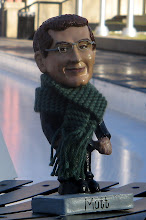
My colleague Mike Eastep, tuba player at the CPO, just invited me over to hear a lunch-time tuba recital by Keith Hartshorn-Walton, at the Cathedral Church of the Redeemer in Calgary. (The concert was presented by the Pro Arts Society as part of their Wednesday series.)
I was surprised to walk in and hear Keith perform, in its entirety, the Antonio Capuzzi Concerto for Double Bass. It came off quite well, with lots of beautiful, ringing high notes and a gracefully phrased, melodic 2nd movement. Tuba players transcribe it down a fifth to B-flat major, with an adapted cadenza -- suggesting a strange, poetic justice for all the cello music we bassists have come to love, transcribe, and re-write.
You might peg bass and tuba players as bottom-feeders, on some hypothetical musical food chain. In actuality though, we play some of the best solo repertoire ever written -- just not written for our instrument, usually. That puts us on the top of the musical food chain, at least by my biased reckoning. Bach may have never envisioned his 5th Cello Suite rattling the lighting fixtures in tuba range, but that's how I hear it, a lot of the time, and I'm pretty sure there's nothing egregiously wrong with that.
But if bass players are going to stay at the top of the food chain, we'd better watch out for these tuba players, stealing all our obscure, bizarre classical concerti. They've already got Capuzzi - watch out for Vanhal, Dittersdorf, Dragonetti, and Sperger!
Showing posts with label double bass. Show all posts
Showing posts with label double bass. Show all posts
Wednesday, May 07, 2008


Sunday, December 30, 2007
on the skin
Which is the most important body part in playing the double bass?
Is it the shoulder, the elbow, maybe the hand? Or we could think more in the abstract - Daniel Barenboim talks about the head, the heart, and the gut, three principal and equal contributors.
 I'm going to suggest something a little more superficial, though: the skin. It's our largest organ, also our most prominent, most often injured, and quickest to heal. We constantly stretch it, squeeze it, splay it, poke it, pluck it - we ask it to be firm, soft, callused, flexible, tough, fleshy, sensitive. Amazingly, it will usually do all these things, without us taking much notice until it cracks, chafes, burns or blisters.
Within the skin are nerve fibers, which create our sense of touch. These nerves provide our most important sensory input while playing; even more than our ears, they allow us to micro-adjust and play in tune. By the time our ears have heard a note played out of tune, everyone else's ears have heard it too - so we depend on our skin to correct it quicker.
A cellist friend recently cut her left middle finger at the knuckle, rather severely - she had to get eight stitches. She's recovering well, but it's still been frustrating for her to play with injured skin. For a while she couldn't flex the finger enough, and then that finger's vibrato didn't seem to work. For something superficial, the skin can have a deep impact.
One bass maker once told me that the reason strings take a while to break in - and sound so much better after a few weeks of playing - is that skin cells and oils fill in the string's gaps, softening and warming the edges of its vibration. So skin becomes an essential part of the instrument, as well as our own bodies. We leave little pieces of our skin all over the place - as gross as that might seem.
I haven't read too much about the skin, and I can't remember any teacher coaching me on proper skin care. But I've definitely been paying more attention to it since I moved to Calgary. The climate is very dry, which can cause our skin (as well as our basses) to tighten and crack. The best solution to the problem seems to be a good humidifier, and some well-insulated gloves.
Is it the shoulder, the elbow, maybe the hand? Or we could think more in the abstract - Daniel Barenboim talks about the head, the heart, and the gut, three principal and equal contributors.
I'm going to suggest something a little more superficial, though: the skin. It's our largest organ, also our most prominent, most often injured, and quickest to heal. We constantly stretch it, squeeze it, splay it, poke it, pluck it - we ask it to be firm, soft, callused, flexible, tough, fleshy, sensitive. Amazingly, it will usually do all these things, without us taking much notice until it cracks, chafes, burns or blisters.Within the skin are nerve fibers, which create our sense of touch. These nerves provide our most important sensory input while playing; even more than our ears, they allow us to micro-adjust and play in tune. By the time our ears have heard a note played out of tune, everyone else's ears have heard it too - so we depend on our skin to correct it quicker.
A cellist friend recently cut her left middle finger at the knuckle, rather severely - she had to get eight stitches. She's recovering well, but it's still been frustrating for her to play with injured skin. For a while she couldn't flex the finger enough, and then that finger's vibrato didn't seem to work. For something superficial, the skin can have a deep impact.
One bass maker once told me that the reason strings take a while to break in - and sound so much better after a few weeks of playing - is that skin cells and oils fill in the string's gaps, softening and warming the edges of its vibration. So skin becomes an essential part of the instrument, as well as our own bodies. We leave little pieces of our skin all over the place - as gross as that might seem.
I haven't read too much about the skin, and I can't remember any teacher coaching me on proper skin care. But I've definitely been paying more attention to it since I moved to Calgary. The climate is very dry, which can cause our skin (as well as our basses) to tighten and crack. The best solution to the problem seems to be a good humidifier, and some well-insulated gloves.
Saturday, November 10, 2007
The Big Bass Viol, by M.T. Bohannon
 My tuba colleague Mike Eastep found this old tune, in his mother's attic I think. He seems to want everyone in the CPO bass section to learn it and perform it. It's called "Bass Song" by M.T. Bohannon, and the lyrics are as follows:
There once lived a man in the town of Missoula,
His name was Augustus Miles.
He was known miles around as a Lalapalousa,
At playing the Big Bass Viol;
And ev'ry night when his work was done,
You'd hear him playing Zum, zum, zum,
And o'er his face there comes a smile,
as he plays this tune on his Big Bass Viol.
(chorus)
Zum, zum, zum, zum, zum, zum,
sounds forth his Big Bass Viol,
Zum, zum, zum, zum, zum, zum,
He plays it all the while,
Theres ne'er a lute nor a harp or flute
with tones so soft or mild,
As the Zum, zum, zum, zum, zum, zum
that he plays on his Big Bass Viol.
(2nd verse)
Augustus Miles played himself into trouble,
For a maid with a roguish eye,
Just gave him a smile and his heart like a bubble,
Went bounding to unknown skies;
And now he goes to serenade,
Beneath the window of this fair maid,
Says he, "Her heart I must beguile
by playing this tune on my Big Bass Viol."
(chorus)
Friday, November 09, 2007
buckets of physiological fun
This post is part of my occasional series on playing the double bass using a human body. Okay, very occasional. You can read the other post here if you like.
One of the odd things about the human body is that it didn't evolve primarily in order to play the double bass. Our body structures were produced by adaptations to pressures and demands having little to do with double bass playing. Demands such as - carrying buckets.
That's right, there seems to have been quite a lot of bucket-carrying in our evolutionary past, and we have the elbows to prove it:

You can see your own carrying angle if you stand in front of a mirror and externally rotate (supinate) your shoulder until your palm faces forward. It's different for every person, though as the Wikipedia article notes, it tends to be greater for women - since women's hips are wider, they need more clearance for those buckets. It will also tend to be larger on your dominant side, meaning most of us are right-arm bucket-carriers.
Of what importance is this to the inquiring bass player, besides a new and hopeless pickup line ("Hey baby, what's your carrying angle?") At least for German-bow players, there's a continuous need to get the elbow onto or above the plane of the string - our elbows tend to dangle down below, accommodating our carrying angles but compromising the weight and support of our bow arms.
 In order to correct for the carrying angle, we tend to lift our elbows and rotate the arm inward - pronating the bow into the instrument. If you use the larger muscles of the back and shoulder to do this, by lifting and compressing the shoulder forward, you'll also compromise the structure of the arm. Which will also disrupt the transfer of weight to the string, and possibly cause long-term injuries. Damn those bucket-schlepping ancestors!
Somehow we have to find a way to keep the chest open, the shoulder lowered and relaxed, and still create the internal rotation to lift the elbow and transfer the weight into the string. It sounds hopelessly complicated, I know - but when you see it in action, it looks effortlessly graceful, almost like we evolved to do this after all. Next time you watch a great string player, pay attention to how he or she rotates the arm - what happens to the shoulder, is the elbow straight or slightly bent, and can you tell where the pronation or supination are happening? How does this change on the lower and upper strings, through different bowings, articulations, and expressive demands?
And when the concert is over, do they still have the strength left to carry a bucket or two?
One of the odd things about the human body is that it didn't evolve primarily in order to play the double bass. Our body structures were produced by adaptations to pressures and demands having little to do with double bass playing. Demands such as - carrying buckets.
That's right, there seems to have been quite a lot of bucket-carrying in our evolutionary past, and we have the elbows to prove it:
Carrying angle -When the arm is extended, with the palm facing forward or up, the bones of the humerus and forearm are not perfectly aligned. The deviation from a straight line (generally on the order of 5-10°) occurs in the direction of the thumb, and is referred to as the carrying angle (visible in the right half of the picture, right). In females the carrying angle is greater than in males.[1]
The carrying angle can influence how objects are held by individuals - those with a more extreme carrying angle may be more likely to supinate the forearm when holding objects in the hand to keep the elbow closer to the body.
- extracted from a Wikipedia article about the elbow
You can see your own carrying angle if you stand in front of a mirror and externally rotate (supinate) your shoulder until your palm faces forward. It's different for every person, though as the Wikipedia article notes, it tends to be greater for women - since women's hips are wider, they need more clearance for those buckets. It will also tend to be larger on your dominant side, meaning most of us are right-arm bucket-carriers.
Of what importance is this to the inquiring bass player, besides a new and hopeless pickup line ("Hey baby, what's your carrying angle?") At least for German-bow players, there's a continuous need to get the elbow onto or above the plane of the string - our elbows tend to dangle down below, accommodating our carrying angles but compromising the weight and support of our bow arms.
In order to correct for the carrying angle, we tend to lift our elbows and rotate the arm inward - pronating the bow into the instrument. If you use the larger muscles of the back and shoulder to do this, by lifting and compressing the shoulder forward, you'll also compromise the structure of the arm. Which will also disrupt the transfer of weight to the string, and possibly cause long-term injuries. Damn those bucket-schlepping ancestors!Somehow we have to find a way to keep the chest open, the shoulder lowered and relaxed, and still create the internal rotation to lift the elbow and transfer the weight into the string. It sounds hopelessly complicated, I know - but when you see it in action, it looks effortlessly graceful, almost like we evolved to do this after all. Next time you watch a great string player, pay attention to how he or she rotates the arm - what happens to the shoulder, is the elbow straight or slightly bent, and can you tell where the pronation or supination are happening? How does this change on the lower and upper strings, through different bowings, articulations, and expressive demands?
And when the concert is over, do they still have the strength left to carry a bucket or two?
Thursday, November 08, 2007
a small post, but a Gran step for bassist-kind
Discussions of music on this blog usually range from works I really, really like to stuff I'm deliriously fanatic about. I'm going to make an exception today and talk about a certain composer of virtuoso double bass music, an Italian whose name rhymes with the phrase "What a weenie!" We shall refer to this composer as He Who Shall Not Be Named (HWSNBN) for reasons which may soon become clear.
A search of past hella frisch posts reveals that HWSNBN has been named in 3 previous posts, or 0.68% of the 436 total. I'd like to get that down to 0.67 or 0.66% if possible. If only I could say that less than 1% of my life has been spent playing and studying HWSNBN's music - sadly, this is probably not the case.
I won't say he never wrote a good piece - I like his Elegy in D somewhat, and last summer I read a string quintet which was rather pleasing, if only because it did not use the bass as a solo instrument. Please don't get me wrong, I have the utmost respect for the double bass' soloistic properties - somehow though, just about every performance of HWSNBN's works ends up sounding like a circus for retarded animals. Even the very best performers end up sounding a little bit foolish and awkward. It's like a person who, having nothing to say, goes on chattering away as high and quickly as possible, in hopes of not being discovered.
Even people who talk about HWSNBN sound rather ridiculous, in my opinion - one of the reasons I'm being so cautious in taking up the subject (please, no hate mail!) Look at this recent comment thread on Jason Heath's blog if you want an example of the level of discourse regarding HWSNBN.
Well, I think bass players are a pretty sophisticated group of musicians in general, and hope we will eventually cast off the scourge of HWSNBN. We'll stop programming him on recitals (three worst words in the English language: All-B******* Program), stop requiring his pieces on auditions and competitions, stop teaching them to our students. Perhaps with this blog post, I can begin to do my own small part.
A search of past hella frisch posts reveals that HWSNBN has been named in 3 previous posts, or 0.68% of the 436 total. I'd like to get that down to 0.67 or 0.66% if possible. If only I could say that less than 1% of my life has been spent playing and studying HWSNBN's music - sadly, this is probably not the case.
I won't say he never wrote a good piece - I like his Elegy in D somewhat, and last summer I read a string quintet which was rather pleasing, if only because it did not use the bass as a solo instrument. Please don't get me wrong, I have the utmost respect for the double bass' soloistic properties - somehow though, just about every performance of HWSNBN's works ends up sounding like a circus for retarded animals. Even the very best performers end up sounding a little bit foolish and awkward. It's like a person who, having nothing to say, goes on chattering away as high and quickly as possible, in hopes of not being discovered.
Even people who talk about HWSNBN sound rather ridiculous, in my opinion - one of the reasons I'm being so cautious in taking up the subject (please, no hate mail!) Look at this recent comment thread on Jason Heath's blog if you want an example of the level of discourse regarding HWSNBN.
Well, I think bass players are a pretty sophisticated group of musicians in general, and hope we will eventually cast off the scourge of HWSNBN. We'll stop programming him on recitals (three worst words in the English language: All-B******* Program), stop requiring his pieces on auditions and competitions, stop teaching them to our students. Perhaps with this blog post, I can begin to do my own small part.
Sunday, October 14, 2007
sponge-worthy?
As a bass student, I've always tried to be like a sponge, absorbing as much of my teacher's knowledge as possible. That's always been my favorite analogy, though I'm sure the goal is not to be all wet and soggy at the end of the lesson. Or to really suck, for that matter.
In any case, being a sponge means a few things to me. It means I'm going to listen to the teacher with an open mind, as much as possible - try to hear what he or she is saying, not what I'm expecting or hoping to hear. And I'll do my best to observe as well as listen - noticing as much as I can from their demonstrations as well as the way they sing, gesture, or discuss. I'll ask questions if I don't understand, or if I feel vague about a concept. And I'll always record lessons and play them back later, since even the best sponge is likely to leak once in a while!
I only mention this because today I co-taught a lesson, along with another bassist who happens not to play German bow. I was brought in as a sort of right-hand consultant for very talented and determined undergraduate bass student. Only as good and willing a sponge as this bass student was, I sort of felt like I was throwing pasta noodles at the wall (to use another damp analogy), hoping they would stick. And I'm afraid I may have overwhelmed this student with too much information, or maybe too scattered and haphazard a presentation.
In many ways it was the perfect opportunity to improve my teaching chops. I had this other bassist, a great musician and experienced teacher, making observations and steering the lesson along. When I would get a little obsessive about some detail, like the motion of the thumb in preparation for the upbow, he would bring me back to the larger topic of legato bow changes. If I started to make vague, general demands ("Play that again, but more consistently!") he would bring up a specific goal to focus on.
I realized that my concept of learning - take in as much as you can! - doesn't necessarily correspond to an effective teaching style. You need to know how to structure a lesson, choose carefully what you want to improve, and be pretty relentlessly on message about those changes. It's a whole lot like practicing - we all want to get things done quickly, and cover a lot of material, but it takes some real patience and focus to change a habit.
I'm sure somewhere along the way I had a teacher explain all of this to me; it just never quite sunk in until I had to teach myself!
In any case, being a sponge means a few things to me. It means I'm going to listen to the teacher with an open mind, as much as possible - try to hear what he or she is saying, not what I'm expecting or hoping to hear. And I'll do my best to observe as well as listen - noticing as much as I can from their demonstrations as well as the way they sing, gesture, or discuss. I'll ask questions if I don't understand, or if I feel vague about a concept. And I'll always record lessons and play them back later, since even the best sponge is likely to leak once in a while!
I only mention this because today I co-taught a lesson, along with another bassist who happens not to play German bow. I was brought in as a sort of right-hand consultant for very talented and determined undergraduate bass student. Only as good and willing a sponge as this bass student was, I sort of felt like I was throwing pasta noodles at the wall (to use another damp analogy), hoping they would stick. And I'm afraid I may have overwhelmed this student with too much information, or maybe too scattered and haphazard a presentation.
In many ways it was the perfect opportunity to improve my teaching chops. I had this other bassist, a great musician and experienced teacher, making observations and steering the lesson along. When I would get a little obsessive about some detail, like the motion of the thumb in preparation for the upbow, he would bring me back to the larger topic of legato bow changes. If I started to make vague, general demands ("Play that again, but more consistently!") he would bring up a specific goal to focus on.
I realized that my concept of learning - take in as much as you can! - doesn't necessarily correspond to an effective teaching style. You need to know how to structure a lesson, choose carefully what you want to improve, and be pretty relentlessly on message about those changes. It's a whole lot like practicing - we all want to get things done quickly, and cover a lot of material, but it takes some real patience and focus to change a habit.
I'm sure somewhere along the way I had a teacher explain all of this to me; it just never quite sunk in until I had to teach myself!
Friday, October 05, 2007
things I learned at the 2007 ISB Convention
This past summer, I went to Oklahoma City for the week-long International Society of Bassists Convention. While I genuinely intended to chronicle the whole trip, I never really did - all that came out of it was this one sad little post with a picture of a flight trunk loaded (successfully!) onto a plane.
I always feel a little guilty to promise stuff on this blog - all those concerts I meant to write up, those videos I meant to upload, the Jason Heath blackmail stories, etc. - then never deliver. I decided in this case I would do a little make-up work. Maybe it will all be really exciting, reading my up-to-the-minute thoughts on things that happened 3 months ago? And if no one much cares anymore, that's okay too.
So to get you in the mood, and maybe refresh my memory, here's a little list I'm calling:
Things I Learned at the ISB Convention (So You Don't Have To)
DO check out some masterclasses
They're a great chance to meet some of the foremost bassists, and get a sample of what they're like as teachers. This past summer, I got to see masterclasses by Jeremy McCoy, Paul Ellison, Ed Barker, Diana Gannett, Scott Haigh, and Rob Kassinger - who titled his class "Things I Learned the Hard Way, So You Don't Have To" (and inspired this list's title). Like Rob's, many of the classes had a certain emphasis - bow strokes, audition advice, etc. But they were all happy to answer other questions, and most of the sessions seemed to spill out into the hallways, with a crowd of bassists curious for the secret to a singing vibrato, or a really kick-ass brush stroke.
DO bring a bass (if possible) and have stuff ready to play
Most of the people at the bass convention did not bring their own instruments - understandably, given the difficulties of travel. I was happy I had mine though, since it meant that I could often play on those masterclasses I just listed. I played for Rob Kassinger, Paul Ellison, and Ed Barker. And Gottfried Engels, a bass professor member of the Dusseldorf Symphony, gave me a fascinating lesson about using my 'hara' to play with a richer sound. (I'd never heard of the 'hara' before this - it's sort of related to the chi.) That's partly why I never got around to writing any of this stuff up; there was just so much of it, and I've got pages of notes messily scribbled on programs.
DON'T eat lunch alone
Okay, you've already flown yourself to a bass convention, one of the geekiest things imaginable. You might as well just geek out entirely, spend all your time talking about bass, and surrounded by people doing the same. One day at the breakfast table, another bassist interrupted our chat about the texture of the eggs and asked, "So what do you guys think about rosin?" It was such a bizarre non-sequitur, and so out of place, I started to laugh. Then I realized he seriously wanted to hear our opinions about bass rosin.
DO enter one of the competitions, if you're eligible and interested
Each year there are several solo competitions for various age brackets, as well as orchestral, composition, and bass makers' competitions. I entered the orchestral competition, and while I wasn't the super-duper grand prize winner (that was Tony Parry), I did have a great time, got some helpful comments, and won a pretty good-sized chunk of cash. The orchestral competition was run like a real audition, with several rounds, and a list of standard solos and excerpts. The solo competitors each presented a full recital program for their final round, which was really cool to watch - all of the competitions are open to the public. So it's worth getting there a day early to listen, even if you're not participating.
DON'T try to keep up with Peter Lloyd
Peter Lloyd was actually a major reason I decided to come to this convention. These are my actual notes from a lesson I transcribed:
DO try out lots of basses and bows
Eventually you're going to need a break from all those recitals, you won't want to hear another word about Viennese tuning, the collected works of Johann Sperger will hold no more mystery for you. That would be a good time to go to the big exhibition room and try out basses. All the biggest shops were represented with dozens of instruments and hundreds of bows. Many of the makers are on hand too, so you're sure to get all your questions answered. Except for, "How in the world can I afford this bass I've suddenly realized I can't live without?"
DON'T miss the evening recitals!
A day at a bass convention can feel like a mad scrambling free-for-all, especially if you're trying to follow Peter Lloyd (see above). But the evening is when everyone comes together for some of the most inspiring performances I've ever heard. I fully expected recitalists Ed Barker, Jeff Bradetich, and Joel Quarrington to be awesome - and they each exceeded my expectations. Even more thrilling to hear Thierry Barbe, Renaud Garcia-Fons, Avishai Cohen, and Jacek Niedziela, all of whom I heard for the first time.
DO bring business cards, if you've got them
You're bound to meet lots of new people, have lots of fascinating conversations, and then forget everyone's name and whereabouts soon afterwards. That's what I did, anyway. Best to hand your cards out liberally, and try and collect everyone else's. Hopefully you'll stay in touch with everyone you meet. After all, it's less than two more years until the ISB Convention 2009 at Penn State University.
I always feel a little guilty to promise stuff on this blog - all those concerts I meant to write up, those videos I meant to upload, the Jason Heath blackmail stories, etc. - then never deliver. I decided in this case I would do a little make-up work. Maybe it will all be really exciting, reading my up-to-the-minute thoughts on things that happened 3 months ago? And if no one much cares anymore, that's okay too.
So to get you in the mood, and maybe refresh my memory, here's a little list I'm calling:
Things I Learned at the ISB Convention (So You Don't Have To)
DO check out some masterclasses
They're a great chance to meet some of the foremost bassists, and get a sample of what they're like as teachers. This past summer, I got to see masterclasses by Jeremy McCoy, Paul Ellison, Ed Barker, Diana Gannett, Scott Haigh, and Rob Kassinger - who titled his class "Things I Learned the Hard Way, So You Don't Have To" (and inspired this list's title). Like Rob's, many of the classes had a certain emphasis - bow strokes, audition advice, etc. But they were all happy to answer other questions, and most of the sessions seemed to spill out into the hallways, with a crowd of bassists curious for the secret to a singing vibrato, or a really kick-ass brush stroke.
DO bring a bass (if possible) and have stuff ready to play
Most of the people at the bass convention did not bring their own instruments - understandably, given the difficulties of travel. I was happy I had mine though, since it meant that I could often play on those masterclasses I just listed. I played for Rob Kassinger, Paul Ellison, and Ed Barker. And Gottfried Engels, a bass professor member of the Dusseldorf Symphony, gave me a fascinating lesson about using my 'hara' to play with a richer sound. (I'd never heard of the 'hara' before this - it's sort of related to the chi.) That's partly why I never got around to writing any of this stuff up; there was just so much of it, and I've got pages of notes messily scribbled on programs.
DON'T eat lunch alone
Okay, you've already flown yourself to a bass convention, one of the geekiest things imaginable. You might as well just geek out entirely, spend all your time talking about bass, and surrounded by people doing the same. One day at the breakfast table, another bassist interrupted our chat about the texture of the eggs and asked, "So what do you guys think about rosin?" It was such a bizarre non-sequitur, and so out of place, I started to laugh. Then I realized he seriously wanted to hear our opinions about bass rosin.
DO enter one of the competitions, if you're eligible and interested
Each year there are several solo competitions for various age brackets, as well as orchestral, composition, and bass makers' competitions. I entered the orchestral competition, and while I wasn't the super-duper grand prize winner (that was Tony Parry), I did have a great time, got some helpful comments, and won a pretty good-sized chunk of cash. The orchestral competition was run like a real audition, with several rounds, and a list of standard solos and excerpts. The solo competitors each presented a full recital program for their final round, which was really cool to watch - all of the competitions are open to the public. So it's worth getting there a day early to listen, even if you're not participating.
DON'T try to keep up with Peter Lloyd
Peter Lloyd was actually a major reason I decided to come to this convention. These are my actual notes from a lesson I transcribed:
Given that kind of ringing endorsement, I naturally couldn't resist - and what's more he was right (sadly no Spice Girls this year, but still). The only qualification is that not everyone is built like Peter Lloyd, who actually goes to 2 or 3 events every hour. I tried this briefly, and quickly reached acute bass overload. One event an hour was plenty for me, thank you.come to a bass convention! You will be in 7th heaven! You are tailor made, they are unbelievable, incredibly inspiring, 800 bass players, 50-60 dealers, everything that exists related to bass, 1000s of recordings, bows, every kind of strings, 900 kinds of mutes, 2-3 things simultaneously every hour on the hour
intellectual treatises on how Dragonetti wrote his music, 8 bassists playing Spice Girls, everything in between, fantastic jazz side, only thing you'll regret is having not gone to one sooner - after an hour, he sat in a corner and kicked himself
DO try out lots of basses and bows
Eventually you're going to need a break from all those recitals, you won't want to hear another word about Viennese tuning, the collected works of Johann Sperger will hold no more mystery for you. That would be a good time to go to the big exhibition room and try out basses. All the biggest shops were represented with dozens of instruments and hundreds of bows. Many of the makers are on hand too, so you're sure to get all your questions answered. Except for, "How in the world can I afford this bass I've suddenly realized I can't live without?"
DON'T miss the evening recitals!
A day at a bass convention can feel like a mad scrambling free-for-all, especially if you're trying to follow Peter Lloyd (see above). But the evening is when everyone comes together for some of the most inspiring performances I've ever heard. I fully expected recitalists Ed Barker, Jeff Bradetich, and Joel Quarrington to be awesome - and they each exceeded my expectations. Even more thrilling to hear Thierry Barbe, Renaud Garcia-Fons, Avishai Cohen, and Jacek Niedziela, all of whom I heard for the first time.
DO bring business cards, if you've got them
You're bound to meet lots of new people, have lots of fascinating conversations, and then forget everyone's name and whereabouts soon afterwards. That's what I did, anyway. Best to hand your cards out liberally, and try and collect everyone else's. Hopefully you'll stay in touch with everyone you meet. After all, it's less than two more years until the ISB Convention 2009 at Penn State University.
Tuesday, September 18, 2007
infinite Jason
Most mornings at 7:15 am, I won't have 5 ideas in preparation for blog posts. In fact, I probably won't even remember I have a blog. That's one difference between me and Jason Heath.
Amid Jason's ongoing quest to chronicle, link, interview, video tape, and generally charm the pants off every bass player in existence, it's sometimes possible to forget that Jason is a wickedly awesome bass player himself. Consider this a reminder.
Jason and I go way back - he tells the stories better than I do, though I'm not sure he's done the one about the melting alarm clock yet. Or the late night bass abduction in St. Petersburg. Maybe I'll have to write some content of my own after all.
 Jason was also the one who introduced me to the David Foster Wallace novel Infinite Jest - this huge, kaleidoscopic book about psychedelic drugs, film-making, a tennis academy, and I'm not sure what else. In retrospect, the book seems like a sort of model for Jason's blog (though he hasn't started footnoting his footnotes yet). If Jason ever feels the need to rename his blog, I might respectfully suggest "Infinite Bass."
I don't often link to Jason's blog, not for lack of content (obviously) but mostly assuming that anyone reading here is already familiar with his site. If you're not, hurry on over - you've got a lot of catching up to do.
Amid Jason's ongoing quest to chronicle, link, interview, video tape, and generally charm the pants off every bass player in existence, it's sometimes possible to forget that Jason is a wickedly awesome bass player himself. Consider this a reminder.
Jason and I go way back - he tells the stories better than I do, though I'm not sure he's done the one about the melting alarm clock yet. Or the late night bass abduction in St. Petersburg. Maybe I'll have to write some content of my own after all.
Jason was also the one who introduced me to the David Foster Wallace novel Infinite Jest - this huge, kaleidoscopic book about psychedelic drugs, film-making, a tennis academy, and I'm not sure what else. In retrospect, the book seems like a sort of model for Jason's blog (though he hasn't started footnoting his footnotes yet). If Jason ever feels the need to rename his blog, I might respectfully suggest "Infinite Bass."I don't often link to Jason's blog, not for lack of content (obviously) but mostly assuming that anyone reading here is already familiar with his site. If you're not, hurry on over - you've got a lot of catching up to do.
Wednesday, August 29, 2007
Mr. Mensch's "slow bow studies"
I've written here in the past about my former teacher Homer Mensch. One of the first things you learned as a student of Mr. Mensch was to not tell anyone about his methods - the warm-up routines, technique exercises, and those mysterious photocopied etudes he would assign at each lesson. When you had played the etude to his satisfaction, he collected the photocopy back from you - making sure it wouldn't fall into the wrong hands, I guess.
Some of the most important of Mr. Mensch's secret exercises were the "slow bow studies". At our first lesson he explained: I was to spend at least 30 minutes each day drawing the bow as slowly as possible on open strings, right down next to the bridge. I should do 15 minutes as loud as possible, and then 15 minutes as soft as possible. In each case, however, I needed to draw the bow as smoothly and evenly as possible, with the best quality sound I could manage.
Mr. Mensch also gave a standard, a goal I was to achieve: 18 counts at the lowest setting on the metronome. He turned on his metronome, dialed it down to 35, and turned up the volume, as if to dare me to play that loud. I gave it my best shot - 7 and a half beats of open E string. I tried again, slower - this time 9 beats, interrupted by croaking, sticking, squawking.
"My goodness, Matthew, this needs some serious work."
Over the next few weeks, my college suite-mates came to dread the sound of me unpacking my bass. Because every practice session began with the "drill" - actually some of them thought I was literally operating a drill in my room. I hated to disturb their naps and "Worms"-video game marathons, but I had some serious work to do. My bow wasn't going to slow itself down!
It seems silly in retrospect, how I obsessed over those "slow bow studies". But at the time, it was like some miraculous sound-production spell had just been revealed. As I worked at it, I was accessing a depth and focus that I'd never even thought was possible on that bass. My suite-mates were cranking up their Fugees albums to deafening levels, just to drown me out!
Beyond that, it was the first time I'd really made an effort to do something slower - which actually meant reducing the effort and tension, since those only made the bow less cooperative. The slow-bow study became like a sitting meditation for me; focusing on steadying, disciplining, and purifying my sound, I think I discovered my first experience of a pure, steady, disciplined, mind. Of course, I was still a frazzled, confused college freshman when I'd finished, but it seemed to take me away from all that confusion, at least for a half-hour each morning.
Some of the most important of Mr. Mensch's secret exercises were the "slow bow studies". At our first lesson he explained: I was to spend at least 30 minutes each day drawing the bow as slowly as possible on open strings, right down next to the bridge. I should do 15 minutes as loud as possible, and then 15 minutes as soft as possible. In each case, however, I needed to draw the bow as smoothly and evenly as possible, with the best quality sound I could manage.
Mr. Mensch also gave a standard, a goal I was to achieve: 18 counts at the lowest setting on the metronome. He turned on his metronome, dialed it down to 35, and turned up the volume, as if to dare me to play that loud. I gave it my best shot - 7 and a half beats of open E string. I tried again, slower - this time 9 beats, interrupted by croaking, sticking, squawking.
"My goodness, Matthew, this needs some serious work."
Over the next few weeks, my college suite-mates came to dread the sound of me unpacking my bass. Because every practice session began with the "drill" - actually some of them thought I was literally operating a drill in my room. I hated to disturb their naps and "Worms"-video game marathons, but I had some serious work to do. My bow wasn't going to slow itself down!
It seems silly in retrospect, how I obsessed over those "slow bow studies". But at the time, it was like some miraculous sound-production spell had just been revealed. As I worked at it, I was accessing a depth and focus that I'd never even thought was possible on that bass. My suite-mates were cranking up their Fugees albums to deafening levels, just to drown me out!
Beyond that, it was the first time I'd really made an effort to do something slower - which actually meant reducing the effort and tension, since those only made the bow less cooperative. The slow-bow study became like a sitting meditation for me; focusing on steadying, disciplining, and purifying my sound, I think I discovered my first experience of a pure, steady, disciplined, mind. Of course, I was still a frazzled, confused college freshman when I'd finished, but it seemed to take me away from all that confusion, at least for a half-hour each morning.
Wednesday, May 16, 2007
letters, stories, and housekeeping
Thanks to everyone who has been reading and commenting on my Calgary audition story! I'll have another installment later today, and then maybe one more to wrap it up before the weekend.
In the meantime, check out Michael Hovnanian's CSO Bass Blog, for the latest part of our inter-blog dialogue on transitioning to life in a professional orchestra. This week, Michael answers my question about standards of preparation and sight-reading - I was really curious about this topic, because I am trying to become a better sight-reader, without sacrificing all that intense and detailed practice we do for auditions. Michael has a great answer, and manages to reference art forgery, rock climbing, and a cringe-worthy audition story of his own.
Jason Heath's Double Bass Blog also linked to an older post I wrote, "eavesdropping on a French horn god." I had forgotten I wrote this, but I think it has some excellent advice - and as one reader pointed, even the typos are pretty good.
 One last piece of housekeeping news: I'm going to the ISB Bass Convention in Oklahoma City next month! It's being held at Oklahoma City University's Bass School of Music - just in case you needed a little more bass. I'm looking forward to meeting some people, hearing some performances and talks, and probably blogging about it as well. If you're planning on coming, please drop me a message or say hello if you see me. Thanks!
In the meantime, check out Michael Hovnanian's CSO Bass Blog, for the latest part of our inter-blog dialogue on transitioning to life in a professional orchestra. This week, Michael answers my question about standards of preparation and sight-reading - I was really curious about this topic, because I am trying to become a better sight-reader, without sacrificing all that intense and detailed practice we do for auditions. Michael has a great answer, and manages to reference art forgery, rock climbing, and a cringe-worthy audition story of his own.
Jason Heath's Double Bass Blog also linked to an older post I wrote, "eavesdropping on a French horn god." I had forgotten I wrote this, but I think it has some excellent advice - and as one reader pointed, even the typos are pretty good.
One last piece of housekeeping news: I'm going to the ISB Bass Convention in Oklahoma City next month! It's being held at Oklahoma City University's Bass School of Music - just in case you needed a little more bass. I'm looking forward to meeting some people, hearing some performances and talks, and probably blogging about it as well. If you're planning on coming, please drop me a message or say hello if you see me. Thanks!
Friday, January 19, 2007
lameness revealed
Reading a recent post called "Some Lame Notes" on the Chicago Bass Blog, it occurs to me that there aren't too many places where you can have a nuanced discussion of double bass fingering choices, outside of lessons and workshops. In orchestra rehearsals we often discuss bowings, since it's imperative that we agree and match, but fingerings are pretty much left to individual discretion. And if you bring up fingering issues over drinks (the other main social setting for bass players) you are likely to be accused of intense geekiness and shunned.
Many readers may not see why any such discussion is really needed. Maybe it is a little like hearing about how the sausage is made, more than you ever want or need to know. Then again, any technical limitation (and we bass players have plenty) forces us to organize and prioritize the material - just as a poet when writing a sonnet has to form his thoughts into 10-syllable lines. And those choices can reveal a lot about the material, as well as the art and craft. Anyone whose eyes have not glazed over yet should check out Michael Hovnanian's blog, as few people besides Michael could make these subjects so thought-provoking.
 I have my own slightly geeky subject today, concerning the notation of double bass parts. In the last few years a great many editions of orchestral pieces have come out in beautiful new urtext editions, like the Mendelssohn 3rd Symphony part shown above. I wonder if we've lost something, though, by segregating the bass and cello parts which were formerly joined together, as shown below.
 This morning we had a reading of Mendelssohn 3rd, with members of the New World Symphony and The Cleveland Orchestra sharing stands. I shared a stand with Max Dimoff, the principal of Cleveland, which was a somewhat humbling experience; very few people make playing the bass seem as easy and natural as Max. I was doing my best to keep up, and also asking Max a few questions about note length, articulations, etc. - basically taking advantage of the opportunity to be a nerd and maybe learn something. Most of Max's comments and suggestions to me, though, were about other lines to listen for in the orchestra: who has a pick-up or grace note to our downbeat, where to find the pulse and which lines to intercept on our entrances.
It occurs to me that this sort of knowledge is exactly what we mean when we talk about experienced orchestral playing. And it's probably not strictly necessary to bring Max Dimoff down to teach me these things: they can be learned from careful study of the score and recordings. (Then again, studying the example of an experienced, great orchestral player is probably one of the better ways of becoming one.) That's why as well-researched and impeccably correct as these new parts are, I really do miss having the cello part to follow along and fit with our part.
Generations of bass players have learned basic score reading in this way, and often managed to embarrass ourselves playing a line not intended for instrument. Hopefully future generations will be resourceful enough to get the score, learn other parts, and maybe embarrass themselves playing the cello parts as we did. A little educational embarrassment can be a very valuable thing.
Many readers may not see why any such discussion is really needed. Maybe it is a little like hearing about how the sausage is made, more than you ever want or need to know. Then again, any technical limitation (and we bass players have plenty) forces us to organize and prioritize the material - just as a poet when writing a sonnet has to form his thoughts into 10-syllable lines. And those choices can reveal a lot about the material, as well as the art and craft. Anyone whose eyes have not glazed over yet should check out Michael Hovnanian's blog, as few people besides Michael could make these subjects so thought-provoking.
 I have my own slightly geeky subject today, concerning the notation of double bass parts. In the last few years a great many editions of orchestral pieces have come out in beautiful new urtext editions, like the Mendelssohn 3rd Symphony part shown above. I wonder if we've lost something, though, by segregating the bass and cello parts which were formerly joined together, as shown below.
 This morning we had a reading of Mendelssohn 3rd, with members of the New World Symphony and The Cleveland Orchestra sharing stands. I shared a stand with Max Dimoff, the principal of Cleveland, which was a somewhat humbling experience; very few people make playing the bass seem as easy and natural as Max. I was doing my best to keep up, and also asking Max a few questions about note length, articulations, etc. - basically taking advantage of the opportunity to be a nerd and maybe learn something. Most of Max's comments and suggestions to me, though, were about other lines to listen for in the orchestra: who has a pick-up or grace note to our downbeat, where to find the pulse and which lines to intercept on our entrances.
It occurs to me that this sort of knowledge is exactly what we mean when we talk about experienced orchestral playing. And it's probably not strictly necessary to bring Max Dimoff down to teach me these things: they can be learned from careful study of the score and recordings. (Then again, studying the example of an experienced, great orchestral player is probably one of the better ways of becoming one.) That's why as well-researched and impeccably correct as these new parts are, I really do miss having the cello part to follow along and fit with our part.
Generations of bass players have learned basic score reading in this way, and often managed to embarrass ourselves playing a line not intended for instrument. Hopefully future generations will be resourceful enough to get the score, learn other parts, and maybe embarrass themselves playing the cello parts as we did. A little educational embarrassment can be a very valuable thing.
Monday, December 04, 2006
Jason Heath's blog
It makes me happy to find several people rediscovering Hella Frisch, reading my ramblings here, and welcoming me back to blogging. I suppose I wasn't away all that long, but still I imagine the collective memory of the blogosphere tends to be short-term. So I'm eternally grateful to have regained a place in your browser window - or perhaps that you were too lazy to remove me in the first place. In any case, thank you for visiting!
I suppose my memory tends towards the short-term as well, but I've been trying to catch up on some of my favorite blogs, and discovering new ones. Today I want to mention Jason Heath, an old friend of mine who has created a great resource for all double bassists, as well as lovers of stylish writing, Chicago news, and cat pictures. I don't want to pile the superlatives on too high, but the Jason Heath's Double Bass Blog is what Hella Frisch aspires to be in its most wishful fantasies. Do blogs have fantasies?
Jason Heath also produces a podcast, featuring a lot of double bass performances you won't hear anywhere else. Honestly, the offerings on Jason's page sort of overwhelm me. (Apparently you can read it translated into Korean or Arabic, if you're so inclined.) But I'll definitely be reading Jason frequently, and then shamelessly poaching his content. You'll also find a link to his site on my 'blog roll', over there to your right.
I suppose my memory tends towards the short-term as well, but I've been trying to catch up on some of my favorite blogs, and discovering new ones. Today I want to mention Jason Heath, an old friend of mine who has created a great resource for all double bassists, as well as lovers of stylish writing, Chicago news, and cat pictures. I don't want to pile the superlatives on too high, but the Jason Heath's Double Bass Blog is what Hella Frisch aspires to be in its most wishful fantasies. Do blogs have fantasies?
Jason Heath also produces a podcast, featuring a lot of double bass performances you won't hear anywhere else. Honestly, the offerings on Jason's page sort of overwhelm me. (Apparently you can read it translated into Korean or Arabic, if you're so inclined.) But I'll definitely be reading Jason frequently, and then shamelessly poaching his content. You'll also find a link to his site on my 'blog roll', over there to your right.
Subscribe to:
Posts (Atom)