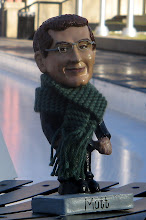
It's New Year's, and this blog is now nine months old;
A few thoughts (and links), if I may be so bold:
They say success has many parents, while failure has none,
But who wants to raise a blog, when all's said and done?
Showing to everyone how poorly we edit,
Then realizing maybe no one even read it.
So I offer this poem, with just one dedication:
To those who provided this blog's inspiration!
To my nephew Isaac, born just this past spring,
His new life in Norfolk's a marvelous thing.
To Jimmy and Grandma, two losses felt deeply,
And endless The New Yorker issues bought cheaply.
To seemingly unending interstate roads,
And friendly excursions, communing with toads.
To a guy on an airplane who told me so much,
And musical hands with a sensual touch.
To Saramago and Murakami, whose books I adored,
And Crichton, and politicians I abhored.
To other Matt Hellers, whose sites may be better,
And Rainer Maria Rilke, for his wonderful letters.
To novelist Nicole Krauss, who wrote The History of Love,
And books I never read (though maybe I should've).
To wise Marcel Proust, still my favorite of all,
And to some random stranger who happened to call.
To studies on how civilizations fail;
And to Ron and Lisa, who took us to sail.
To talking with kids about musical things,
And all of the joys that an orchestra brings.
To Katrina and Wilma, I can't say we'll miss you,
Global warming's made guilt a political issue.
To Lydia's comments, a blog in themselves,
And NSA agents like sly Christmas elves.
To beautiful South Beach, with all of its wonders,
And humble Kent State, paving over its blunders.
To stuff Karen taught me on Hindemith's style,
And stuff that I learned in a grocery aisle.
To cathartic discussions while munching on challah,
And favorite composers, like Bruckner and Mahler,
And Adams, Schoenberg, Elgar, Martinu,
And while on the subject, why not Hummel too?
Dmitri, and Ludwig, and dear Humperdinck
Are harder to fit in a rhyme scheme, I think,
But still deserve mention, with Anita O'Day
And teachers, some recent and one passed away;
There's Dimoff from Cleveland, and San Francisco's Steve,
A hornist named Phil you must hear to believe,
Though for advice on auditions there may be no peer
To another from Cleveland, percussionist Tom Freer.
While few can shape time like New World's MTT;
His Don Juan was great, and his Beethoven 3.
To Knussen and Schuller, and Feltsman, and Bunch,
And Internet 2, and Marc Fest bringing lunch.
Much more could be said about music and bass,
But all of these lines are a bit of a waste
If I forget all my friends, so many in number,
Both here in Miami, and those made last summer.
For you, I hope this New Year will bring something greater,
And I'll see you all again, sooner or later.
So to 2006! and to all that's impending,
While this year, like that moving walkway, is ending.
Friday, December 30, 2005
a new year's poem


Tuesday, December 27, 2005
political dissonance
A good musical analogy can be a beautiful thing, but a bad one can drive me to insanity. I don't know how many times I've read about things "reaching a crescendo," when the writer is obviously unaware that the most quiet moment comes when the crescendo has just been reached. I guess this is one of my pet peeves. Anyway, here's David Greene in a recent column on npr.org:
Okay, I probably shouldn't get so annoyed by this. But contrapuntal lines don't have to differ in dynamic, tone, style, and certainly not in harmony. Maybe David Greene listens to a lot of Charles Ives, but when most of us hear 'counterpoint,' we think of Bach, or maybe Palestrina. Their styles allowed for a great deal of independent, contrary motion, but only within a very strict, harmonically integrated framework. The Wikipedia entry for counterpoint does have a section on dissonant counterpoint, but you have to scroll down pretty far to get to that.
Still, I hope David Greene and other political pundits won't abandon their musical analogies altogether, since it is kind of nice to imagine Bush and Cheney singing in tight Renaissance polyphony. Maybe in Maureen Dowd's next column they can do an isorhythmic motet.
Vice presidents usually sing in harmony, if not in unison, with their boss. But there are times when the No. 2 voice in the administration is most effective in counterpoint.
Vice President Dick Cheney has been especially effective in this role, often playing the "bad cop" when President Bush has chosen a softer, more sympathetic tone.
So it was again this week, when the two men defended the administration's goals and policies using highly disparate styles.- from "Cheney's Plain Talk on Presidential 'Authority'" by David Greene, Dec. 23rd, 2005, online at npr.org
Okay, I probably shouldn't get so annoyed by this. But contrapuntal lines don't have to differ in dynamic, tone, style, and certainly not in harmony. Maybe David Greene listens to a lot of Charles Ives, but when most of us hear 'counterpoint,' we think of Bach, or maybe Palestrina. Their styles allowed for a great deal of independent, contrary motion, but only within a very strict, harmonically integrated framework. The Wikipedia entry for counterpoint does have a section on dissonant counterpoint, but you have to scroll down pretty far to get to that.
Still, I hope David Greene and other political pundits won't abandon their musical analogies altogether, since it is kind of nice to imagine Bush and Cheney singing in tight Renaissance polyphony. Maybe in Maureen Dowd's next column they can do an isorhythmic motet.
Monday, December 26, 2005
Epiphany
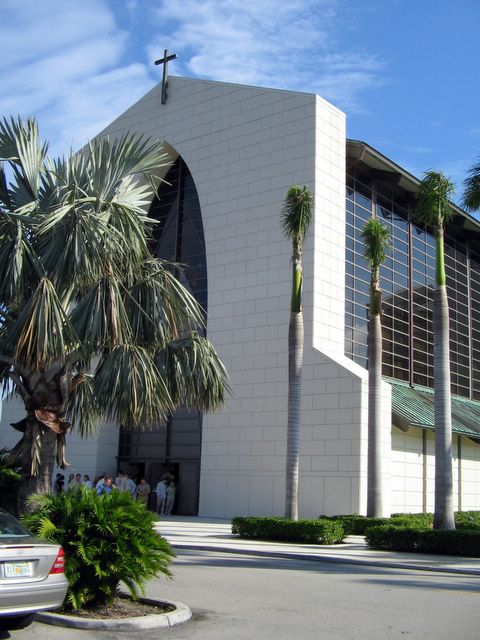 While playing several Christmas masses this weekend at Epiphany, the enormous Catholic church shown here, I realized there are certain stories that we feel need to be told and heard again and again. And again and again and again. I can't complain so much though, since I didn't play one single Nutcracker or Messiah this year; also the church really is gorgeous, with wonderful acoustics, a devoted congregation, and a beautiful new organ.
The story of my own life is admittedly not the greatest story ever told. In fact, according to Technorati, it is only the 247,530th greatest story being told on a blog at this very moment. Still though, in the spirit of this season, in which we take shiny new wrapping paper and make a great show of giving people stuff they didn't really want in the first place, I've decided to write a poem summarizing the first nine months of hella frisch, with links to some of the posts that you might have missed, whether by chance or by choice.
Sunday, December 25, 2005
light holiday reading, and existential angst
I've been reviewing some books lately in my Friendster profile. If you have bookstore gift card money to burn (or a good public library!) you might want to check some of these out:
Saturday, by Ian McEwan
 You probably don't need to be a brain surgeon to navigate all the social, political, personal, and moral dilemmas faced by 21st-century people. Sometimes though, as in this novel, it might help.
Henry Perowne is a neurosurgeon (don't call him a brain surgeon, please) whose day on Saturday, February 15, 2003 begins with a chilling sight: a plane plumetting across the London sky in flames. It soon proves to be a relatively harmless malfunction, but the mood of pensive foreboding remains. It is a day marked by London's largest anti-war demonstration before the Iraq invasion, and McEwan draws a fascinating portrait of how that conflict permeates a city and an individual's consciousness.
Had I met Perowne, a grudging war supporter for humanitarian reasons, I probably would have argued fiercely against him, as his daughter does at one point in the novel. Reading this helped me to realize, though, that a sensible person could approve of military action in Iraq for rational reasons. Even now that many of the worst predictions have come true, this novel reminds of the confusion and ambivalence of that time. It rarely leaves Perowne's thoughts, even while shopping for fish or visiting his senile mother. All private thoughts and actions seem to center around this defining public event, so distant and yet so inevitable, so inescapable.
The novel explores deeply the complexities of national and personal conflict, but it is not simply a rant, or a fictionalized op-ed piece. The plot is carried along by the series of encounters and challenges facing Perowne, with a shockingly climactic finish.
An excerpt from the novel is available online: "The Diagnosis" appeared in The New Yorker last spring.
Chinese Whispers, by John Ashbery
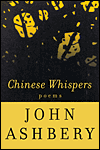 Please don't confuse this author's name with John Ashcroft, the crooning attorney general. Ashbery is one of my favorite poets, and his writing sings with evocative turns of phrase, cliches twisted into new forms, and curious surprises. The book's title is the British name of the game known to Americans as 'Telephone,' in which the words of a story transform with each retelling.
Ashbery's poetry revels in linguistic games and puzzles, the playful intimacies suggested by "Chinese Whispers," and verses which seem to deconstruct familiar patterns of speech. Here's a bit from one called "Like Air, Almost":
I tend to read more prose, but I love how Ashbery's poetry seems to awaken the unconscious, making me feel more alive to all things, written and heard. Highly recommended for anyone who enjoys incandescent phrases and inspired nonsense.
"A Christmas Memory," "One Christmas" and "The Thanksgiving Visitor," by Truman Capote
 These three holiday stories are published in the Modern Library edition shown here. Lots of people have been reading and talking about "In Cold Blood" since the film release, but the hold queue for that book was too long at my library, so I checked this out instead.
Getting into the holiday spirit is a little bit difficult in warm southern climates. Still, Capote's stories are reminders that it exists wherever there are little kids:
Miss Sook Faulk is the 6-year old narrator's elderly cousin and best friend, and she is the most memorable, vivid, and lovable character in all three stories. In the first, they assemble a batch of fruitcake; the narrator journeys to New Orleans to meet his father in the second; and in the third, a savage bully visits for Thanksgiving.
Like holiday meals, the stories are filled with delights that would almost be too sweet any other time of year; their nostalgia is tinged with darkness, though, and all the cruelties, confusion, and fears of childhood. They can each be read independently, but stand together well as a collection, drawing a warm picture of friendship and holiday memories.
You can also hear "A Christmas Memory" read by Capote, courtesy of NPR and This American Life. Skip to 21:00 or so.
Saturday, by Ian McEwan
You probably don't need to be a brain surgeon to navigate all the social, political, personal, and moral dilemmas faced by 21st-century people. Sometimes though, as in this novel, it might help.Henry Perowne is a neurosurgeon (don't call him a brain surgeon, please) whose day on Saturday, February 15, 2003 begins with a chilling sight: a plane plumetting across the London sky in flames. It soon proves to be a relatively harmless malfunction, but the mood of pensive foreboding remains. It is a day marked by London's largest anti-war demonstration before the Iraq invasion, and McEwan draws a fascinating portrait of how that conflict permeates a city and an individual's consciousness.
Had I met Perowne, a grudging war supporter for humanitarian reasons, I probably would have argued fiercely against him, as his daughter does at one point in the novel. Reading this helped me to realize, though, that a sensible person could approve of military action in Iraq for rational reasons. Even now that many of the worst predictions have come true, this novel reminds of the confusion and ambivalence of that time. It rarely leaves Perowne's thoughts, even while shopping for fish or visiting his senile mother. All private thoughts and actions seem to center around this defining public event, so distant and yet so inevitable, so inescapable.
The novel explores deeply the complexities of national and personal conflict, but it is not simply a rant, or a fictionalized op-ed piece. The plot is carried along by the series of encounters and challenges facing Perowne, with a shockingly climactic finish.
An excerpt from the novel is available online: "The Diagnosis" appeared in The New Yorker last spring.
***
Chinese Whispers, by John Ashbery
Please don't confuse this author's name with John Ashcroft, the crooning attorney general. Ashbery is one of my favorite poets, and his writing sings with evocative turns of phrase, cliches twisted into new forms, and curious surprises. The book's title is the British name of the game known to Americans as 'Telephone,' in which the words of a story transform with each retelling.Ashbery's poetry revels in linguistic games and puzzles, the playful intimacies suggested by "Chinese Whispers," and verses which seem to deconstruct familiar patterns of speech. Here's a bit from one called "Like Air, Almost":
And when the post-climax happened
in soft shards, falling
this way and that,
signing the night's emeralds away,
we took it to be a sign of something.
"Must be a sign of something."
Then the wind came on, and winter with it.
"Why, weren't we just here,
five minutes ago?"
I thought I'd have another look,
but that way is all changed, and besides,
no one goes there anymore,
it's too popular.
Just one fragment
is all I ever wanted,
but I can have it, it's too much,
but its touch is for another time,
when I'm ready.
Crowd ebbs peacefully.
Hey it's all right.
I tend to read more prose, but I love how Ashbery's poetry seems to awaken the unconscious, making me feel more alive to all things, written and heard. Highly recommended for anyone who enjoys incandescent phrases and inspired nonsense.
***
"A Christmas Memory," "One Christmas" and "The Thanksgiving Visitor," by Truman Capote
These three holiday stories are published in the Modern Library edition shown here. Lots of people have been reading and talking about "In Cold Blood" since the film release, but the hold queue for that book was too long at my library, so I checked this out instead.Getting into the holiday spirit is a little bit difficult in warm southern climates. Still, Capote's stories are reminders that it exists wherever there are little kids:
Snow! Until I could read myself, Sook read me many stories, and it seemed a lot of snow was in almost all of them. Drifting, dazzling fairytale flakes. It was something I dreamed about; something magical and mysterious that I wanted to see and feel and touch. Of course I never had, and neither had Sook; how could we, living in a hot place like Alabama? I don't know why she thought I would see snow in New Orleans, for New Orleans is even hotter. Never mind. She was just trying to give me courage to make the trip.
Miss Sook Faulk is the 6-year old narrator's elderly cousin and best friend, and she is the most memorable, vivid, and lovable character in all three stories. In the first, they assemble a batch of fruitcake; the narrator journeys to New Orleans to meet his father in the second; and in the third, a savage bully visits for Thanksgiving.
Like holiday meals, the stories are filled with delights that would almost be too sweet any other time of year; their nostalgia is tinged with darkness, though, and all the cruelties, confusion, and fears of childhood. They can each be read independently, but stand together well as a collection, drawing a warm picture of friendship and holiday memories.
You can also hear "A Christmas Memory" read by Capote, courtesy of NPR and This American Life. Skip to 21:00 or so.
Friday, December 23, 2005
early Christmas in Quantico
First of all I want to say that I do not in any way condone the President's policy allowing spying on American citizens. However, I do feel very sorry for the official who has to read through all my e-mail, listen to all my phone conversations, maybe even observe my day-to-day activities, like some kind of overworked national security Christmas elf. Actually, these security guys may have it worse than the elves - they don't just have to tell who's naughty and nice, they have to apprehend them, send them to a secret detention facility somewhere, maybe even build a case against some of them....
I don't get a huge amount of e-mail, but it must make for some dull reading. Also there may be some things in there which, while not necessarily incriminating, might be just bizarre enough to warrant further investigation. So as my little Christmas present to my FBI friend, I have decided to go through my e-mail records and explain some of the suspicious stuff:
Have a very happy holiday, and I hope not too many visions of scary terrorists go dancing through your head while you are all snug in your bed. BTW, I do know that the spying is being done by the NSA, not the FBI; I just thought Quantico would make for a punchier title than 'early Xmas in Ft. Meade, Maryland.'
I don't get a huge amount of e-mail, but it must make for some dull reading. Also there may be some things in there which, while not necessarily incriminating, might be just bizarre enough to warrant further investigation. So as my little Christmas present to my FBI friend, I have decided to go through my e-mail records and explain some of the suspicious stuff:
- "ANTI-SPAM BLOCKER VIRUS SPYWARE RENEW NOW!" - Ever since I bought a new computer last May, I have been getting these messages almost daily, which apparently concern some dire threat to my 'firewall.' As I don't know what that is, I have been disregarding these messages, and you should too. I am most assuredly not planning on contaminating the nation's processed meat supply.
- IMPORTANT REQUESTS FROM NIGERIAN TREASURY OFFICIALS - Usually I just ignore these, and let the $10 million fall into the hands of the Nigerian Evil Military Guerilla Brigade. Once in a while, though, I'll write back, promising my bank account info in the first paragraph, then the next 10 paragraphs will be chatty questions about Nigeria, stories about my friend who went to Haiti once etc., and I'll forget all about the bank account stuff.
- EXTENSIVE E-MAIL, PHONE, AND LIVE CONVERSATIONS ON HOW TO CHECK LARGE, UNWIELDY TRUNKS ON COMMERCIAL DOMESTIC FLIGHTS - This is a topic of great interest to all bass players, perhaps only slightly less interest than French vs. German bow or the eternal rosin quandary. None of these are of even remote interest to anyone else (except maybe tuba players).
- "ALL YOUR BASE ARE BELONG TO US" - I have no idea what this means, or how it got into my inbox. If it is some kind of secret code phrase, though, this little sleeper cell is still asleep.

Have a very happy holiday, and I hope not too many visions of scary terrorists go dancing through your head while you are all snug in your bed. BTW, I do know that the spying is being done by the NSA, not the FBI; I just thought Quantico would make for a punchier title than 'early Xmas in Ft. Meade, Maryland.'
Wednesday, December 21, 2005
zen mind, bassist's mind?
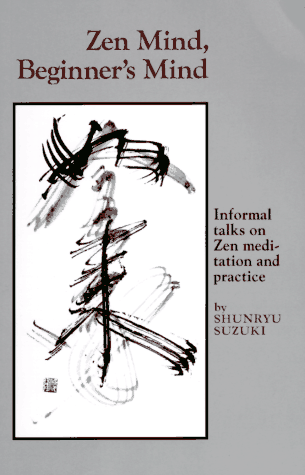
There are several poor ways of practice that you should understand. Usually when you practice zazen, you become very idealistic, and you set up an ideal or goal which you strive to attain and fulfill. But as I have often said, this is absurd. When you are idealistic, you have some gaining idea within yourself; by the time you attain your ideal or goal, your gaining idea will create another ideal. So as long as your practice is based on a gaining idea, and you practice zazen in an idealistic way, you will have no time actually to attain your ideal. Moreover, you will be sacrificing the meat of your practice. Because your attainment is always ahead, you will always be sacrificing now for some ideal in the future. You end up with nothing. This is absurd; it is not adequate practice at all. But even worse than this idealistic attitude is to practice zazen in competition with someone else. This is a poor, shabby kind of practice.Recently I've been reading Shunryu Suzuki's teachings on Buddhist meditation practice, known as 'zazen,' as an analogy to musical practice. As in meditation, musicians try and maintain an elevated state of focus, to purify ourselves of all excess thoughts and doubts, to ultimately transcend our limitations and become part of something greater than ourselves. I wonder if the analogy doesn't break down a bit here, though. My practice has always seemed to center on idealistic thinking - whether it be winning an audition or just playing a certain passage in tune!
- from "Mistakes in Practice," Zen Mind, Beginner's Mind by Shunryu Suzuki, p. 71-72
Of course, obsessing over ideals doesn't cause them to be realized. Only careful, disciplined work can do that. And I agree with Suzuki-roshi that competitive striving only results in a shabby sort of practice. The problem is finding some source of motivation, a way to pull ourselves forward without grasping at unseen goals or clawing at our competitors. As Suzuki-roshi says later in the same chapter:
So as long as you continue your practice, you are quite safe, but as it is very difficult to continue, you must find some way to encourage yourself. As it is hard to encourage yourself without becoming involved in some poor kind of practice, to continue our pure practice by yourself may be rather difficult.He goes on to write about the advantages and difficulties of having a teacher, also similar in meditation and music. Most of us at some point feel the need to find our way by ourselves, though, however useful a teacher may be. Being without a regular teacher, I find I am especially appreciative of those I do meet occasionally, as well as other outside sources of wisdom I can apply to the bass, like Suzuki-roshi's book. It is no small feat to master any sort of art, not the least of which is the art of sitting calmly and mindfully in meditation - and those who can maintain their practices with humility and dedication are particularly to be admired!
Tuesday, December 20, 2005
happy holidays with surprising swizzle sticks
Maybe it's a result of my upbringing beneath the majestic mountains and overcast skies of Tacoma, Washington. Or maybe it's the all-pervasive holiday advertising blitz at Starbucks. But whatever the reason, nothing symbolizes Christmas time for me like the Pacific Northwest. I unfortunately won't be there to visit family this year, but my Dad and step-mom Theresa were nice enough to send this lovely gift basket, full of Washington-linked food products.
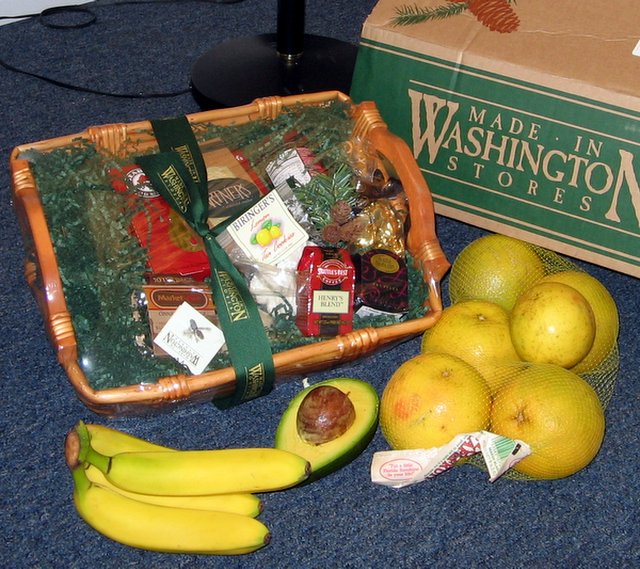 Coffee and tea, smoked salmon, caramel nuts, chocolate truffles, I have no complaints with any of these things. But 'Pickled Crispy Beans'? What do these have to do with my native state? The label suggests that I 'Use Beans as a surprising swizzle stick in Bloody Mary cocktails!' Somehow that sounds more to me like something a Californian would do.
Anyway, in honor of its transcontinental journey, I've photographed the gift basket surrounded by some made in Florida specialties, such as bananas, avocado, and grapefruit. I wasn't able to include any horrific traffic jams or fraudulent elections.
Thanks Dad and Theresa, and merry Christmas!
Coffee and tea, smoked salmon, caramel nuts, chocolate truffles, I have no complaints with any of these things. But 'Pickled Crispy Beans'? What do these have to do with my native state? The label suggests that I 'Use Beans as a surprising swizzle stick in Bloody Mary cocktails!' Somehow that sounds more to me like something a Californian would do.Anyway, in honor of its transcontinental journey, I've photographed the gift basket surrounded by some made in Florida specialties, such as bananas, avocado, and grapefruit. I wasn't able to include any horrific traffic jams or fraudulent elections.
Thanks Dad and Theresa, and merry Christmas!
Subscribe to:
Posts (Atom)